
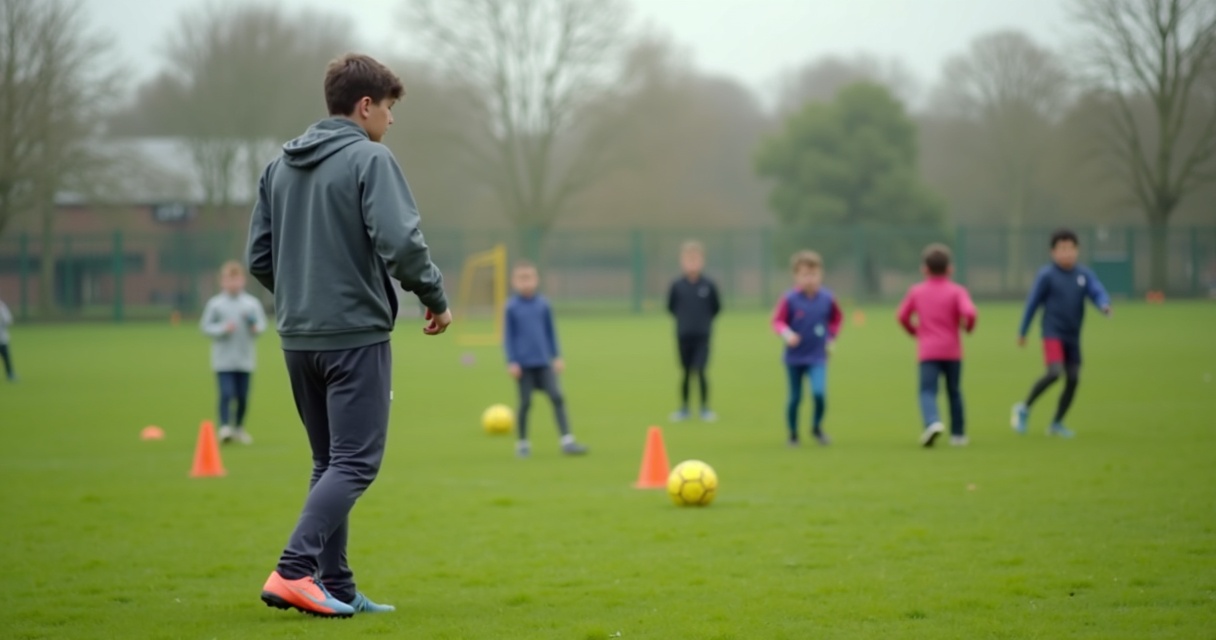
Master 1v1 defending at U10 with progressive drills that teach defensive stance, positioning, and timing. Build confident defenders through structured prac
Defending is often overlooked in grassroots coaching, yet it's the foundation of effective football. At U10, young players are beginning to understand individual responsibility and how positioning can control an opponent. Teaching 1v1 defending isn't just about winning the ball—it's about preventing attacking opportunities from developing in the first place.
This session develops the core defensive skills every young player needs: proper stance, intelligent positioning, and decisive timing. By mastering individual battles, your players will become more confident defenders and contribute meaningfully to their team's overall shape.
Why 1v1 Defending Matters at U10
At this age, players are transitioning from basic movement patterns to tactical understanding. They're learning that defending is active, not passive. A well-coached defender doesn't just react—they anticipate, delay, and control their opponent.
1v1 defending teaches individual responsibility. When every player understands their one-on-one role, team shape naturally improves. Players learn to track runners, maintain defensive lines, and support teammates. These habits, formed young, create disciplined defenders as they develop.
Crucially, success builds confidence. Young defenders who experience winning balls through good positioning and timing develop belief in their abilities. They stop fearing attackers and start reading the game intelligently.
The Three Pillars of Effective 1v1 Defending
Defensive Stance
Correct body position is non-negotiable. A defender on their heels is vulnerable to quick movements. A defender with legs crossed cannot move laterally effectively.
Teach your players to stand on the balls of their feet with knees slightly bent. Their body should be between the attacker and the goal, providing stability and balance. This position allows players to react quickly in any direction without crossing their feet—a common mistake that leaves defenders exposed.
This isn't about being rigid. A good defensive stance is athletic and responsive. Players should feel balanced, ready to move. Use the coaching cue 'Stay on your toes' to reinforce this constantly.
Delaying the Attacker
Rushing in recklessly is a beginner's mistake. Young defenders often commit too early, allowing attackers to skip past them easily. Instead, teach patience.
Delaying is about controlling the pace of play. By maintaining distance and forcing the attacker to make a decision, the defender gives teammates time to provide support. This compression of space reduces opportunities for dangerous play. The attacker faces a choice: pass, shoot from range, or run into more defenders.
Delaying requires reading the game. Encourage defenders to watch the attacker's hips and body shape, not their feet. Feet lie; hips don't. By observing center of gravity and trunk movement, defenders anticipate direction changes and maintain positioning.
Timing the Tackle
The difference between a clean tackle and a foul is timing. A premature tackle leaves space behind the defender. A late tackle allows the attacker to progress dangerously.
The best moment to commit is when the ball is furthest from the attacker's body. This might be after a touch, during a run, or when preparing to strike. At this moment, the defender has maximum chance of winning possession cleanly.
Teaching timing develops decision-making. Young players learn to read situations, anticipate movement, and commit with conviction. These are the hallmarks of good defenders throughout their football career.
The Progressive Drill: Three-Station Setup
This session uses a 20x15 yard area divided into three 20x5 yard channels. You'll need 12 players minimum (pairs rotating through stations), cones, and footballs.
Station 1: Defensive Stance and Shadowing (3-4 minutes)
One defender shadows an attacker's movements without any ball contact. The focus is entirely on footwork and positioning. The defender mirrors the attacker's lateral movement, staying between them and the goal line.
Cue: 'Stay on your toes', 'Make yourself big', 'Watch their hips'.
This station builds muscle memory. Players develop the habit of correct positioning without the distraction of winning the ball.
Station 2: Delay Defending (3-4 minutes)
Introduce a football. Attackers move towards goal while defenders position themselves to delay progression. Defenders shouldn't tackle but should force attackers wide or backwards through intelligent positioning.
Cue: 'Stay between attacker and goal', 'Make them go wide'.
This develops spatial awareness. Players learn how positioning controls space without aggression.
Station 3: Live 1v1 (3-4 minutes)
Full defending is allowed. Attackers dribble freely while defenders attempt to win the ball using proper timing and technique. Award points for clean tackles or forcing turnovers.
Cue: 'Commit when the ball is away from their body'.
This combines everything learned. Players apply stance, delay, and timing under realistic conditions.
Coaching for Success
Rotate players between stations every 3-4 minutes. Each pair completes 1 minute of active play per station before rotating.
Use specific coaching cues consistently: 'Stay on your toes', 'Watch their hips, not their feet', 'Stay between attacker and goal', 'Commit when the ball is away from their body', 'Make yourself big'.
Focus on effort and decision-making, not just success. A defender who reads the game correctly but loses the ball has still learned. Celebrate good positioning and intelligent delay as much as clean tackles.
Building Confident Defenders
1v1 defending is where individual battles are won. By teaching proper stance, intelligent delay, and decisive timing, you're building the foundation for effective defending at every level. Young players who master these fundamentals gain confidence that carries through their football journey.
Start with these drills, emphasize the fundamentals, and watch your defenders develop into intelligent, confident players who control their individual battles consistently.
Written and reviewed by the PlayTactiq Coaching Team
Practical guidance for grassroots coaches, shaped around age-appropriate sessions, clear coaching language and real match-day problems.
Put it into a session
Ready-to-run U10 session plans
Setup, animated diagrams, coaching points and player-number adaptations — every U10 session in one place.
U10 football session plans →