
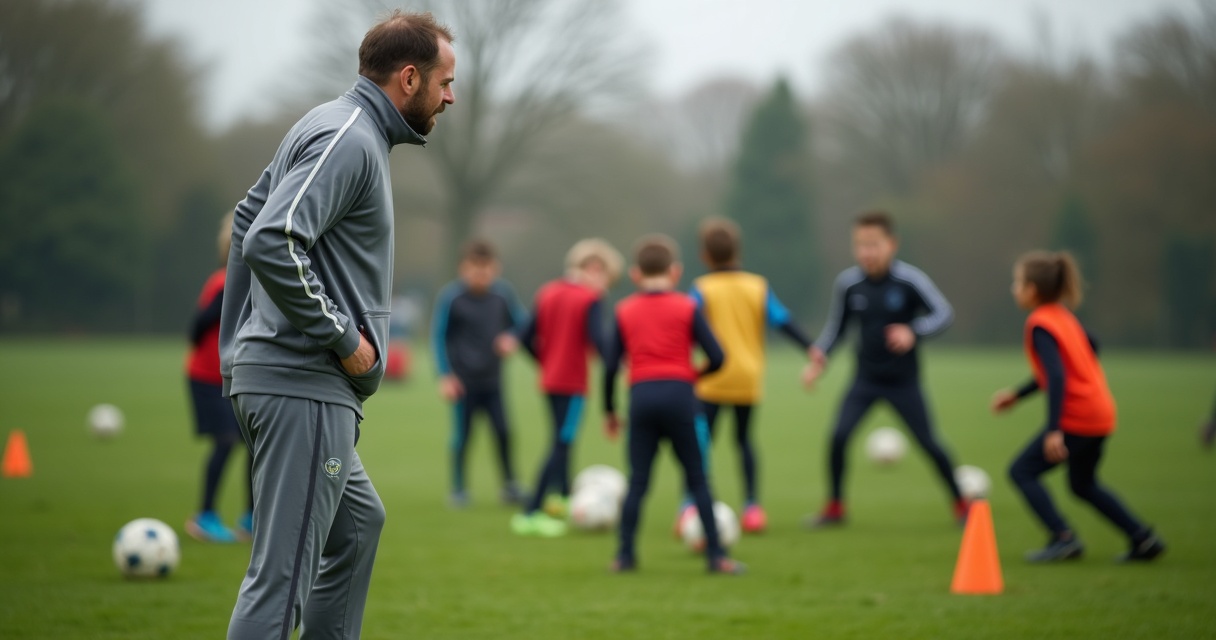
Teach U12 players to switch play effectively with this diagonal passing drill. Build tactical awareness, game intelligence, and decision-making skills your
Switching play is one of the most powerful attacking principles in football. When executed well, it transforms how your team moves the ball and creates scoring opportunities. For grassroots coaches working with U12 players at intermediate ability, introducing switching play now builds tactical foundations that will serve young footballers for years to come.
But here's the challenge: many young players at this age fall into predictable passing patterns. They move the ball sideways or backward, rarely using the full width of the pitch. They haven't yet developed the awareness to recognize when the opposition is vulnerable to a quick switch. Teaching them this skill requires the right drill, clear progression, and focused coaching cues.
This session focuses on diagonal passes—the technical tool that makes switching play effective—and gives your players repeated opportunities to practice recognizing when and how to execute it.
Why Switching Play Matters at U12
Switching play forces opposition defenses to cover more ground horizontally. When defenders are committed to defending one flank, a quick switch to the opposite side stretches them and creates space for attackers to exploit. It's elegant, efficient, and teaches young players a fundamental principle: sometimes patience and smart positioning matter more than constant forward movement.
At U12, introducing switching play also develops game awareness and decision-making. Young players learn to think two passes ahead rather than just focusing on the next touch. They begin to understand positioning, support play, and how to use the entire pitch as a resource.
The diagonal pass is the technical skill that makes this possible. Unlike straight passes, a diagonal pass travels forward and across the field simultaneously, covering distance quickly while bypassing several opponents. It requires accuracy, timing, and an understanding of where teammates are positioned.
Mastering these skills now gives your players a significant advantage as they progress and encounter more sophisticated tactical demands.
The Drill Setup
Set up a rectangular field approximately 50 x 30 yards and divide it into four zones: two attacking zones (left and right) at one end and two defensive zones (left and right) at the other end.
Divide your squad into two teams of 6-8 players. One team attacks while the other defends. The attacking team starts with possession in one zone and must move the ball to the opposite attacking zone using a diagonal pass. They score a point each time they successfully switch play and complete two consecutive passes in the new zone without losing the ball.
The key constraint: defenders cannot leave their assigned zone. This forces compact defending and makes switching play genuinely valuable rather than optional. When defenders are zoned, they can't simply collapse toward the ball—they must stay in their area, which means a successful switch immediately creates a numbers advantage elsewhere on the pitch.
Run 5 minutes of continuous play, then rotate teams. This keeps all players engaged and gives everyone attacking and defending experience.
Progressions to Challenge Your Players
Progression 1: Two-Touch Limit Add a rule that players can only take two touches before passing. This accelerates decision-making and forces sharper, more direct passing. Players must scan the field quickly, identify the switch opportunity, and execute it without delay. This progression mimics real match conditions where time and space are limited.
Progression 2: Compressed Space Reduce the field width slightly to compress space. This demands more accurate and longer diagonal passes. Players can no longer rely on short, safe passes—they must commit to longer, more penetrative balls that require better technique and greater confidence.
Progression 3: Free Defender Allow one defender to move freely between zones when the attacking team initiates a switch. This teaches players to execute the switch quickly, before defenders can react and close them down. It also introduces the concept of timing—switching when defenders are vulnerable rather than switching automatically.
Key Coaching Cues
While your players are working through this drill, focus your feedback on these points:
Timing and Awareness: Look for the moment when defenders are committed to one side before switching. Don't switch just because the opportunity exists—switch when it's most advantageous.
Body Position: The passer should check their shoulder before making the diagonal pass. This small action helps them see the field and ensures they're passing into space rather than into a defender.
Movement and Receiving: The receiving player should move to meet the pass and be ready to turn immediately. Passive receiving slows play and wastes the advantage created by the switch.
Communication: Encourage players to call for the ball to signal they're available. Verbal communication helps the passer make quicker decisions and prevents confusion.
Quality Over Speed: Emphasize that a slow, inaccurate pass loses possession faster than a slower, well-weighted switch. Accuracy and technique always come first.
Building Long-Term Development
This session plants seeds for more sophisticated tactical concepts. As your players develop, they'll apply these principles against pressing opponents, in transition situations, and in more complex attacking patterns.
By mastering diagonal passes and recognizing when to switch play now, your U12 players build confidence and tactical intelligence. They learn that football rewards patience, smart positioning, and understanding space. Most importantly, they develop the decision-making skills that separate good players from great ones.
Start simple, progress gradually, and celebrate the small moments when a player spots the switch early or executes a perfectly weighted diagonal pass. Those moments matter far more than the points scored.
Written and reviewed by the PlayTactiq Coaching Team
Practical guidance for grassroots coaches, shaped around age-appropriate sessions, clear coaching language and real match-day problems.
Put it into a session
Ready-to-run U12 session plans
Setup, animated diagrams, coaching points and player-number adaptations — every U12 session in one place.
U12 football session plans →