
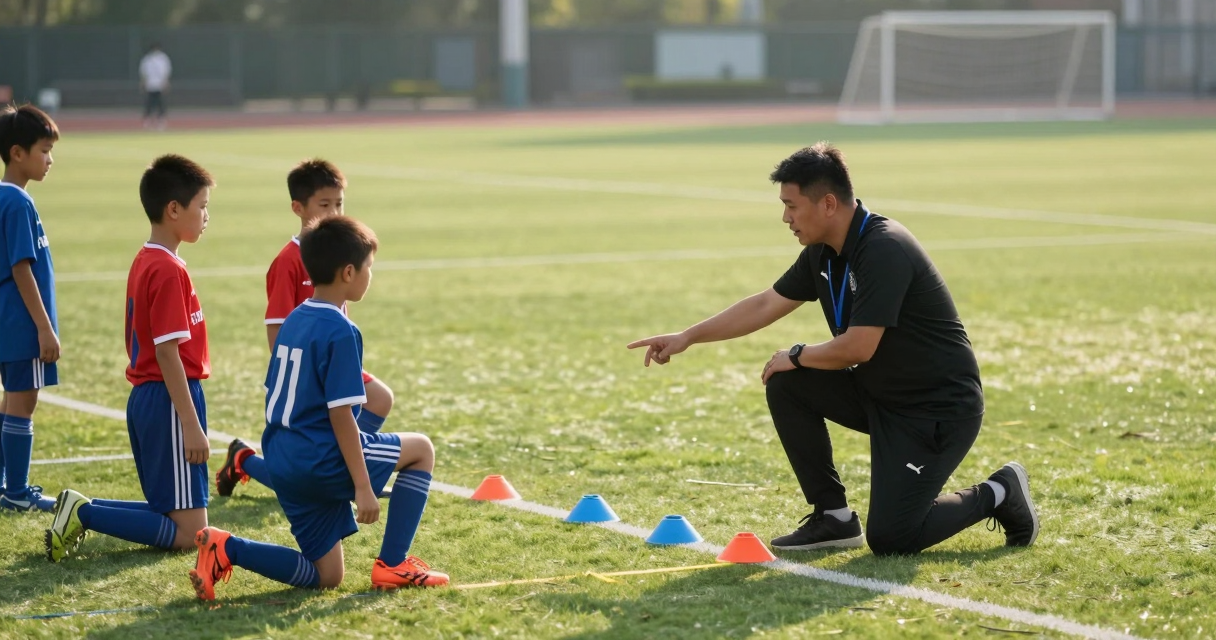
Taking on a grassroots coaching role for the first time? This complete session plan works for coaches with zero formal training and players aged 6 to 12.
Your first session as a grassroots coach is mostly an organisational problem, not a football one. Get the first fifteen minutes right and the rest tends to look after itself.
This is a practical structure for a first night with a group of children you have never met. It assumes an hour, a patch of grass, and no assistant.
Before you leave the house
Write your session on one sheet of paper and put it in your pocket. Not a folder, not your phone — a sheet you can hold while twelve children talk at you.
Take more than you think you need:
- Balls. One each if you possibly can. Children waiting for a ball is the main cause of a session falling apart.
- Cones. Twenty is plenty. Two colours is better than one.
- Bibs. Two colours, more than you need, because at least one child will refuse the colour they are given.
- A ball pump, a first aid kit and a full water bottle.
Arrive fifteen minutes early and set up your first activity before anyone gets there. Setting up cones while children arrive is how you lose the group before you start.
The first five minutes: names and one rule
Get everyone in a circle. Say your name. Ask each child theirs, and repeat each one back — you will not remember them all, and that is fine, but they need to see you trying.
Then give them exactly one rule. Not five. One.
"When I put my hand up, the ball goes still and so do you."
Practise it twice, make it slightly silly, and use it all session. A group that stops when asked is a group you can coach. Everything else — respect, effort, listening — follows from having one thing that reliably works.
Minutes 5 to 15: a game, not a warm-up
Skip the lap of the pitch and the stretching. Young children do not need it and it teaches them that football starts with something boring.
Give every child a ball and a defined area, and play something with a simple objective: dribble around without touching anyone, keep the ball inside the square, follow the leader. Everyone moving, everyone with a ball, nobody queuing.
You are looking for one thing here: does this group listen when you stop them? If they do not, spend another two minutes on it. Do not move on hoping it improves.
Minutes 15 to 35: one activity, one message
Choose a single activity and stick with it. New coaches often plan four things and rush all of them. One activity done for twenty minutes, adjusted as you go, is far better.
Whatever you choose, check it against three questions:
- Is every child involved most of the time? If half are watching, change it.
- Can the least confident child succeed at it? If not, make the area bigger or the target easier.
- Can I explain it in two sentences? If not, simplify it before you start.
Explain it by showing rather than telling. Walk through it once at half speed with two volunteers, then start. Long explanations lose children faster than anything else.
If it is not working after three or four minutes, stop it and change it. That is not failure, that is coaching.
Minutes 35 to 55: small-sided games
Finish with games. Small teams, small pitches, more than one game running at once if you have the numbers. Three-a-side or four-a-side rather than one big match where half the group never touches the ball.
Say very little during this part. Let them play. A first session that ends with twenty minutes of proper football is a first session children want to come back to.
If teams are unbalanced, change them between games rather than announcing that one team is stronger.
The last five minutes
Bring them in. Say one genuinely positive thing you noticed — not a general "well done", something specific you saw a child do. Tell them when the next session is. Send them to their parents.
Then, while it is fresh, write three lines on the back of your sheet: what worked, what did not, one thing to try next time. That habit is worth more than any coaching course in your first season.
When it goes wrong — and it will
It probably will not go to plan. Players arrive late. The pitch is smaller than promised. An activity that looked simple confuses everyone.
Pause, bring them in, explain one point, restart. If it still does not work, switch to a small-sided game. Nobody has ever been disappointed by more football.
Children will remember whether the session felt welcoming and enjoyable long after they forget the exact practice you ran.
A first-session structure at a glance
| Time | What | Why |
|---|---|---|
| 0–5 min | Names and one rule | Establishes you can stop the group |
| 5–15 min | Ball-each game | Everyone active immediately |
| 15–35 min | One main activity | Depth beats variety |
| 35–55 min | Small-sided games | The reason they came |
| 55–60 min | One positive point, next date | They leave wanting to return |
What to do next
Pick your session before the night, not on the way there. Our U6 and U7 session plans are built for coaches in exactly this position, and the new coach's guide covers what the role involves beyond the pitch.
If you are not sure what your group needs, answer three questions and we will match you to a session you can run this week.
Written and reviewed by the PlayTactiq Coaching Team
Practical guidance for grassroots coaches, shaped around age-appropriate sessions, clear coaching language and real match-day problems.
Put it into a session
Ready-to-run session plans by age group
Setup, animated diagrams, coaching points and player-number adaptations, from U6 through to U18.
Browse session plans by age group →