
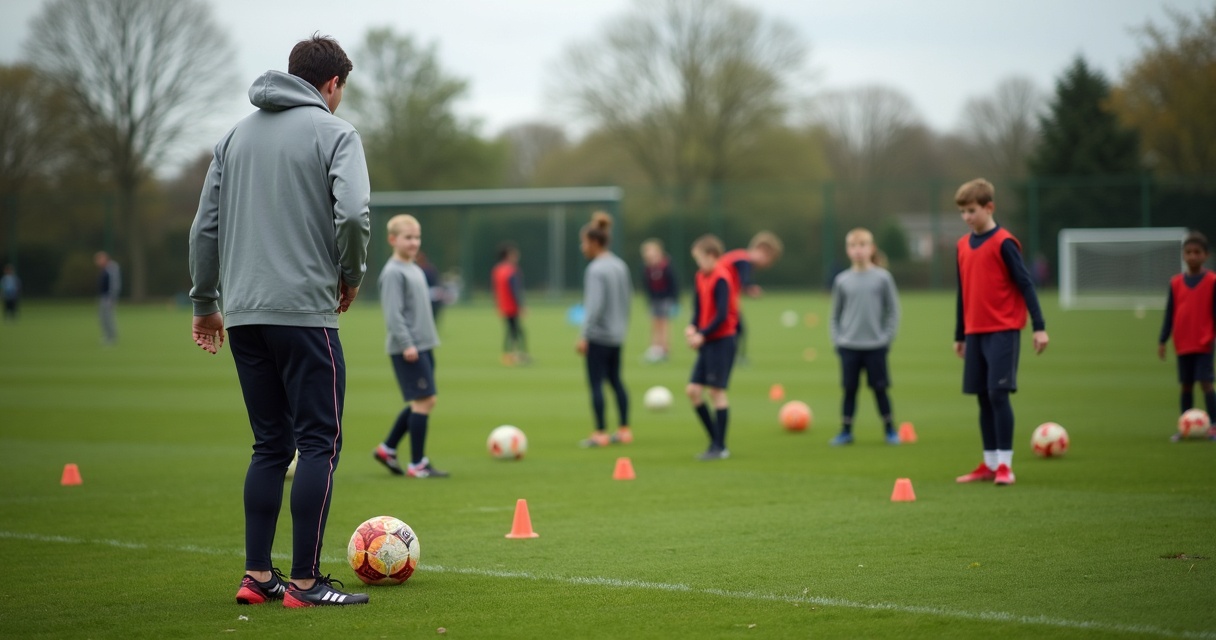
Master free kick routines at U14 with structured drills for central and wide positions. Learn how to build consistency in delivery, timing, and finishing t
Free kicks represent some of the most valuable scoring opportunities in football. Unlike open play, they offer attackers a controlled environment to execute pre-planned movements without initial defensive pressure. At U14, this developmental stage is ideal for teaching players how to coordinate timing, positioning, and delivery to transform set pieces into reliable attacking weapons.
Whether your free kick is awarded 30 metres from goal in the centre or out on the wing, understanding how to structure routines—and how to adapt them based on defensive shape—is what separates grassroots teams from more organised opponents.
Why Free Kick Routines Matter at U14
At this age group, players are developing the technical precision and tactical awareness needed to execute coordinated set piece attacks. Free kicks create psychological advantages: they signal momentum shifts, demonstrate team organisation, and build confidence when routines succeed.
However, free kicks only become reliable scoring weapons when three principles align:
Clarity of Purpose: Every player must know their specific role before the ball is struck. This eliminates confusion and ensures coordinated movement.
Numerical Advantage: Free kicks allow attackers to pre-position themselves favourably, often creating local superiority in key zones. Exploiting this advantage through smart movement is essential.
Timing Synchronisation: Players must arrive at their intended positions simultaneously with ball delivery. Poor timing undoes even the best-planned routines.
Defensive Awareness: Effective routines account for how defenders will position themselves. Understanding defensive blocking patterns allows your team to create space through movement.
At U14, mastering routine execution builds confidence, improves decision-making under pressure, and creates repeatable patterns players can rely on during competitive matches.
Wide vs Central Free Kicks: Different Approaches
Free kick position dramatically changes tactical options. Treating all free kicks the same limits your team's attacking potential.
Wide Free Kicks (outside the penalty box, near the touchline) typically benefit from:
- Low crosses toward the far post, where attacking players time runs to finish
- Pullbacks to the edge of the box for secondary attempts
- Direct shots when positioned favourably (usually 25+ metres from goal)
- Short passes to switch play and create unpredictable angles
Central Free Kicks (directly in line with goal, 25-35 metres out) unlock:
- Direct shooting opportunities from skilled players
- Layoffs for teammates to strike first-time
- Intricate wall-passes that break down organised defences
- Curved deliveries that arc over defensive walls
Coaches should develop 2-3 reliable routines for each scenario, then drill them repeatedly so players execute instinctively during matches.
The U14 Free Kick Routine Drill
This progressive drill develops both routine execution and adaptive decision-making.
Setup and Organisation
Use the full pitch width with marked zones. Create a central zone 30-40 metres from goal using cones, with two wide zones flanking either side. Place actual goals at one end or use cones marking the goal area. Assign one defender to act as the defensive wall, positioned realistically.
You'll need 8-12 outfield players plus a goalkeeper. Divide into attacking units of 3-4 players and rotating defensive teams of 2-3. Rotate roles so everyone experiences attacking and defensive responsibilities.
Progression 1: Basic Routines
Start with fundamentals. Central free kicks involve straight shooting or simple one-touch layoffs. Wide free kicks focus on standardised low crosses to near and far post zones. Emphasise accuracy over power. Award points for shots on target and successful routine completions.
Coaching Focus: 'Know your role before the kick.' 'Deliver with accuracy, not power.' 'Follow through on shots.'
Progression 2: Movement Patterns
Introduce dummy runs and off-the-ball movement. Players practice decoy movements that create space for teammates. A player might run toward the ball, then peel away, pulling a defender out of position for a teammate to exploit.
This is where timing becomes critical. Movement and delivery must synchronise perfectly—early runs are wasted, late runs miss the ball.
Coaching Focus: 'Time your run to meet the ball.' 'Create space with movement.' 'Support the ball carrier.'
Progression 3: Reactive Scenarios
Add realistic defensive pressure. Defenders actively disrupt routines, forcing attackers to adapt. Teams must maintain core routine objectives while reacting to defensive positioning. This develops resilience and decision-making.
Players learn that routines provide a framework, not a rigid script. Adaptability within structure is what makes elite finishers.
Coaching Focus: 'React to defensive shape.' 'Stick to your principle, not your plan.' 'Make quick decisions.'
Key Coaching Principles
While executing your drill, reinforce these universal principles:
- Consistency builds reliability: Players who understand positioning and timing become dangerous and unpredictable opponents.
- Clarity before creativity: Master the basics before adding complexity. A simple routine executed perfectly beats an intricate routine executed poorly.
- Pressure inoculation: Practice under defensive pressure so match conditions feel familiar.
- Role clarity: Every player must know their responsibility. Confusion kills routines.
Maximising Your Free Kick Sessions
Rotate player positions regularly so everyone understands different roles. Film successful routines so players visualise execution. Keep routines simple enough that U14 players can recall them under match pressure.
Remember: free kicks represent controlled opportunities. The team that executes routines with precision and adapts intelligently to defensive shape will score more goals and build match confidence.
Start with basic routines this week, progress to movement patterns next week, then add defensive pressure as players gain competence. By season's end, your U14 team will have reliable free kick weapons that shift match momentum in your favour.
Written and reviewed by the PlayTactiq Coaching Team
Practical guidance for grassroots coaches, shaped around age-appropriate sessions, clear coaching language and real match-day problems.
Put it into a session
Ready-to-run U13 and U14 session plans
Setup, animated diagrams, coaching points and player-number adaptations — every U13 and U14 session in one place.
U13 and U14 football session plans →