
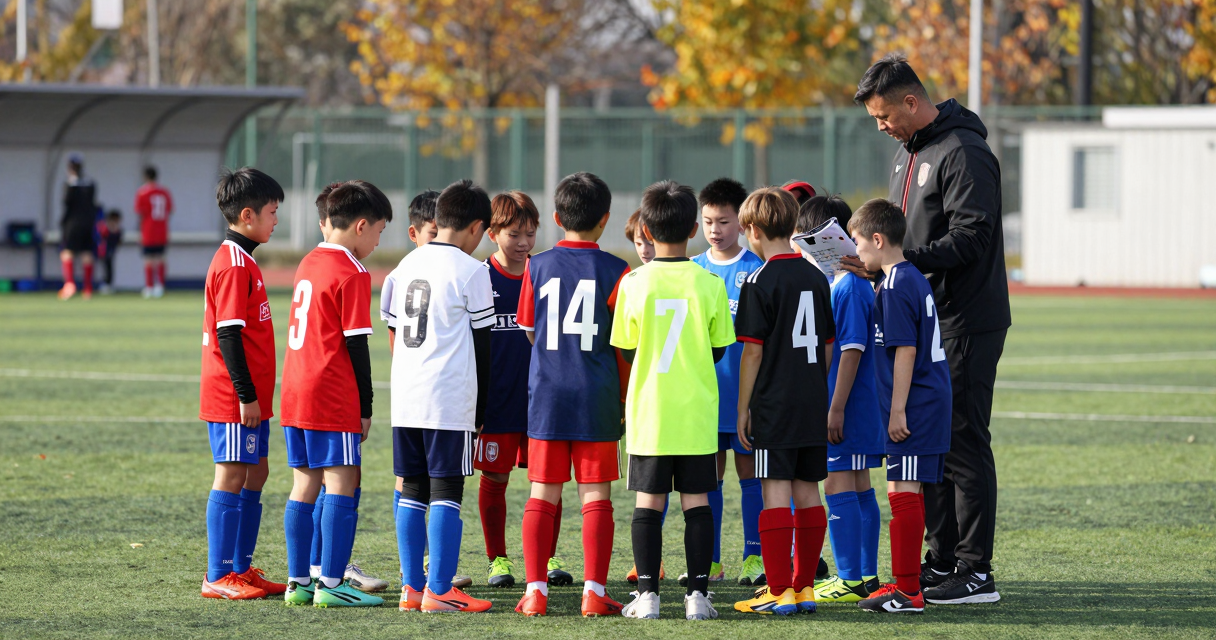
A month-by-month framework for coaching U9 football across a full season. Three phases covering foundation, development, and consolidation.
Why U9 Needs a Different Approach
U9 players are at a critical transition point. They have moved from foundation phase basics into their first experience of team play, small-sided formats, and tactical awareness. A full season plan for this age group needs to build technical skills in the first third, layer in simple decision-making in the middle third, and consolidate through competitive play in the final third.
This framework gives you a month-by-month structure. It is not a rigid script — adapt it to what your players need. But it gives you a spine for the season.
The Season Framework: Three Phases
Phase 1: Foundation (Months 1 and 2)
Goal: Every player confident on the ball. Basic techniques embedded before any tactical work begins.
Priority skills:
- Dribbling with both feet
- Passing with the inside of the foot at 10 metres
- Receiving and controlling a moving ball
- Turning away from light pressure
Session structure each week:
- 10 min: ball mastery — every player with their own ball
- 15 min: technical practice — passing pairs, 1v1 dribbling corridors
- 20 min: small-sided game 3v3 or 4v4
- 5 min: debrief — one question, not a lecture
What to avoid in Phase 1: Fixed positions. Do not put players in set roles. Let them explore freely. Rotation and freedom at this stage builds better footballers than early specialisation.
Success looks like: Every player attempts to dribble rather than immediately clearing the ball. This takes 4 to 6 weeks to embed consistently.
Phase 2: Development (Months 3 and 4)
Goal: Begin to understand team shape and movement without the ball.
Priority skills:
- Passing and moving — give and go patterns in pairs
- Supporting the player on the ball
- Pressing as a unit when possession is lost
- Simple transitions: winning the ball then moving forward quickly
Session structure each week:
- 10 min: warm-up rondo 5v2 or 4v2
- 15 min: combination play in pairs and threes
- 25 min: 5v5 with coaching interventions
- 5 min: cool-down stretch and one team question
Key coaching tool for Phase 2: Freeze moments. Stop the game and ask the player without the ball: "Where could you move right now?" Then restart. Do not tell them the answer — ask the question and let them work it out.
At U9, players begin to understand they can influence the game even when they do not have the ball. This is the most important concept in the development phase.
Phase 3: Consolidation (Months 5 and 6)
Goal: Apply what has been learned in competitive formats with reduced coach intervention during play.
Priority skills:
- Reading the game — when to press, when to hold shape
- Simple set piece routines: corners and free kicks
- Resilience: maintaining performance when behind in a game
Session structure each week:
- 8 min: dynamic warm-up with ball
- 12 min: targeted technical work on one skill only — based on what last match revealed
- 25 min: full 7v7 game simulation
- 5 min: player-led debrief — you ask one question, players drive the discussion
By Phase 3, your players should need less instruction. They should be starting to solve problems for themselves. Your role shifts from explaining to facilitating.
Month-by-Month Skill Targets
| Month | Primary Focus | Secondary Focus |
|---|---|---|
| 1 | Ball mastery with both feet | Passing technique |
| 2 | Receiving under pressure | Turning away from defenders |
| 3 | Give and go movement | Supporting positions |
| 4 | Pressing as a unit | Transition speed |
| 5 | Game reading | Simple set pieces |
| 6 | Resilience and consolidation | Player-led debrief |
The One Thing That Makes the Biggest Difference
Most grassroots coaches switch topics too quickly. They spend one session on passing, one on dribbling, one on shooting, and rotate through topics each week. Players develop faster when the same skill is practised across 3 to 4 consecutive sessions before moving on.
At U9, this means spending all of Month 1 on ball mastery — not sampling six different topics. The repetition you find dull as the coach is not dull for the player. They are still improving on the same skill you have delivered three times.
Block your season. Repeat your priorities. Trust the repetition.
Tracking Progress Without Paperwork
Keep a single note after each session: one player who improved this week, one player who needs extra attention next week. After six months you will have a detailed picture of every child in your group without ever writing a formal assessment.
Written and reviewed by the PlayTactiq Coaching Team
Practical guidance for grassroots coaches, shaped around age-appropriate sessions, clear coaching language and real match-day problems.
Put it into a session
Ready-to-run U9 session plans
Setup, animated diagrams, coaching points and player-number adaptations — every U9 session in one place.
U9 football session plans →