
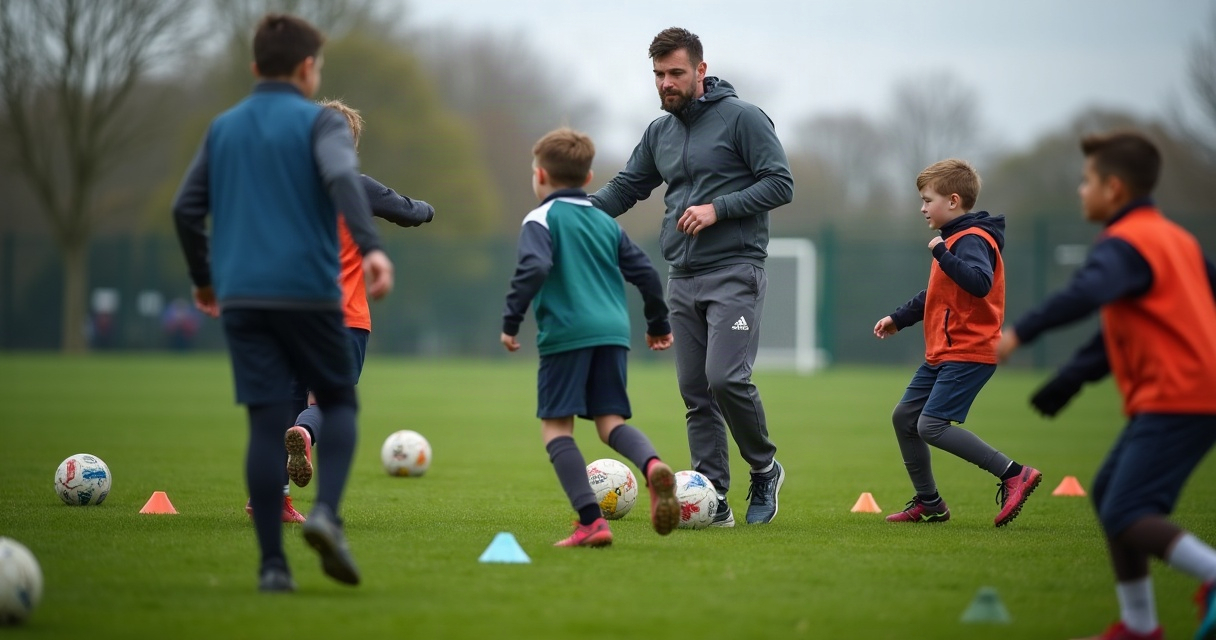
Simple ideas to help young beginners carry the ball into space with confidence, courage, and plenty of smiles.
Why Speed and the Ball Go Together at U6
When a five or six-year-old first gets a ball at their feet, the instinct is to stop and stare at it. That is completely natural. What we want to do, gently and playfully, is help them realise that the ball is something to carry—like a treasure they can take anywhere on the pitch. Running with the ball is the first truly exciting skill a young player discovers, because it combines two things children already love: moving fast and being in charge.
At this age, the technical detail does not need to be heavy. We are not asking children to master a specific part of the foot or to count their touches. We are simply helping them feel comfortable taking the ball from one place to another while staying on their feet and having fun. That feeling—ball at my feet, space in front of me, freedom to go—is the seed of everything that comes later.
The session in Racing with the Ball is built around exactly this idea. It gives children lots of turns, keeps waiting to a minimum, and lets them make their own choices about where and how to run. This article adds a little more thinking behind why those choices matter and how you can support every child in your group, not just the confident ones.
Giving Every Child Room to Succeed
One of the most common mistakes in early football sessions is accidentally designing things that reward only the fastest or most confident children. Racing formats can do this if we are not careful. A child who finishes last every time will quietly decide that running with the ball is not for them—and they will switch off long before the session ends.
The fix is straightforward: shift the focus away from who wins and towards what everyone is doing. Here are a few practical ways to do that.
Keep groups tiny. Four or five children per group means every player runs frequently. No one is standing in a long queue getting cold and distracted. Short waits also keep energy levels steady and reduce the chance of silly behaviour born from boredom.
Change what counts as success. Rather than celebrating the child who reaches the cone first, celebrate the child who kept the ball close, or the one who looked up as they ran, or the one who tried a different route. Say what you saw: 'I loved how you kept the ball moving there.' These small, honest observations land better than vague praise and they tell the child exactly what to repeat.
Offer variations, not alternatives. If a child is struggling to run while keeping the ball under control, do not remove them from the activity. Instead, shorten their distance, slow the pace slightly, or ask them to run alongside a friend. This keeps them in the group and part of the fun, which matters enormously at this age.
Understanding What You Are Actually Watching
When you stand at the side of a U6 session and watch children run with the ball, it can look chaotic. Balls go in unexpected directions, children crash into each other, someone stops to pick a daisy. This is all entirely normal, and beneath the noise there is real learning happening.
Know what to look for. The most important moments are the ones where a child makes a choice: they see a gap and run into it, or they feel pressure and change direction, or they slow down because something ahead has caught their attention. These decision-making moments, however brief, are the real signs of development at U6. A child who loses the ball but made a brave run has learned something useful. A child who holds the ball and waits for someone to tell them what to do has learned dependency instead.
When you spot a good moment—a child who glances up, notices space, and takes the ball into it—pause the session briefly and draw attention to it without singling out the child in a way that embarrasses them. You might say: 'Did everyone see how much room there was over on that side? That is exactly what we are looking for.' Then restart immediately. Long pauses lose young children's attention quickly.
Also watch for hesitation. A child who repeatedly stops with the ball, looks around anxiously, and waits is telling you something. They might need a simpler task, a buddy to run with, or simply a warm word of encouragement before they go again. Belonging to the group matters more to a five-year-old than any skill drill you can design.
Making the Practice Feel Like Play
The best U6 sessions have an atmosphere that feels like the children invented the game themselves, even though you have planned every detail carefully. A few things help create that feeling.
Use games with built-in rules that teach without lecturing. A simple traffic-light game—run on green, slow on amber, stop on red—teaches children to change pace and scan around them without you ever saying the word 'awareness.' They just think they are playing a fun game. They are, of course. But they are also learning.
Use the environment. Set up your space so children naturally encounter different challenges: a gentle curve of cones to weave around, a wider section where they can really open up, a narrow channel where they need to carry the ball more carefully. The space teaches the skill without a word from you.
Let music do some of the work. Upbeat music played quietly in the background changes the mood of a session. Children naturally move more freely and with more rhythm. Pause the music as a signal to stop, restart it as a signal to go. It becomes a game in itself.
Follow the energy. If something is clearly delighting your group, stay with it a little longer. If something is falling flat, move on without dwelling on it. Flexibility is a coaching skill, not a weakness.
You can explore more sessions designed around these same principles at /explore, where practices are organised by age, ability, and theme to help you plan sessions that suit your group.
The Bigger Picture for Young Players
A child who leaves a U6 session smiling, slightly out of breath, and asking when they can do it again is a success story. They may not have developed a perfect running-with-the-ball technique. They may have kicked the ball in entirely the wrong direction several times. None of that matters yet.
What matters is that they felt capable, they felt included, and they felt that football is something they belong to. Confidence built at this age is remarkably durable. It carries children through the more demanding sessions that come later, through mistakes and setbacks, and into a long, enjoyable relationship with the game.
Your job in a session like this is not to produce polished players. It is to make sure every child goes home wanting to come back. Keep the turns coming, keep the encouragement genuine, and keep the joy at the centre of everything you do.
Written and reviewed by the PlayTactiq Coaching Team
Practical guidance for grassroots coaches, shaped around age-appropriate sessions, clear coaching language and real match-day problems.
Put it into a session
Ready-to-run U6 and U7 session plans
Setup, animated diagrams, coaching points and player-number adaptations — every U6 and U7 session in one place.
U6 and U7 football session plans →