
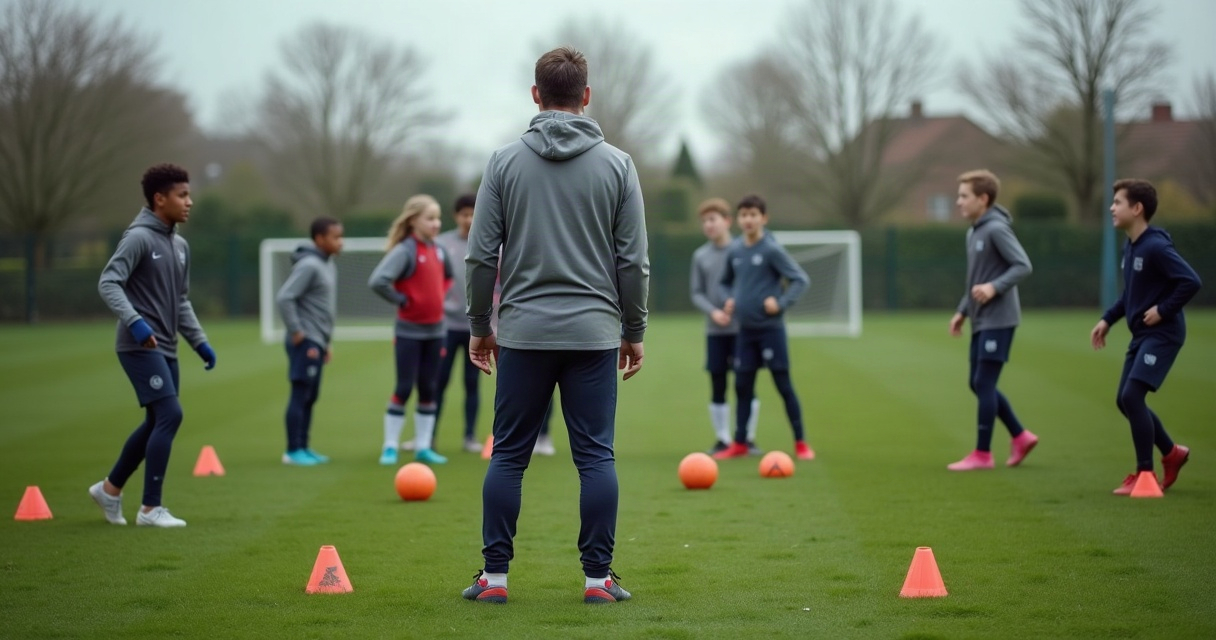
Help young beginners feel in charge of the ball with simple stop-and-start skills that build confidence from the very first session.
Why Stopping the Ball Changes Everything
When a young child first meets a football, the ball is in charge. It rolls away, bounces unexpectedly, and generally does whatever it likes. That feeling of being chased by something you can't control is quietly exhausting, and it's the main reason some young children drift to the edge of the session and stop trying.
Stopping the ball changes that in an instant. The moment a child plants their foot and the ball goes still, the relationship flips. Now they're in charge. That small experience of control—unremarkable to an adult, genuinely thrilling to a five-year-old—is the foundation every other football skill is built on.
Starting the ball, the gentle push or roll that sends it exactly where the child chooses, is the natural companion. Together, stopping and starting give children a complete basic loop: receive, pause, decide, move. They don't need to know those words. They just need lots of chances to feel it.
This is the heart of what Stop, Go and Grow: Your First Football Moves is built around, and it's worth understanding why these two actions matter so much before you step onto the grass.
What 'Control' Actually Looks Like at U6
At this age, expect wobbly stops and pushes that drift wide. That is completely normal and not a sign of a problem. Young children are still developing the spatial awareness to judge where the ball is relative to their foot, and the motor control to apply just enough pressure without booting it across the car park.
Useful things to look for instead of technical precision:
- Attention to the ball. Is the child watching it? Even tracking it with their eyes is a form of engagement.
- Willingness to try again. A child who fetches a runaway ball and has another go is already developing resilience.
- Any use of the foot to slow or redirect the ball. Sole, inside, toe—any surface counts at this stage.
- Moments of stillness followed by a deliberate push. That pause is the child thinking. It's valuable.
If you see those things, you're seeing learning. Praise the effort specifically: 'You watched the ball all the way to your foot' is far more useful than 'Well done' on its own, because it tells the child exactly what they did right and makes them more likely to do it again.
Setting Up a Session That Gives Everyone Lots of Touches
The biggest single thing a grassroots coach can do for U6 players is make sure nobody stands waiting. Long queues, complex explanations, and round-robin formats all eat into touch time, and touch time is everything at this age.
A simple principle: one ball per child wherever equipment allows. If you're short on balls, pairs work fine, but make sure the pair is rolling and stopping together rather than one child watching while the other performs.
Keep the space small enough that you can see everyone—roughly 20 metres by 20 metres is plenty. A large space makes it harder to spot a child who's quietly struggling, and it encourages children to kick hard rather than move carefully.
Start with free exploration. Put the balls down, say 'Stop it with your foot, then push it somewhere'—and demonstrate it once, slowly. Then step back. Children learn a huge amount just from doing, especially when they're not waiting for the next instruction. Resist the urge to keep talking. Watch, move quietly around the group, and offer a word or two to individual children rather than stopping everyone.
Add progressions only when the group is comfortable, not on a clock. If children are still figuring out the basic stop after five minutes, stay there. If they're clearly ready, introduce the next layer: stopping near a cone, or stopping and then choosing a direction. The session should follow the children, not the other way around.
Including Every Child in the Room
Inclusion at U6 isn't a special add-on. It's what good coaching looks like by default.
Some children will arrive nervous, particularly if this is their first group activity. A child who stands at the edge and watches is not refusing to join—they're gathering information about whether this place is safe. Make it safe. Keep your voice warm, move at their level, and never put them on the spot. Offer them a ball to explore on their own at the side of the group while the session runs. Most children migrate towards the fun when they're ready.
For children who find the ball difficult to control—whether through developmental delay, motor difficulties, or just very limited prior experience—simplify the starting point rather than lowering your expectations of them. A larger, lighter ball is easier to stop. Starting from a standing position and stopping a ball you roll to them gently removes the variable of their own kick. Once they feel the stop reliably, the rest follows naturally.
For children at the other end who are clearly comfortable and want more challenge, give them something to think about rather than something faster. 'Can you stop it with the inside of your foot instead of the sole?' or 'Can you stop it and then push it to two different cones before coming back?' keeps them engaged without creating a visible gap between them and less experienced classmates.
Aim to give every child a private moment of genuine, specific praise during the session. That one-to-one 'I saw you do that' is worth more than any group announcement.
How to Close the Session So Children Want to Come Back
The last two minutes of a session are surprisingly powerful. Children remember endings, and a good ending sets the tone for next time.
Bring everyone together—sitting down is usually easier than standing for this age—and name one or two things you genuinely saw. Not the 'best' effort or the fastest or the most technically polished. Something real: 'I saw someone stop the ball and look up before they pushed it. That's brilliant football thinking.' Nobody needs to know who it was, but the child who did it knows.
Ask the group a single open question: 'What did you do with the ball today?' You'll get a lovely range of answers and a reminder that they were all doing their own version of the same thing.
Finish with something simple and honest: 'You stopped the ball. You started the ball. That's football.' Children at this age respond to clarity. They want to know they did the thing, not a practice version of the thing.
If you're looking for more sessions built around these principles, explore the full session library for ideas across ages and abilities.
Written and reviewed by the PlayTactiq Coaching Team
Practical guidance for grassroots coaches, shaped around age-appropriate sessions, clear coaching language and real match-day problems.
Put it into a session
Ready-to-run U6 and U7 session plans
Setup, animated diagrams, coaching points and player-number adaptations — every U6 and U7 session in one place.
U6 and U7 football session plans →