
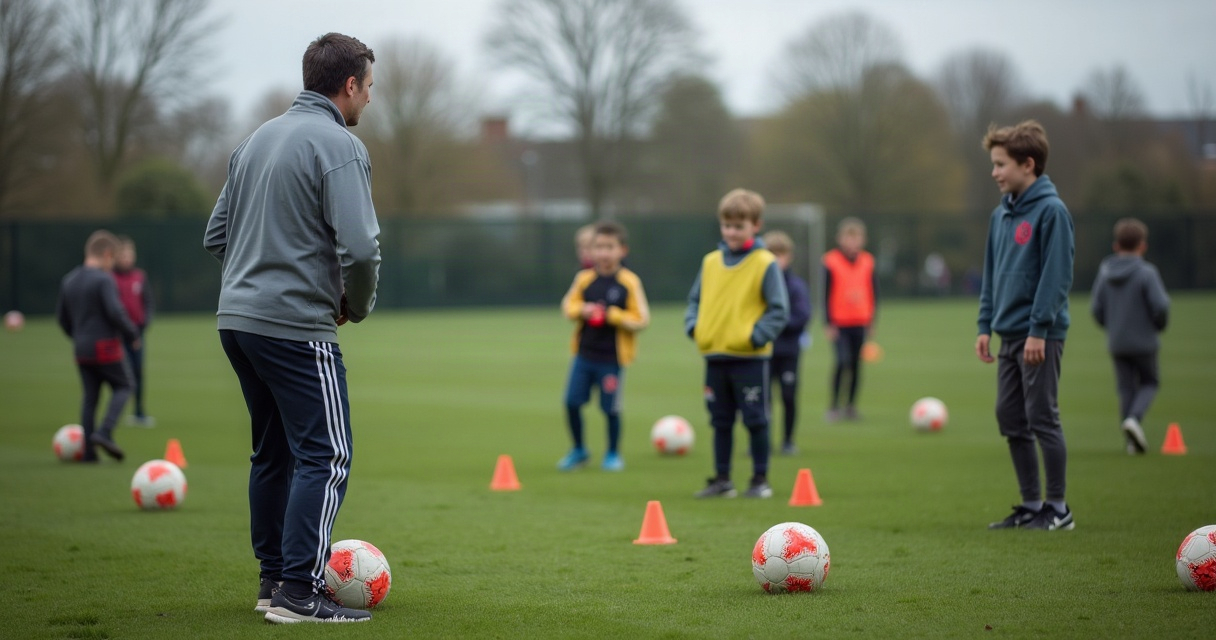
Help young players spot and use numerical advantages with confidence, quick decisions, and lots of enjoyment on the ball.
Teaching overloads to U10s is less about tactics and more about a feeling. When a child realises they have more teammates than opponents in one corner of the pitch, something clicks. The pass suddenly makes sense. The move into space makes sense. Football starts to feel like a game they can actually control rather than something that just happens around them.
The practices in More Players, More Chances: Playing in the Extra are built around that feeling. This article gives you the background thinking so you can coach those moments more naturally, notice what matters, and keep every child involved.
What an Overload Actually Is
An overload is simply when your team has more players in one area than the opposition does. Two attackers against one defender is an overload. Three players keeping the ball away from two is an overload. It does not require a whiteboard or a formation talk. It just requires children to glance around and notice who is free.
At U10, children are at exactly the right stage to start noticing this. They are moving away from chasing the ball in a pack and beginning to think about where to be. Overloads give that awareness a very clear, rewarding purpose: if you pass it to the player with space, something good usually happens. That cause-and-effect experience is worth far more than any instruction you could give on the touchline.
The key coaching idea is speed of recognition. An overload only lasts a moment. The moment you spot it and use it, before the opposition adjusts, is where the advantage lives. So what you are really coaching is the habit of looking, deciding, and acting—quickly but calmly.
Why Small Games Work Better Than Drills
Small-sided overload games give children enormous numbers of repetitions in a short time. In a 2v1 game, every child is involved on almost every action. There is no waiting in line, no standing around watching someone else have a go. Everyone is either on the ball, moving to receive it, or trying to win it back. That density of involvement is crucial at U10 because children at this age need lots of touches to build confidence.
The other reason small games work so well is that the decisions emerge naturally. In a 3v2 keep-ball exercise, children will discover for themselves that passing to the player furthest from both defenders is usually the best choice. They do not need to be told—they will work it out if you give them enough tries. Your job is to create the conditions and then step back.
This is also why keeping score lightly or not at all in some activities helps. When winning feels too important, children stop experimenting. They play safe, they avoid risk, and the learning slows down. Keep the atmosphere playful. Celebrate the clever pass, not just the goal.
How to Group Children Without Embarrassing Anyone
Overload situations can feel exposing for less confident children, particularly when they are the single defender against two attackers. They might rush in and give the ball away, or freeze up entirely. Neither is a failure—both are completely normal at this age—but you can arrange your groups to make it feel safer.
Pairing a quieter child with a patient, encouraging teammate in the first 2v1 activity helps enormously. When the confident child takes the pressure off by making the first decision, the quieter child gets to experience success without being under the spotlight. Over a few rotations, they begin to trust themselves more.
The free-player role in a 4v3 game is a particularly useful one to offer children who are finding the pace tricky. Being the extra player means you often receive the ball in space, with time to look up and make a decision. It is the least pressured position in the overload and often produces the best moments of individual confidence.
Watch too for the child who always wants to shoot alone rather than pass to the free teammate. Rather than correcting them directly, ask a question at a natural break: 'Was anyone free on your left when you had the ball?' Let them work back through the moment. This builds awareness without any sense of blame.
Connecting Training to Match Day
The real test of any session is whether children start to notice the same patterns during a game. With overloads, the transfer is very natural because the situations come up constantly. Three players pressing forward, two defenders back—your team has the advantage. Four of the opposition have pushed up, leaving only one back against two of yours—there is the moment.
The simplest thing you can do on match day is name what you are seeing, once, calmly. 'Three of us, two of them—let's go.' That is enough to plant the idea. Over several matches, children will start spotting it themselves and saying it to each other, which is exactly the moment you are working towards.
Avoid attaching this to fixed positions or formations. At U10 the game is fluid and positions shift constantly. Instead, encourage children to think about areas of the pitch rather than roles. 'Where are more of us bunched together right now?' is a more useful question than 'Who is supposed to be on the left?'
If you want to explore more session ideas that develop these same principles across different ages and themes, browse PlayTactiq's full practice library where everything is organised by age, ability, and theme.
Keeping the Energy Right Through the Session
Sixty minutes with U10s passes quickly when the activities flow well. The practical advice here is to change activities before energy drops, not after. If a group has been in the same zone for six minutes and a couple of children are starting to drift or chat, move them on. Four minutes of sharp, focused play is worth three times as much as eight minutes of gradually fading attention.
End every session—or every zone rotation—with something that feels like success. A goal scored in a 2v1, four consecutive passes completed, or a defender winning the ball cleanly are all worth a quick acknowledgement. Children need to leave feeling capable. When they do, they come back next time ready to go again, and that sustained enthusiasm is where real development lives.
Overloads are one of football's most joyful ideas precisely because the benefit is so immediate and obvious. Pass to the free player, move before the opposition adjusts, and something good happens. At U10, that is all the tactics you need.
Written and reviewed by the PlayTactiq Coaching Team
Practical guidance for grassroots coaches, shaped around age-appropriate sessions, clear coaching language and real match-day problems.
Put it into a session
Ready-to-run U10 session plans
Setup, animated diagrams, coaching points and player-number adaptations — every U10 session in one place.
U10 football session plans →