
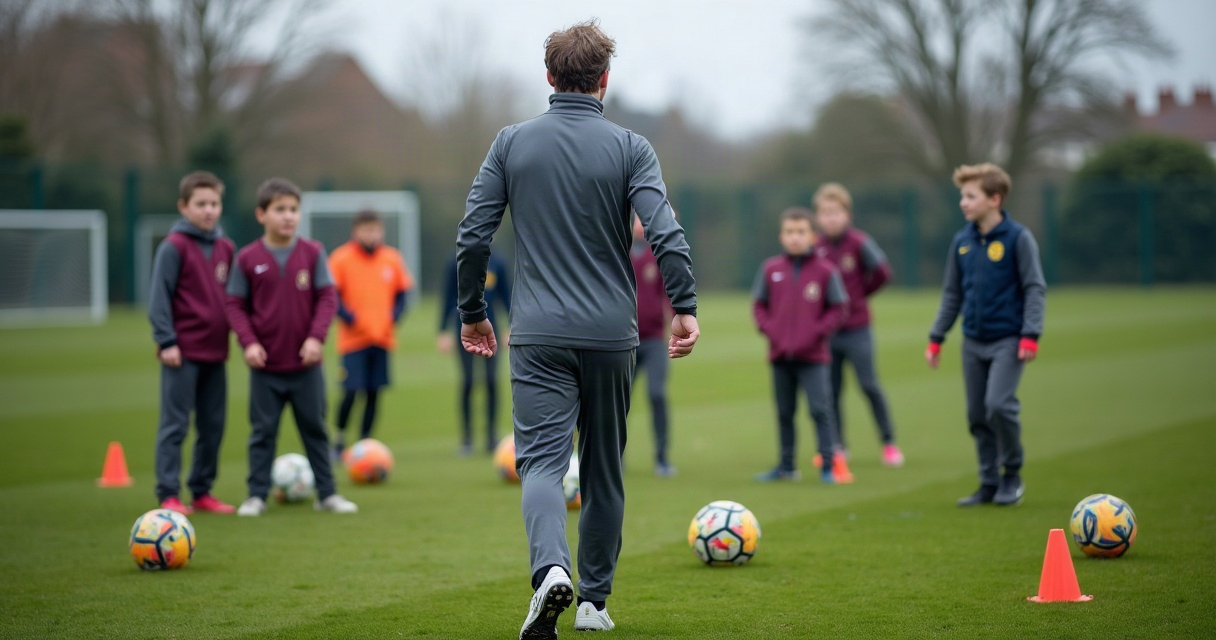
Help U10 players discover the joy of combination play with simple ideas that build confidence, trust and lots of touches for everyone.
There is a particular moment in grassroots football that every coach recognises: two children exchange a quick pass, one sprints into space, the ball arrives perfectly, and both of them grin. That moment is what wall passes and overlaps are built on. It is not a tactic in the grown-up sense; it is two children learning to trust each other and read the game together. This guide sits alongside the Passing Partners: Wall Passes and Overlaps practice and explains the thinking behind the activities so you can coach them with confidence.
Why Combination Play Works for This Age Group
At U10, children are moving from 'I want the ball' thinking towards a genuine curiosity about what teammates are doing. They are ready to notice space, but they still need the idea to feel simple and rewarding. Wall passes and overlaps give them exactly that: a short, clear action with an immediate, visible payoff. When a player passes, moves, and receives the ball back in a new position, the cause and effect is obvious. They felt it. That feeling matters far more than any explanation you could give from the touchline.
Combination play also does something subtle and important for less confident children. When success is shared between two players, no single child carries all the pressure. The quiet child who is anxious about making mistakes can contribute meaningfully as the 'wall' — the steady passer who sets a teammate free — without needing to dribble or shoot. Framing the roles this way from the start means every child finds a way in.
Setting the Scene Before You Start
Before any passing activity, take a minute to establish two habits that underpin all combination play. First, move after you pass. Many young players pass and then watch the ball, rooted to the spot. Gently challenge this by pointing out that the moment of passing is also the best moment to run, because defenders are watching the ball, not the runner. Second, keep your head up before you receive. A child who looks before the ball arrives can already picture where space might open.
You do not need to lecture these points. A quick question works better: 'When you pass to your friend, where could you run?' Let a few children suggest answers, then say 'Let's try it and see what happens.' Curiosity beats instruction at this age.
Keep your groups small — four to six players per station is ideal — so that waiting time is short and every child gets plenty of repetitions. Long queues are where engagement drops and where less confident players start to feel invisible. If you have an odd number of children, pair yourself with a player rather than leaving anyone without a partner.
Progressing the Activities Without Losing the Fun
The best progression at U10 is never harder for the sake of harder. Every step you add should answer the question: does this help children feel more of that passing-and-moving magic, or does it frustrate them?
Start with the simplest possible version of a wall pass: two players, a short distance, a return ball into space. Let them repeat it until the timing starts to click. Then, when you notice children completing the pattern comfortably, add a passive defender — someone who stands in the general area but is not trying to win the ball. This small addition changes how the passer reads the picture without adding real pressure. Later still, the defender can become semi-active, moving to close the ball but not tackling.
For overlaps, begin in a small box with two attackers and one passive defender. The overlap is simply player A passing to B, then running wide and slightly ahead so B has an extra option. At first, B will often ignore the overlapping runner entirely — that is fine. Over several attempts, the pattern starts to register. Resist the urge to stop and explain. A quiet word during a natural pause ('Did you see where your teammate ran? What might happen if you passed to them there?') plants the idea without halting the flow.
If a group is finding things difficult, make the space bigger and allow three touches instead of two. If a group is finding things easy, reduce the space slightly or ask the defender to become fully active. You are adjusting the challenge to match the group, not pushing everyone through identical steps.
Making Sure Every Child Belongs
Inclusion in combination play practice is straightforward when you are deliberate about it. Rotate roles frequently and loudly celebrate every kind of contribution. The child who makes a tidy pass deserves the same acknowledgement as the child who completes the full overlap. If you only cheer the runners, the passers feel invisible — and combination play falls apart without good passers.
Watch for children who hang back at the edges of the activity. Rather than calling them out, give them a specific small role: 'Can you be the wall for these two and give it back quickly?' That is a valued, active job, and it keeps them in the game while they build confidence. Open questions work well here too: 'Where do you think your partner might run after you pass?' You are asking them to think, not to perform, and that is a lower-stakes invitation.
Praise the process rather than the outcome. A wall pass that does not quite come off still deserves recognition if the idea was right: 'I saw you pass and move — that was exactly the right thought.' Over several sessions, children who feel safe to try will try more often, and the combination play patterns will emerge naturally from their own curiosity rather than from your instructions.
Carrying the Ideas Into a Small-Sided Game
The purpose of every activity in a passing and combination session is to create moments that children will recognise when they play a match. In a four-versus-four or five-versus-five game, avoid stopping play to set up combination moves. Instead, notice when a pair links up naturally — a quick one-two, a run that creates space — and mention it briefly at the next natural pause: 'Did you see what happened when those two passed and moved together? The third player suddenly had loads of room.'
You are helping children see patterns that were already there, not imposing patterns from the outside. That distinction keeps the game theirs. If you want more ideas for how to build sessions around these themes, explore more practices and see what fits your group's next step.
Combination play at U10 is ultimately about friendship expressed through football. Two children who learn to read each other's movement, trust each other's timing, and celebrate each other's success are developing something that will serve them long after they have forgotten the name of any drill. Keep the turns coming, keep the praise generous, and let the magic happen.
Written and reviewed by the PlayTactiq Coaching Team
Practical guidance for grassroots coaches, shaped around age-appropriate sessions, clear coaching language and real match-day problems.
Put it into a session
Ready-to-run U10 session plans
Setup, animated diagrams, coaching points and player-number adaptations — every U10 session in one place.
U10 football session plans →