
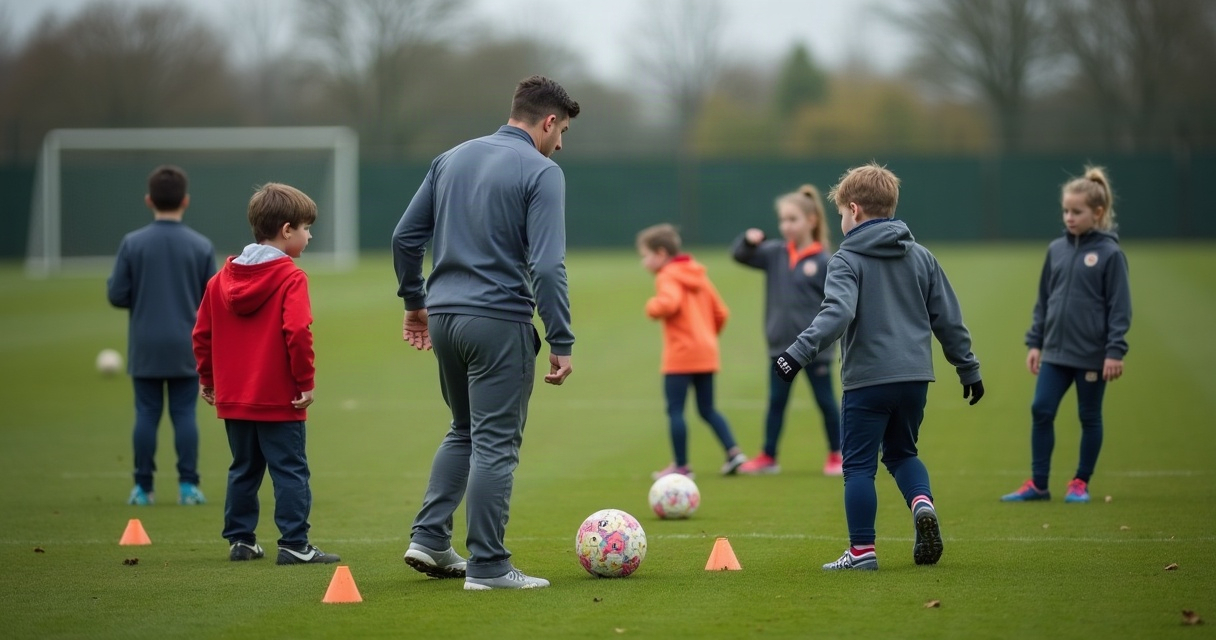
Help your U12s turn corner kicks into confident, practised routines with three simple set-piece patterns every child can enjoy and remember.
There is a particular hush that falls over a group of ten and eleven-year-olds the moment a corner is awarded. Everything stops. Players look around. Someone has a plan — or at least they want one. That moment of stillness is actually a gift, and this session is about helping your U12s use it well.
Corner kicks feel significant to children. Unlike the blur of open play, a corner comes with a pause, a breath, and a sense of purpose. A simple routine practised a few times gives players something they genuinely own: a shared plan they built together on the training pitch.
Session at a glance
- Age group: U12 (approximately 10–12 years)
- Session length: 60 minutes
- Players: 8–16 (works in two small groups)
- Space: 40 x 30 metre zone using one corner of your pitch or training area
- Equipment: One corner flag or cone to mark the corner spot, training cones to outline the penalty area, a supply of footballs
Why children enjoy this game
Corner routines hit a sweet spot for this age group. Children are developing sharper spatial awareness and can start to read where teammates are moving, which makes the choreography of a set piece feel genuinely satisfying rather than confusing.
Every player rotates through every role — taker, near-post runner, far-post runner, short-option receiver — so nobody is stuck in goal or stuck waiting. That variety matters enormously. When a child who usually hangs back suddenly curls one to the far post and a teammate heads it goalward, the look on both their faces is worth the whole evening.
The repetition in this session is deliberate and reassuring. Running the same routine five times lets players feel the timing in their body, not just hear it described. Confidence comes from familiarity, and familiarity comes from repetition done at the right pace.
How to run the session
Warm-up (10 minutes) Keep bodies moving with light passing and a few gentle headers or chest controls. Nothing complicated — you just want everyone warm and comfortable receiving a ball from various heights.
Introduce routines one at a time. Do not show all three at once.
Routine 1 — Near-post run (15 minutes) The corner taker plays a firm, low-to-mid ball to the near post. One teammate times a run to arrive just as the ball does, finishing or flicking on with one or two touches. Snappy and direct. Run it five times, then rotate every player into the taker and runner roles before moving on. The cue to give players: 'Run to meet it — don't wait for it to find you.'
Routine 2 — Far-post delivery (15 minutes) The corner taker drives or curves the ball to the far post. A runner attacks that space, focusing on timing their movement and reading the flight of the ball. This is the routine where children start to understand that arriving late is often better than arriving early. Repeat five times, rotate roles. Cue: 'Eyes on the ball, decide early, commit.'
Routine 3 — Short corner (10 minutes) The taker plays sideways to a teammate just outside the box. That player now has a real decision to make: shoot, re-cross, or drive forward. This one takes pressure off the taker and builds composure in the receiver. It is also a natural way to bring quieter players into a decision-making role. Cue: 'First touch sets up the second — what do you see?'
Progression: Once players feel confident in all three, add a goalkeeper and one defender. Ask players to call 'near', 'far', or 'short' before each routine begins so they are communicating, not just reacting.
Keep every child involved
While one group works through corner routines, the other group keeps active nearby with heading practice, passing sequences, or a small heading challenge — nothing that requires your full attention, just enough to keep everyone moving and engaged.
Rotate groups every five to six minutes so no one watches for long. Set a simple shared target — say, three different routines with at least three shots on goal — so players feel a collective sense of progress rather than individual pressure.
If a player finds heading uncomfortable, a chest control or volley from ground level works perfectly here. The routine still functions and the child still feels included. If bending the ball feels beyond a player right now, a firm, straight delivery is just as valid — several professional corners are exactly that.
Pair players thoughtfully. A quieter child alongside a kind, vocal teammate will often surprise you both.
What to notice and say
Watch the timing of runs, not just the delivery. A beautifully struck corner that nobody meets is worth less than a simple ball that a well-timed runner connects with. When you see a child read a run correctly — even if the finish does not work — name it: 'Brilliant movement, you were there at exactly the right moment.'
Know when not to stop the game. If a routine breaks down but players problem-solve themselves and try again, let it run. That self-correction is more valuable than a coaching interruption.
Two questions worth asking your group during or after a routine: 'What made that one work better?' and 'If you were defending against that, what would worry you most?' Both questions put players in charge of the thinking.
Easy ways to adapt it
- Smaller group (6–8 players): Run just one or two routines and add a mini target of five successful deliveries before moving on.
- Larger group (16+): Set up two corner stations simultaneously, one on each side of the pitch, with a coach or trusted player leading each.
- Limited equipment: Flat cones can mark every post, flag, and box line. You do not need goals — a cone gate works well as a target.
- Mixed confidence levels: Let the more confident players demonstrate once, then step aside so others lead the repetitions. Seeing a peer do it — not just an adult — is often the cue that makes it feel achievable.
Common coach questions
'What if they keep forgetting the routine mid-exercise?' That is completely normal at U12. Keep the signal simple — one word, called before the corner is taken — and run the same routine more times before adding the next one. Familiarity, not pressure, is what builds the memory.
'Do I need real goals for this to be useful?' Not at all. Cone goals or even marked target zones work just as well. The learning is in the movement, timing, and decision-making, not in whether a net ripples.
'What if my group really struggles with heading?' Take it out entirely and allow any contact — chest, volley, instep. The set-piece shape and the runner timing still teach everything you want them to learn.
The best thing about a corner kick session is that children leave it feeling like they have a secret weapon for matchday — something they practised, understood, and made their own. That sense of ownership is what brings them back next week.
You can find the full structured session plan here, or browse more sessions at Playtactiq to find your next training idea.
Written and reviewed by the PlayTactiq Coaching Team
Practical guidance for grassroots coaches, shaped around age-appropriate sessions, clear coaching language and real match-day problems.
Put it into a session
Ready-to-run U12 session plans
Setup, animated diagrams, coaching points and player-number adaptations — every U12 session in one place.
U12 football session plans →