
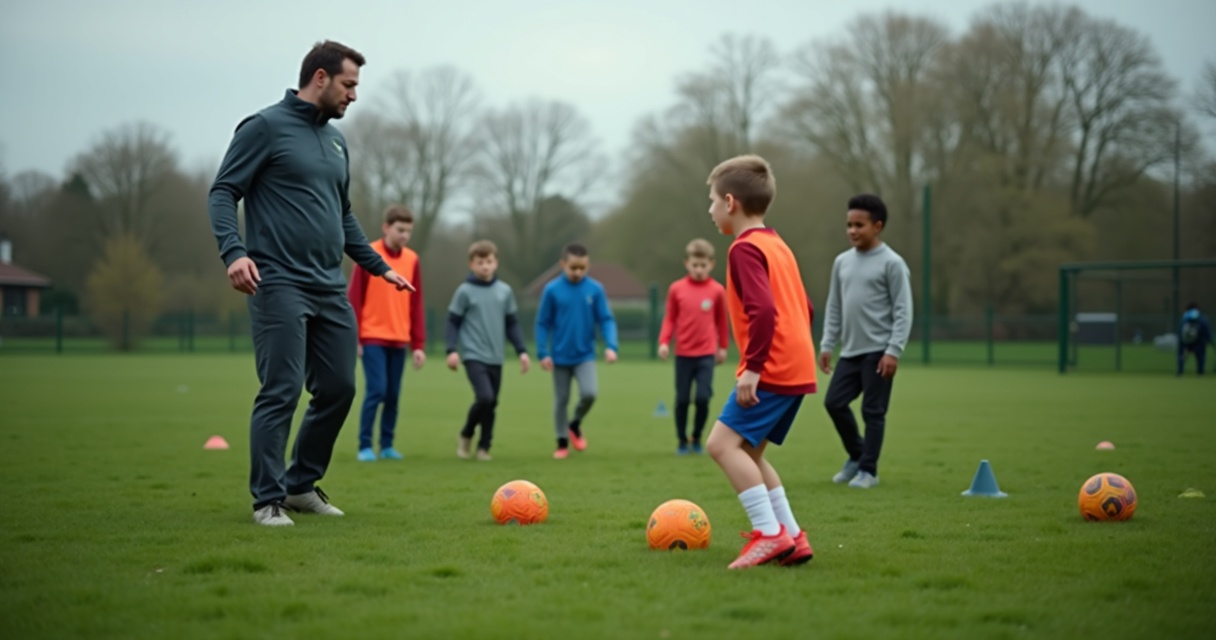
Master first touch coaching with this complete U10 drill. Learn how to develop soft feet, body awareness, and game-ready receiving skills that reduce turno
The first touch is where football begins. At U10, it's the single most important technical foundation you can build. A player who receives the ball with purpose—with their body already positioned for the next action—transforms defending pressure into attacking opportunity. A poor first touch invites chaos; a good one creates tempo instantly.
This is the principle behind Control and Go: teaching young players to receive the ball not as an isolated action, but as the first step in a continuous attacking sequence. When your U10s master this skill, you'll notice immediate changes in your team's play—fewer turnovers, sharper transitions, and players who control matches rather than react to them.
Why First Touch Matters at U10
Many grassroots coaches focus heavily on passing technique or positioning, but they overlook the foundation: receiving. At U10, young players often make the same mistake repeatedly—they take heavy touches when receiving, breaking their body shape, losing sight of the field, and inviting defenders to close them down.
The reason? They're receiving the ball passively. They're waiting for it to arrive instead of anticipating it. Their body is closed off—facing the passer rather than the field. Their feet are rigid instead of soft.
When you teach players to scan before receiving, adjust their body shape in flight, and cushion the ball with relaxed ankles and knees, everything changes. Suddenly, they're playing at tempo. They're seeing options before they receive. They're making decisions faster. The ball moves through the thirds quicker, and your team's attacking threat multiplies.
This isn't just about technique—it's about building confidence on the ball. U10s who receive well become U10s who want the ball. They take responsibility. They drive attacking play. These habits, repeated session after session, create technically secure players who form the backbone of your team.
The Setup: Three Zones, One Clear Focus
The Control and Go drill uses a simple 30x40 yard area divided into three zones. You'll need 12-16 players, organized into two groups, working in pairs: one receiver, one passer. A single defender in the middle zone creates light pressure—enough to enforce good decision-making without overwhelming young players.
This setup is deliberate. The three zones keep the drill focused. The light initial pressure teaches receiving under realistic match conditions without frustrating beginners. The pairing structure ensures continuous repetition—every player touches the ball frequently, building the motor memory that leads to automatic good technique.
The Basic Run: Establish the Core Principle
Start simple. The passer plays a 10-yard pass to the receiver in the receiving zone. The receiver takes one touch to control, orients their body away from the defender, and plays a pass to an open target.
This is the foundation. One touch. Away from pressure. Into space.
Coach ruthlessly here. Watch for players receiving with their body facing the passer—turn them side-on. Watch for heavy touches that kill the ball—teach them to use the sole of their foot for control, the inside for direction. Watch for players looking down—make them scan the field before the ball arrives.
Use these coaching cues repeatedly:
"Scan before you receive." Your players should know where the defender is, where the target is, and where they're going before the ball reaches them.
"Small, soft touches." The ball should stick to their foot. A heavy touch loses time and invites pressure.
"Body side-on so you see both." Players need to see the ball and the field simultaneously. This positioning makes it possible.
"Move to receive—don't wait." Passive receiving invites pressure. Active receiving takes defenders away from passing lanes.
"First touch takes you away from pressure." Every touch should be a micro-decision: if a defender is near, the first touch moves away. If space is ahead, the first touch moves forward.
Progressive Layers: Build Complexity Gradually
Once the basic run is solid, layer in complexity.
Progression 1: Receive and Turn introduces a second defender. Now the receiver must take their first touch away from both defenders, then turn to find a passing lane. This forces better body awareness and spatial reasoning.
Progression 2: Game Speed adds realism. After passing, players rotate roles immediately. The defender becomes the passer; the passer becomes the receiver. Now players don't know the exact timing of the next pass—they must react in real time, just like in a match.
Progression 3: Direction Change places two target zones on opposite ends of the area. The receiver's first touch determines which zone they attack based on where the defender positions. This is decision-making in its purest form: receive, assess, attack.
Bringing It Together
The beauty of Control and Go is its scalability. Start with the basics. Build layer by layer. Keep the pressure realistic—challenging but not overwhelming. And most importantly, repeat it. First touch is a habit. Habits are built through repetition.
When your U10s leave training having taken hundreds of first touches with good technique, they take that skill into their next match. They carry it through the season. By the time they reach U11, U12, and beyond, receiving the ball with purpose is automatic—they're no longer thinking about the technique; they're thinking about the next decision.
That's when you know you've built a foundation worth building on.
Written and reviewed by the PlayTactiq Coaching Team
Practical guidance for grassroots coaches, shaped around age-appropriate sessions, clear coaching language and real match-day problems.
Put it into a session
Ready-to-run U10 session plans
Setup, animated diagrams, coaching points and player-number adaptations — every U10 session in one place.
U10 football session plans →