
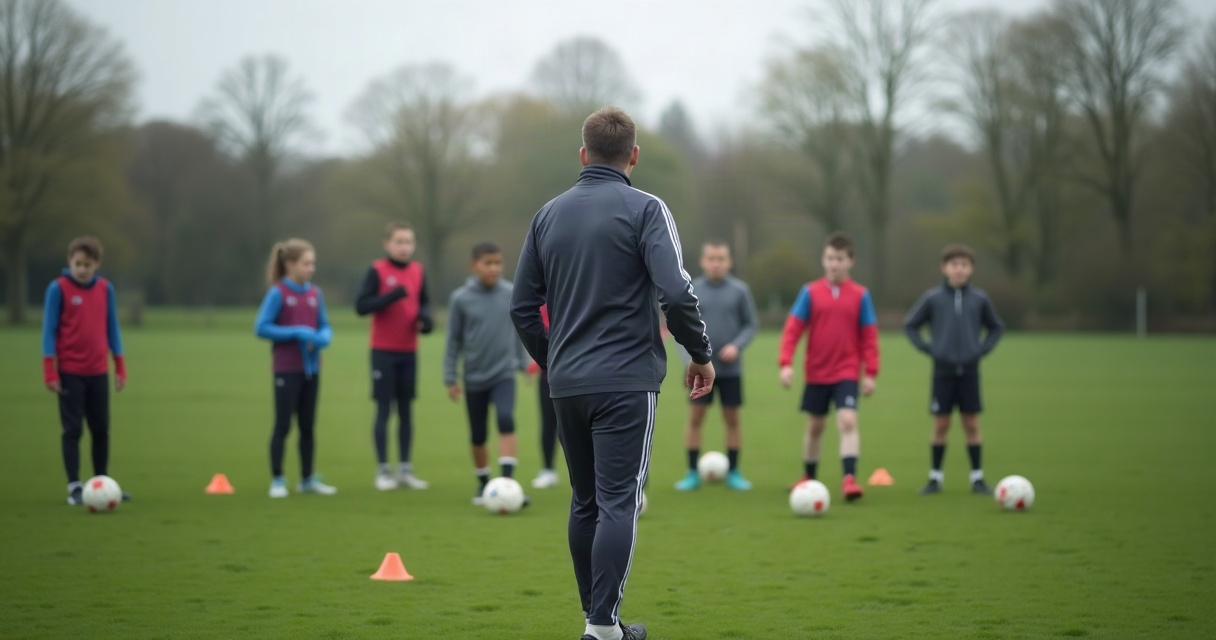
Practical coaching ideas to help U14 players find and use the gaps between defensive lines with confidence and creativity.
At U14 level, players start meeting defences that sit tight, stay organised, and make the pitch feel very small. This is one of the most common frustrations young players bring to training: we kept the ball fine, but we couldn't get through them. The good news is that a compact defence, far from being impossible to break, actually creates the gaps it is trying to close. The lines between defenders and midfielders, or between midfielders and forwards, are where penetrating passes live. Your job as a coach is to help players see those gaps, trust their teammates, and act quickly when the moment arrives.
The Playing Through Lines practice gives you a structured, high-repetition session built around exactly this challenge. The companion ideas below explain the thinking behind that session and offer extra context you can draw on throughout the week.
Why Compact Defences Actually Invite Penetration
When defenders stand close together, they protect the spaces behind them very well. But in doing so, they leave the spaces between their lines relatively open. Think of it like a crowd: people standing shoulder to shoulder block you from going through the crowd, but they create corridors between the rows.
For your players, understanding this changes the mental picture. Instead of seeing a wall, they start seeing a puzzle with a solution already inside it. A short pass sideways draws a defender across; a forward drops between the lines to receive; a quick return pass goes through into the space the defender just vacated. Two or three actions, and the defence is behind the ball.
That sequence feels genuinely satisfying to pull off. It rewards reading the game, trusting a teammate and making a brave pass rather than just running harder. Kids this age respond brilliantly to that feeling of being clever on the pitch — and once they experience it, they want to do it again.
Setting Up Simple Situations That Teach the Idea
The most useful thing you can do in training is create conditions where the gaps appear naturally, so players discover the solution rather than being told it. A three-zone game does this well. Defending teams in fixed zones cannot follow attackers, which creates exactly the kind of gap between lines that appears in a real match. Because defenders cannot sprint out to close, attackers must use passing, movement and timing rather than pace to progress.
A few design details make a big difference:
- Keep teams small. Groups of five or six give every player frequent touches and constant decisions. Large groups mean watching others play, which loses your players quickly.
- Rotate often. Two-minute rounds with immediate rotation mean no one waits long and everyone gets multiple attempts. The first round is often scrappy; the second or third is where real learning shows up.
- Use plenty of balls. Having three or four balls available across the session means a lost ball never stops another group from playing.
- Adjust the challenge in both directions. Reduce zone size or allow defenders one step forward to compress space for players ready for more. Allow backwards passes and resets, or reduce defenders, for those who need more time with the ball. The same game works for the whole group when you tune the constraints.
Movement Off the Ball Is the Real Skill
Once the session is running, the detail you will notice most is what players do without the ball. Passing into gaps only works when someone has moved to create the passing lane in the first place. A player standing still beside a defender gives the passer no angle and no option.
Help your players understand that moving away from space can create it. If a forward drifts toward the ball, the defender follows — and leaves the central gap open for a third player to run into. This is the combination that unpicks compact blocks in real matches: one player occupies, one moves to receive, and the pass goes to the space.
Useful questions to prompt this thinking mid-session:
- Can you move so your teammate can see a gap?
- Where is the furthest defender? That's usually where the space is.
- If you shift left, what opens up on the right?
Ask these as genuine questions, not instructions. Let players think, discuss briefly and try again. When they find the answer themselves, they are far more likely to apply it in a match.
Recognising and Praising the Right Moments
One of the most important coaching decisions in a session like this is what you choose to praise. If you only celebrate goals or completed passes, you risk encouraging cautious, sideways play. Instead, praise the attempt to find the gap — even when it does not come off.
I saw you spot that space between their lines — that was exactly the right idea is more useful than silence after a mispass. It tells the player their decision-making was good and encourages them to try again with more confidence.
Also look for players who move to create space for teammates but never receive the ball. That selfless movement is often invisible in a normal session, but it is one of the most important skills in playing through lines. Name it out loud: That run you made pulled the defender away — that's why the pass worked.
For players who are less confident on the ball, highlight safe decisions that kept possession or good starting positions. Inclusion in the recognition keeps every player engaged and willing to take risks.
When a breakthrough does happen — when a team strings together two or three passes and finds the forward in behind the last line — let them celebrate it, then encourage them to repeat it. Repetition of a successful pattern builds the muscle memory and game understanding that transfers to Saturday mornings.
Taking It Into Matches
The ideas from training show up in matches when players have the language and experience to recognise the moments. Encourage them to switch play when the defence narrows: moving the ball side to side stretches the shape and opens the central gaps. Remind midfielders to know where forwards are running before they receive the ball, so the penetrating pass is already in mind.
Simple collective language helps too. Three in a line — one moves, we pass to the gap is a phrase a group can share on the pitch without a coach nearby. Ownership of that idea, built in training, is what makes it stick.
For more session ideas built around similar game understanding themes, explore the full session library and filter by age group and theme. The right practice, repeated with good questions and honest praise, gives U14 players something better than a tactical trick — it gives them a way of seeing the game.
Written and reviewed by the PlayTactiq Coaching Team
Practical guidance for grassroots coaches, shaped around age-appropriate sessions, clear coaching language and real match-day problems.
Put it into a session
Ready-to-run U13 and U14 session plans
Setup, animated diagrams, coaching points and player-number adaptations — every U13 and U14 session in one place.
U13 and U14 football session plans →