
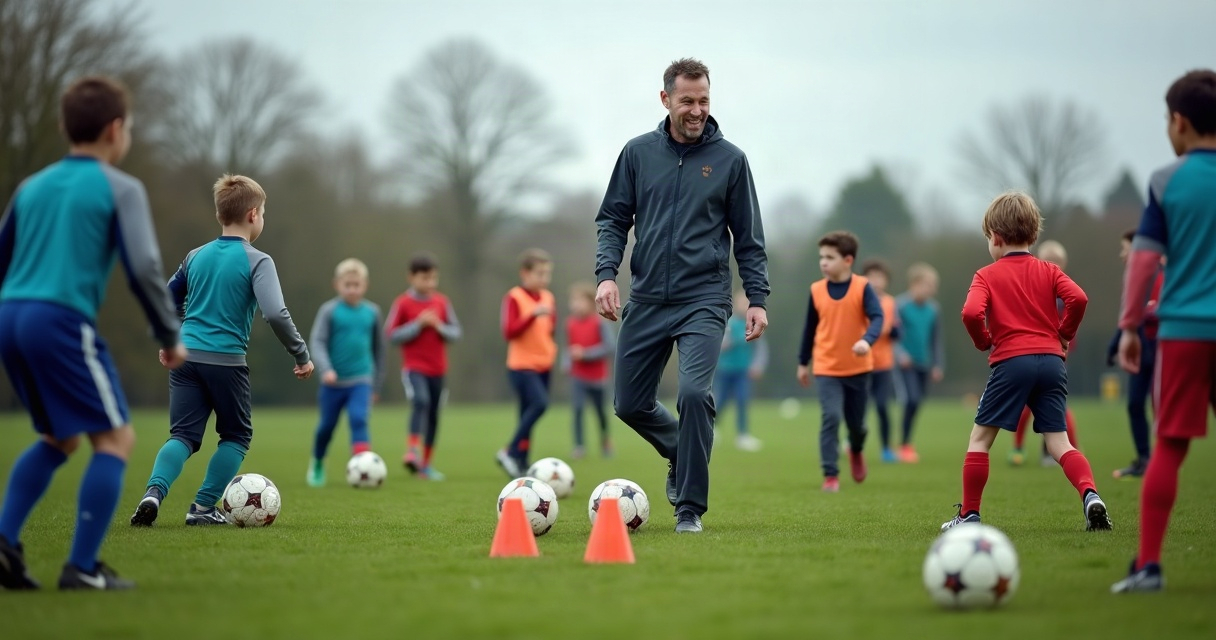
Help your U6 players receive the ball with confidence and keep moving with this simple, fun first touch session every child enjoys.
You roll the ball gently to a six-year-old, and they stand over it, stare at it, then step on top of it with their sole as if they're pinning it to the floor. Sound familiar? At this age, that is completely normal — the ball arriving feels like a small emergency, and stopping it dead feels like a triumph. Your job is not to correct that instinct harshly; it is to show them something that feels even better: touching the ball into space and immediately having somewhere to go.
That shift — from 'stop the ball' to 'move the ball into a good place' — is what this session is all about.
Session at a glance
- Age group: U6
- Session time: 45–60 minutes
- Players: 6–16 (easily scaled)
- Space: 30m × 20m with a line marked down the middle
- Equipment: One ball per pair, a handful of spare balls at the side, and a few cones to mark the area
Why children enjoy this game
Six-year-olds want to touch the ball as often as possible. They want to feel like they are doing something, not standing in a queue watching others. This session gives every child their own ball and their own partner, so touches are constant and waiting is almost zero.
There is also a lovely sense of rhythm to it — receive, move, send it back — that children settle into quickly. It feels a bit like a game rather than a drill, and when a touch goes well and the ball lands exactly where they meant it to, their face says everything. That small moment of 'I did that' is what keeps them coming back on a rainy Thursday evening.
Beyond the physical, there is something important happening socially. Pair work at this age builds connection. Children start talking to each other, encouraging each other, and laughing together when the ball bobbles off in the wrong direction. That sense of belonging is just as important as any technical habit they are forming.
How to run the session
Getting started
Mark your 30m × 20m area and draw or cone a line down the middle. Pair children up and give each pair one ball. Partners stand on opposite sides of the centre line, about four to five metres apart to begin with.
One child rolls or gently passes the ball to their partner, who receives it, touches it into a small space slightly away from the line, takes a couple of steps with it, then turns and sends it back. After four or five exchanges, they swap who starts the pass.
Keep the first few minutes deliberately easy. Let them find the rhythm before you add anything.
Building it gently
Once most pairs look comfortable, you can progress in small steps:
- Move the partners a little further apart so passes need slightly more weight behind them.
- Ask children to receive and move the ball to their left, then their right, so they are practising different directions of touch.
- Add a short burst of movement after the touch — receive, move it forward two steps, turn, then send it back. This keeps energy high and reinforces that the first touch is the beginning of something, not the end.
Three principles worth keeping in your pocket
- Body shape: Encourage children to turn slightly side-on so they can see both the ball coming and the space around them. You do not need to explain the biomechanics — just say 'turn a little so you can see where the space is.'
- Move toward the ball: Children who wait for the ball to arrive often receive it awkwardly. A small step to meet it changes everything.
- What comes next: The touch should always lead somewhere. After they receive it, something happens — a little run, a turn, a pass back. This keeps the idea alive that football is about moving, not just controlling.
Keep every child involved
If a child is new, shy, or just finding their feet, pair them with you first. Stand on the opposite side of the line, roll the ball gently, and let them receive it a few times before you invite them to try with a peer. A quiet 'whenever you are ready' is always better than a gentle push.
For children who find the footwork tricky early on, let them receive with their hands first. Getting the idea of 'ball comes to me, I move it into space, I do something next' matters more at this stage than which surface of the foot they use. Feet will follow.
For children who are comfortable quickly, give them a small cone to receive beside — they must touch the ball so it ends up next to the cone rather than anywhere. It adds a tiny challenge without removing their confidence.
What to notice and say
Watch for children using the sole to stop the ball dead. Rather than stopping the session to correct it, try standing near them and offering a simple cue: 'Try the inside of your foot — nice and soft.' Some children will adjust straight away. Others will need to hear it several times across several sessions, and that is completely fine.
Notice which children are already moving toward the ball and which are rooted to the spot. You do not need to stop the game every time — a brief, specific word as you walk past often lands better than a whole-group pause.
Two questions worth asking during a natural break:
- 'Where did you put the ball after you touched it — was there space there?' This opens up their thinking without putting them on the spot.
- 'What did you do straight after you controlled it?' It reinforces that the first touch always leads somewhere.
When something goes well — a lovely soft touch, a pair that has found their rhythm — name it simply and move on. 'That was a really good touch, you moved it straight into space.' Children remember that.
Easy ways to adapt it
- Smaller group (4–6 players): Work with two or three pairs side by side. More space per pair means less pressure, which suits hesitant children well.
- Larger group (14–16 players): Run pairs across the full width of your area. Spare balls at the edge mean no one stops if a ball rolls away.
- Limited equipment: Cones are optional — you can mark the centre line with jumpers or simply agree where it is. One ball per pair is the only real requirement.
- Mixed confidence: Let more confident pairs progress to the further-apart variation while newer players stay close. No one needs to know there is a difference.
Common coach questions
What if children keep using their sole to stop the ball? It is the instinct at this age — stopping feels safe. Try the cue 'inside of the foot, gentle and soft' and demonstrate it yourself. A few children will switch immediately; others will take several sessions. Both are normal.
What if pairs fall apart and children start playing on their own? That is often a sign they are enjoying it, which is good. Gently redirect them back to their partner, or briefly join in yourself to model the exchange again.
How do I know when to move to the progression? When most pairs are exchanging smoothly without looking anxious about the ball arriving, that is your cue. You do not need everyone to be ready — if half the group is comfortable, introduce the next step and let the others catch up at their own pace.
This is a session children will ask for again, because it gives them touches, a partner to work with, and that small private satisfaction of a touch that goes exactly where they meant it to. See the full session plan here, and if you are looking for more ideas to keep your sessions fresh, browse what else is available.
Written and reviewed by the PlayTactiq Coaching Team
Practical guidance for grassroots coaches, shaped around age-appropriate sessions, clear coaching language and real match-day problems.
Put it into a session
Ready-to-run U6 and U7 session plans
Setup, animated diagrams, coaching points and player-number adaptations — every U6 and U7 session in one place.
U6 and U7 football session plans →