
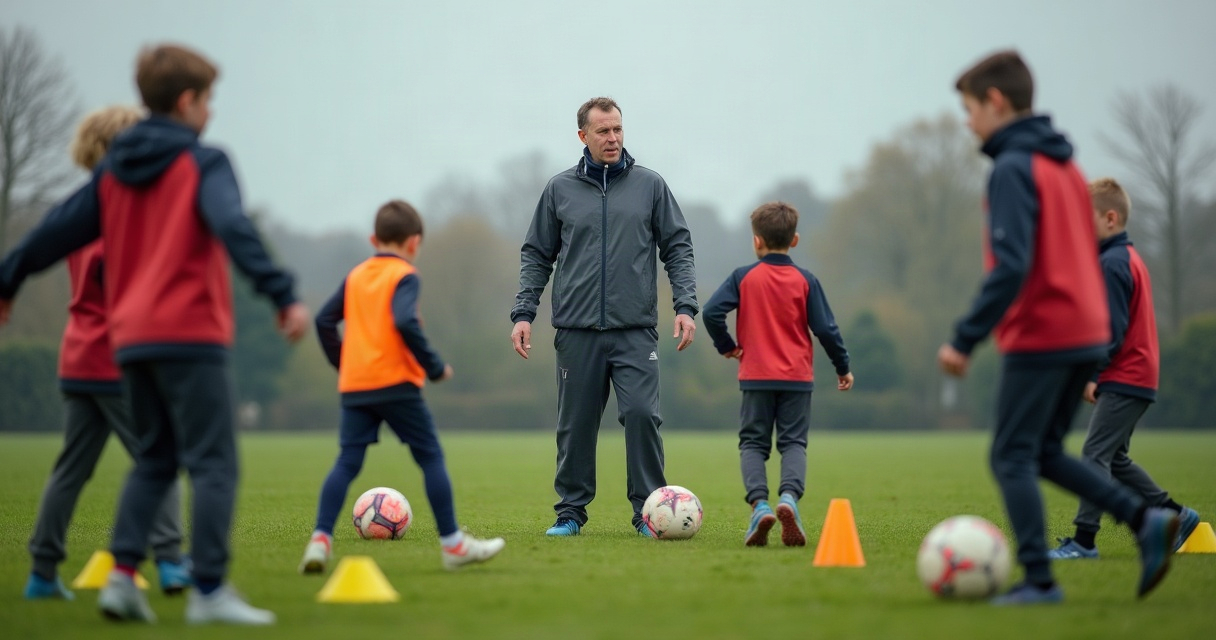
These three ball-based warm-up games help U8 beginners feel welcome, get loads of touches, and arrive at your main session ready to enjoy themselves.
It happens at almost every U8 session. A child wanders onto the pitch, ball tucked under their arm, eyes scanning the group to see if this is going to be fun or frightening. The next ten minutes — your warm-up — will answer that question for them. Get it right and they are giggling, moving, and already in love with the session before you have even started the main activity.
The good news is that a great warm-up for this age does not need to be complicated. It needs a ball each, a bit of laughter, and the sense that everyone belongs here.
Session at a glance
- Age group: U8
- Ability level: Beginner
- Total warm-up time: 16 minutes
- Players: Works for groups of 6–16
- Space: Roughly 20m × 20m — adjust smaller for fewer children
- Equipment: One ball per child, cones to mark the area
Why children enjoy this warm-up
At this age, children do not separate 'warm-up' from 'playing'. To them, it is all just football. That is exactly what you want to protect. When every child has a ball at their feet from the very first minute, no one is standing around feeling invisible or waiting for a turn that seems to take forever.
The three games here — Follow My Feet, Pairs and Passes, and Dribble Dance — are designed so that success feels easy and frequent. There is no elimination, no scoreboard, and no moment where one child is singled out. Children feel the warmth of the group, get their heart rate up gradually, and start to find their feet with the ball — all without realising they are doing anything technical at all.
Confidence at this age is fragile and precious. A warm-up that lets every child feel capable sets the tone for everything that follows.
How to run the session
Gather together (30 seconds). Keep this really brief. Crouch down to their level, smile, and tell them simply what is happening: 'We are going to play three little games with the ball. First one is Follow My Feet — let's go.'
Game 1 — Follow My Feet (5 minutes). Every child finds a space with their ball and moves freely around the area. You call out simple movements: 'tap it left, tap it right, stop it with your sole, roll it slowly.' Keep your voice upbeat and your cues short. You are not drilling them — you are playing a game together. Move around the space yourself so children are watching you rather than feeling watched.
Game 2 — Pairs and Passes (6 minutes). Pair children up. Partners stand 2–3 metres apart and simply roll or pass the ball to each other. Call out little variations as they go: 'pass and follow your ball, pass with the other foot, pass and give me a little hop.' Keep the distance short enough that nearly every pass reaches its partner. A successful pass feels brilliant at this age. If numbers are odd, make a group of three — it works just as well.
Game 3 — Dribble Dance (5 minutes). Children dribble freely around the space again, but now you become a friendly, slow-moving obstacle they have to dribble around. When you call 'freeze,' everyone stops with a foot on the ball. Then off they go again. No one is out. No one is chasing anyone. It is simply about moving with the ball and responding to your voice — which is very good listening and co-ordination practice wrapped inside something that feels like a dance.
Keep every child involved
If a child looks lost during Follow My Feet, drift alongside them, give a gentle smile, and do the movement together without drawing attention to them. That quiet moment of togetherness is often all they need.
For Pairs and Passes, watch for children who look anxious about having a partner. It is perfectly fine for a child to work alongside you for a moment, or to swap partners if a pairing is not working. Keep it low-key — you can quietly reorganise without anyone noticing.
In Dribble Dance, reduce the space slightly if children are struggling to keep their ball close. A smaller area naturally brings more success without you having to say a word about technique.
What to notice and say
During these games, you are not looking for perfect technique. You are watching how each child feels with a ball at their feet. Notice who looks comfortable, who looks tense, who is laughing, and who is quietly watching others before they try.
Use short, warm cues as you move around: 'Nice footwork,' 'Good eyes — keep looking up,' 'That is great balance.' Avoid correcting more than one or two things per child across the whole warm-up.
Know when not to stop the game. If the energy is good and children are moving and smiling, let it run. A well-timed intervention helps; a constant stream of stoppages breaks the spell.
Two questions worth asking at the end of the warm-up, just for a moment:
- 'Which game did you enjoy most?'
- 'Did anyone try something tricky with the ball?'
Those questions tell you a great deal and make children feel their opinion matters — because it does.
Easy ways to adapt it
- Smaller group (6–8 players): Reduce the space to around 12m × 12m so there are more natural interactions and passes feel easier.
- Larger group (14–16 players): Add a second 'friendly obstacle' in Dribble Dance — another adult or a confident child — so the space does not feel congested.
- Limited equipment: If you are short of balls, run Pairs and Passes with one ball between two throughout, and give each child a solo ball for the individual games only.
- Mixed confidence: Let quieter children choose their own partner for Game 2. Giving them that small choice can make a real difference to how safe they feel.
Common coach questions
What if children keep crashing into each other during Dribble Dance? Slow your own movement down and use a calm voice: 'Find a space, find a space.' You can also shrink the group into a smaller cluster temporarily and then open the space back up as they settle.
What if a child refuses to join in? Let them stand near the edge with a ball at their feet. Do not pressure them. Often, watching the fun for two minutes is all it takes before they drift in naturally.
How do I know when the warm-up has done its job? When most children are moving freely, smiling, and responding to your voice without hesitation, they are ready. You will feel it as much as see it.
A warm-up that makes every child feel welcome and capable is one of the best things you can give your group — and it makes everything that comes after easier and more enjoyable for everyone, including you. You can find the full session plan here or browse more sessions on Playtactiq to keep your coaching fresh.
Written and reviewed by the PlayTactiq Coaching Team
Practical guidance for grassroots coaches, shaped around age-appropriate sessions, clear coaching language and real match-day problems.
Put it into a session
Ready-to-run U8 session plans
Setup, animated diagrams, coaching points and player-number adaptations — every U8 session in one place.
U8 football session plans →