
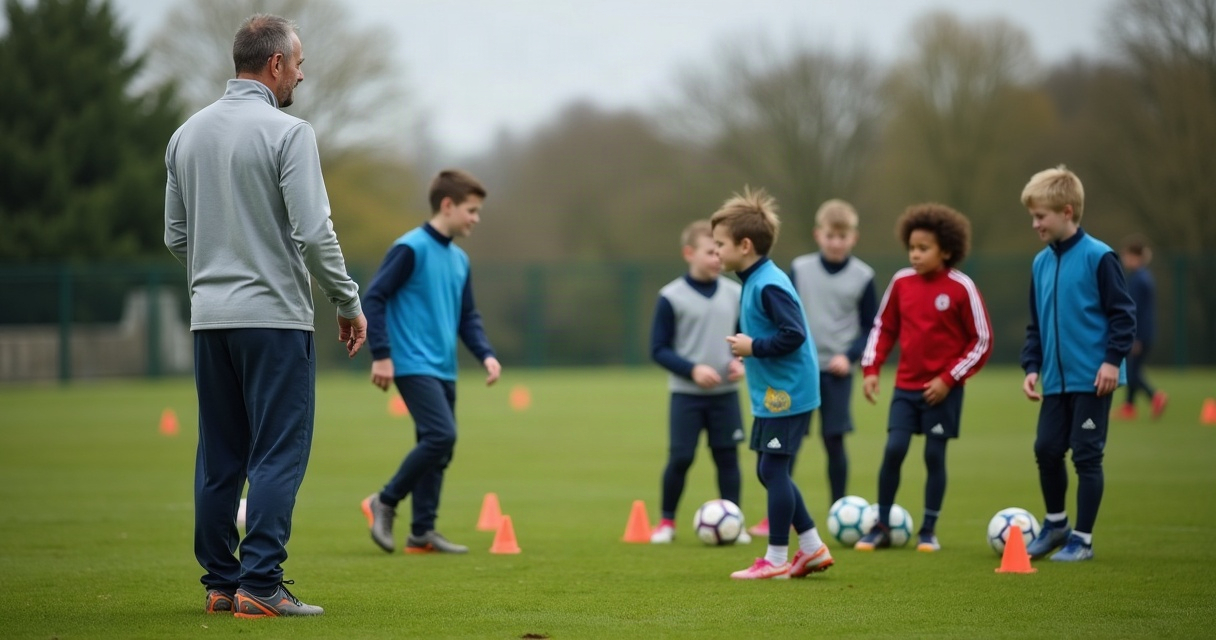
Simple ideas to help young footballers enjoy changing direction, stopping safely, and moving freely through space.
Teaching agility to five and six-year-olds isn't really about agility at all. It's about helping small people feel capable, safe, and free inside a big open space. When a child can turn without wobbling and stop without crashing into someone, they start to enjoy movement for its own sake—and that enjoyment is what keeps them coming back to football week after week.
This article sits alongside the Twists and Turns: Moving Like a Dancer session and explains the thinking behind the games. Whether you're running that session for the first time or looking for ways to weave these ideas into your regular warm-ups, the principles here will help you get the most from every minute on the grass.
Why Turning and Stopping Feel Hard at This Age
Children at U6 are still building what movement specialists sometimes call body awareness—the sense of where your limbs are and what they're doing. Turning quickly while keeping your feet underneath you requires a whole chain of small adjustments that adults do automatically. For a five-year-old, that chain is still being wired together.
This means wobbling, stumbling, and the occasional tumble aren't signs of weakness—they're signs that the nervous system is doing exactly what it should be doing. Every time a child turns, stops, and catches their balance, a small piece of that wiring strengthens. Your job as a coach isn't to prevent the wobbles; it's to create a space where wobbling feels completely fine.
The other thing worth understanding is that young children think in pictures and stories, not in technical instructions. Telling a child to 'pivot on your standing foot' will get you a blank stare. Telling them to 'turn like a butterfly changing direction' gives their imagination something to work with—and their body follows the picture without being told.
Setting Up Space That Invites Movement
Before anyone arrives, take a moment to look at your space with a child's eyes. A large, open rectangle with nothing in it can actually feel intimidating at this age. A few cones placed loosely around the area give children visual anchors—landmarks to head towards, turn around, or stop next to.
Keep the area compact. A 20-metre square is plenty for a group of six to ten children. A smaller space means more collisions but also more natural reasons to turn, dodge, and change direction. Collisions at walking or jogging pace are part of the game; they teach children to read the space around them.
One soft ball per child is ideal. When every child has a ball, no one is waiting and no one is left out. Balls can be dribbled, rolled, carried, or just tucked under an arm while a child works on their movement. You decide what role the ball plays in each activity—sometimes it's the whole point, sometimes it's just a comfort object for a shy child who needs something to hold.
Games That Teach Without Feeling Like Teaching
The best activities for this age group disguise the learning inside a story or a character. When children pretend to be butterflies or robots, they're not thinking about their footwork—they're thinking about butterflies and robots. The footwork improves anyway, because the imagination pulls the body into new shapes and rhythms.
Here are three ideas that work well beyond the structured session:
Shadows. One child follows another, copying every movement—turning, stopping, speeding up, slowing down. This is brilliant for reading movement and reacting quickly. Swap roles after a minute. Even watching from the side teaches a hesitant child what turning looks like in practice.
Cone colours. Scatter cones of two or three different colours across the space. Call a colour and children race to touch one of those cones, then return to the middle. Simple, but every trip to a cone involves a turn and a stop. Change the rules: hop to the red cone, walk backwards to the blue one, spin once before touching the yellow.
Tail tag (without the elimination). Tuck a bib into each child's waistband as a tail. Children try to collect tails from others while protecting their own. No one sits out when their tail is taken—they just go to a coach for a new one and rejoin immediately. This game produces hundreds of direction changes in five minutes without anyone feeling singled out.
The common thread in all of these is that children are making their own decisions about when and how to turn. That self-directed decision-making is exactly what builds real agility. A child who turns because they've chosen to is practising something much more useful than a child following a cone course laid out for them.
Including Every Child, Especially the Hesitant Ones
Every group has at least one child who stands at the edge and watches. This is not a problem to solve—it's a normal part of how some children learn. They're absorbing information, building confidence, and deciding whether the space feels safe enough to enter.
The gentlest invitation is to stand near them and copy whatever the group is doing yourself. You become a model without making them the centre of attention. Offer a ball to hold, a cone to carry, or a simple job—'Can you be in charge of saying freeze?'—that gives them a role without requiring them to perform.
Avoid singling children out in front of the group, even for praise. 'Everyone look at how Lily turns!' can feel wonderful to one child and mortifying to another. Instead, direct your warmth at the group: 'I can see so many brilliant stops out there,' and then have a quiet word with individuals when you're close enough to speak only to them.
Flexibility in how children participate matters more than consistency in what they do. A child who spends half a session watching and half a session playing has still had a positive experience. That positive experience is why they'll come back.
Carrying These Ideas Into Your Next Sessions
Agility and change of direction aren't a topic you cover once and move on from. These movement skills thread through everything young footballers do—chasing, avoiding, positioning themselves near the ball, turning to find a friend. Every session you run can include a few minutes of turning and stopping play, even if that's not the main theme.
The simplest habit to build is offering frequent, playful direction changes in your warm-ups. 'Turn left,' 'stop,' 'find a new space,' 'spin around'—these small instructions woven into the start of any session build the movement vocabulary children need without taking up separate time.
When you're ready to explore more session ideas built around confident movement and joyful participation, browse the full session library for activities matched to your group's age and ability. The best sessions for U6 players are the ones that feel least like sessions—and most like play.
Written and reviewed by the PlayTactiq Coaching Team
Practical guidance for grassroots coaches, shaped around age-appropriate sessions, clear coaching language and real match-day problems.
Put it into a session
Ready-to-run U6 and U7 session plans
Setup, animated diagrams, coaching points and player-number adaptations — every U6 and U7 session in one place.
U6 and U7 football session plans →