
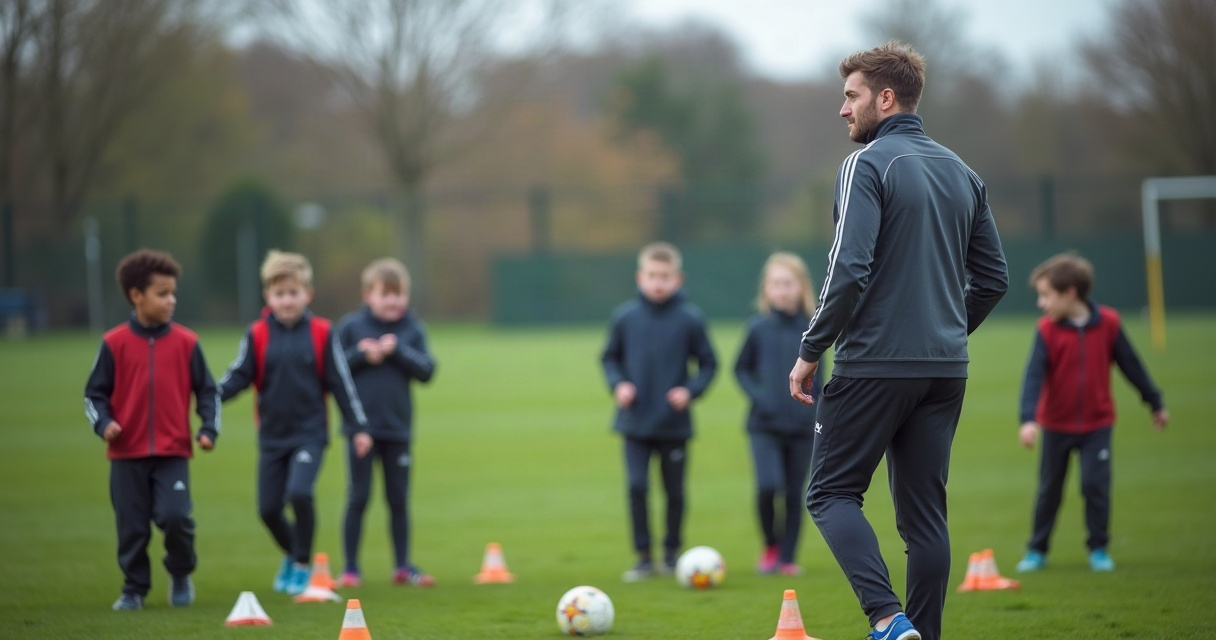
Help your U14s build real match stamina through ball work that keeps them engaged, moving, and learning all at once.
The Problem With Running for Its Own Sake
Ask most 14-year-olds to run laps and you will see two things happen fairly quickly: their bodies comply and their minds check out. They finish the circuits, they catch their breath, and they learn almost nothing transferable about the game. Worse, some players quietly begin to associate football with punishment, which is the last thing a grassroots coach wants to cultivate at an age when enjoyment is still the strongest hook.
The good news is that stamina does not require laps. A well-designed ball session can push heart rates just as high, develop aerobic capacity just as effectively, and do something a running circuit simply cannot: teach players how fitness feels inside a real football context. When a player is concentrating on keeping possession, tracking a teammate's run, or deciding when to press, fatigue arrives without announcement. They are too busy solving football problems to resent the work.
This matters especially at U14. Players at this age are ready to join the dots between physical effort and performance. They can begin to understand that the reason they make poor decisions late in a match is often tiredness rather than a lack of talent. Give them that insight through experience rather than a lecture and it tends to stick.
What Ball-Based Conditioning Actually Develops
It helps to be clear about what you are training, because 'fitness' can mean several different things on a football pitch.
Aerobic capacity is the engine that keeps players ticking over throughout a match — the steady, lower-intensity work between sprints. Possession-based drills with constant movement build this reliably, because players are always either passing, moving, scanning, or preparing to receive.
Recovery ability is arguably more important at youth level than raw fitness. In a real match, effort comes in waves: a press, a break, a transition, a rest, then another press. The goal is not to be fit in the abstract but to recover quickly enough to be useful again in the next moment. Any session that deliberately varies its intensity — holding high for forty seconds, then allowing players to breathe — trains this rhythm in a way laps never can.
Decision-making under fatigue is the third component, and the most underrated. Tired players rush, misplace passes, and switch off. A session that keeps the ball in play while players feel their legs forces them to practise the thing they actually need: making decent choices when it would be much easier to take a shortcut. That is exactly what the final fifteen minutes of a match demands.
A session like Stamina With the Ball: Fitness That Feels Like Play brings all three of these together across rotating stations, each with a different intensity and a different football problem to solve.
Keeping Everyone Moving and Involved
One of the quiet failures of traditional conditioning is that it often rewards the already-fit and discourages everyone else. The player who struggles drops behind, feels exposed, and either pushes through discomfort alone or quietly gives up caring. Neither outcome is useful.
Ball-based conditioning naturally distributes the load more fairly, but you still need to think about inclusion deliberately.
Smaller groups mean more touches and less waiting. If you have sixteen players, four groups of four will always give more ball contact than two groups of eight. More contact means more decision-making, more movement, and incidentally more conditioning — players who are always involved do not get the chance to drift.
Varied roles within a drill give players with different confidence levels somewhere useful to stand. A player who is tiring can slow the tempo by taking an extra touch; that is not failure, it is intelligence. A player who is finding it easy can be challenged to switch the ball or use their weaker foot. These adjustments happen naturally when the structure allows for them, without anyone needing to be singled out.
Built-in rest moments — a short drink break, a brief turn as observer — let players recover without shame. Framing a two-minute rest as 'have a look at what your teammates are doing and tell me one thing they're doing well' turns recovery into a coaching contribution rather than an admission of weakness.
Helping Players Own Their Fitness
The long-term goal of any conditioning session at this age is not just a fitter team today. It is players who understand their own bodies well enough to manage their effort across a whole match and who see fitness as something they have agency over.
That shift starts with the language you use. 'Feel your legs — that's your body adapting' is a very different message from 'work harder.' The first gives players information; the second just adds pressure. When a player says they are tired, the most useful question is often 'what can you do differently so you can keep going?' rather than anything that implies they should not be tired at all.
Asking players to notice their own recovery is particularly powerful. After a high-intensity wave, prompt them: 'Has your breathing settled? Could you go again?' Most of them will realise they have recovered faster than they expected. That realisation — that the body bounces back — is something they can carry into a match and use to pace themselves intelligently.
Small questions at the end of a session do more than a long debrief. 'Which station felt hardest?' and 'did you notice yourself recovering between efforts?' take thirty seconds each and plant the kind of reflective habit that eventually produces players who manage themselves rather than waiting to be managed.
Connecting Fitness to Positions and Game Moments
Once players have experienced ball-based conditioning and begun to feel its effects, you can start connecting the work directly to their roles on the pitch. A central midfielder who has just spent twelve minutes in a possession circuit has lived, briefly, the movement demands of their position. A defender who has practised wave transitions has felt the pattern of holding a line, pressing, recovering.
The question 'how does your fitness affect the shape we're trying to keep?' is worth asking, even briefly, because it elevates conditioning from something done to players into something done for the team. When they understand that their energy in the seventieth minute affects whether the shape holds or falls apart, the motivation to work shifts from external to internal.
If you are looking for more sessions that connect physical and technical development across different themes and age groups, explore the full session library to find something that fits your squad right now.
Written and reviewed by the PlayTactiq Coaching Team
Practical guidance for grassroots coaches, shaped around age-appropriate sessions, clear coaching language and real match-day problems.
Put it into a session
Ready-to-run session plans by age group
Setup, animated diagrams, coaching points and player-number adaptations, from U6 through to U18.
Browse session plans by age group →