
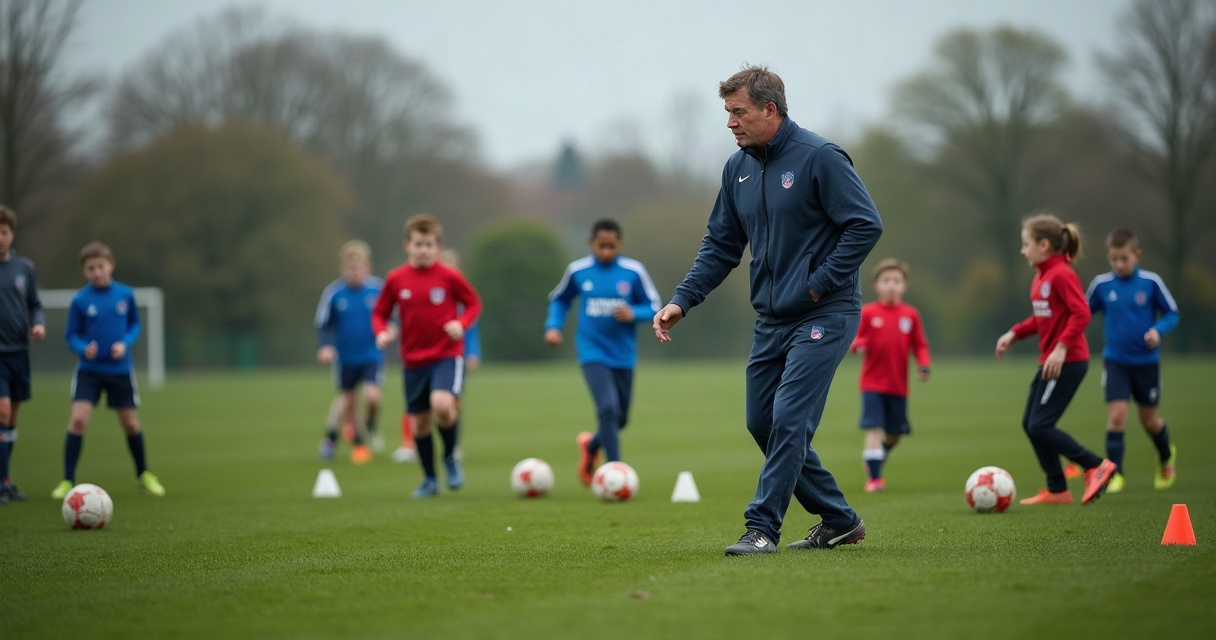
How to bring U14 players back to football after a break without burning them out or killing their enthusiasm in the first session.
Pre-season for U14s is a funny thing. The players are keen to see their mates, their boots have been sitting idle for weeks, and there is a genuine buzz about being back. But underneath that energy there are tired legs, rustier touches than anyone will admit, and — for some — a quiet anxiety about whether they are still good enough, still fit enough, still part of the group. Your first session back sets the tone for everything that follows. Get it right and you create momentum. Rush it and you risk sore bodies, dented confidence, and a queue of parents on the touchline wondering why their child does not want to go back.
Why the First Week Back Deserves Real Thought
After a break of any length, muscles that have not been working in football-specific ways need time to warm back up — not just within a session, but across several weeks. At U14, that matters more than it did at U10 because growing bodies carry more load through joints, and the gap between being motivated and being overcooked is narrower than it looks.
The instinct for many coaches is to use the first session to prove that the group is serious: long runs, fitness circuits, competitive drills with winners and losers. The problem is that this approach tends to flatten exactly the players you most want to protect — the less confident ones, those returning from minor knocks, and the quieter kids who needed the break to recharge. A session designed around enjoyment, constant touches on the ball, and lots of short efforts with natural recovery baked in will do more for your squad's fitness across six weeks than any amount of running without the ball in week one.
The session in Back to Sharp: Building Fitness Week One is built around exactly this idea: keep everyone moving, keep the ball close, and make the effort feel like play rather than punishment.
Making Fitness Feel Like Football
The smartest way to build fitness in young footballers is to disguise it inside football. When a player is dribbling through cone gates, changing direction, choosing when to speed up or slow down, they are working their cardiovascular system, their coordination, and their technical habits all at once. They are not thinking about effort — they are thinking about their next move. That cognitive engagement is precisely what makes ball-based conditioning so effective.
For the coach, this means resisting the urge to freeze the game to deliver long instructions. Short, sharp cues called into the flow of activity — 'quick touches now', 'find a new path', 'pass and move' — keep everyone active while still directing learning. The less time players spend standing in lines waiting for a turn, the more each child benefits from the session. Minimum waiting, maximum touches: that is the principle.
It also means offering natural choices within the activity. Some players will arrive back brimming with energy; others will need to find their rhythm gradually. Designing tasks where a player can work at their own pace — dribbling faster or slower through gates, choosing to pass or carry in the possession game — removes the social pressure of being seen to struggle. No one is singled out. No one is last. The group stays together while individuals quietly calibrate their own effort.
Inclusion is a Structure, Not an Afterthought
Inclusive coaching at U14 is not about lowering expectations — it is about designing the session so that every player can access it honestly. The 'everyone must touch the ball before a goal counts' rule in the small-sided game is a neat example. It does not feel like a welfare measure; it just feels like the rule. And yet it guarantees that the quieter, less assertive players are actively involved in every attacking move. The loud, dominant player cannot score without first involving the teammate who is still finding their feet.
That same instinct should run through how you set up pairs and groups. In the early part of a session, pairing a less confident player with someone calm and kind is a simple act with a significant effect. It does not need to be announced. Just arrange it naturally as you set the activity up.
Watch for body language throughout. A player who is moving stiffly, avoiding contact with the ball, or hanging at the edge of the group is telling you something. It might be physical — a knock they have not mentioned — or it might be emotional. A quiet word, away from the group, costs thirty seconds and can change that child's entire afternoon. 'How are you finding it?' is often all you need to ask.
For any player managing load after an injury or illness, agree a simple private signal at the start — a hand up, a thumbs down — that means 'I need a moment'. No fuss, no public acknowledgement, just a water break and a brief rest. It gives them agency and removes the embarrassment of having to ask in front of teammates.
Coaching Questions That Build Thinking
One of the habits worth building from week one is asking questions rather than giving answers. When you stop to reorganise the possession game, instead of explaining where players should stand, try asking: 'Where do you think there was space just then?' or 'What might help your teammate get the ball more easily?'
This approach takes a little longer in the short term and might feel uncomfortable if you are used to directing. But at U14, players are starting to develop genuine game understanding, and the way they develop it is by solving problems, not by being told solutions. The small-sided game at the end of a session like this is where that thinking happens naturally — players see spacing, they feel what it means to be unmarked, they work out for themselves that moving away from the ball can be more useful than chasing it.
Praise the thinking as much as the execution. 'You checked your shoulder before you passed — well spotted' is more useful than 'great pass', because it tells the player what to repeat.
Setting the Right Tone for the Weeks Ahead
Week one is not about fitness gains. It is about belonging. Every child who leaves your session on week one feeling that they had fun, touched the ball plenty, and are genuinely glad to be back is a child who will come back next week ready to work a little harder. That willingness, multiplied across a squad and across several weeks, is what pre-season is actually for.
As you plan further sessions, keep that principle at the centre. Explore more pre-season and theme-based practices to find the right next steps for your group once this first week has done its job.
The intensity will come. The structure will sharpen. But only if the players want to be there. That is what week one is for.
Written and reviewed by the PlayTactiq Coaching Team
Practical guidance for grassroots coaches, shaped around age-appropriate sessions, clear coaching language and real match-day problems.
Put it into a session
Ready-to-run U13 and U14 session plans
Setup, animated diagrams, coaching points and player-number adaptations — every U13 and U14 session in one place.
U13 and U14 football session plans →