
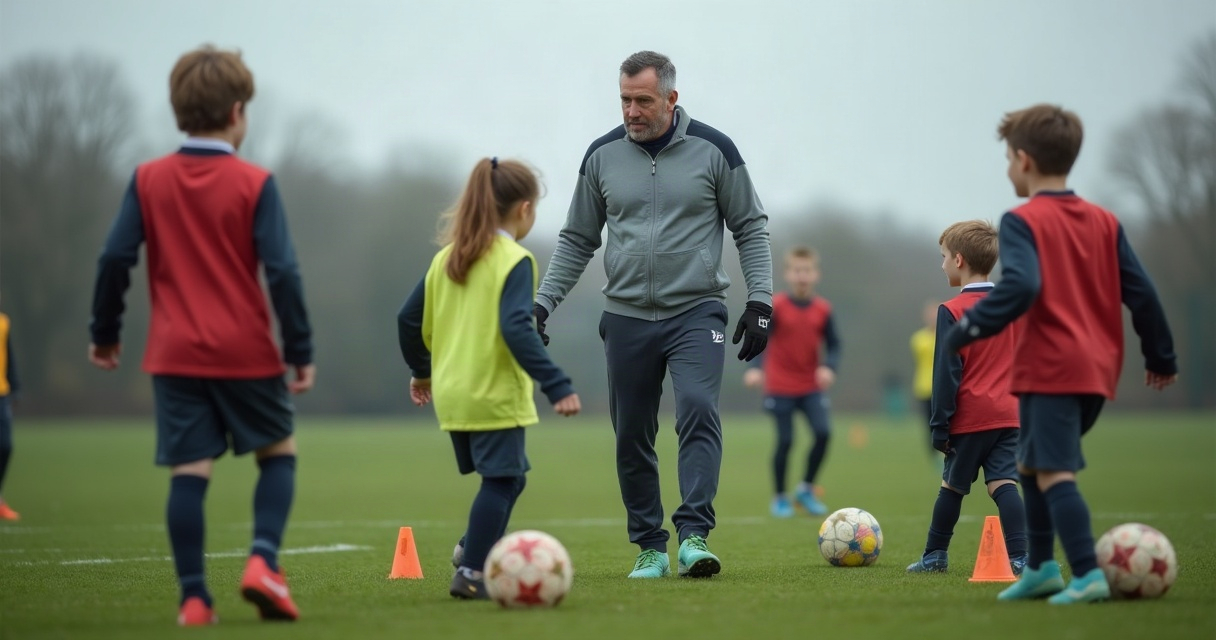
How simple ladder and cone activities build the footwork, confidence and spatial awareness young footballers actually need in a game.
Teaching footwork to five and six-year-olds is one of the most rewarding things a grassroots coach can do—and one of the easiest to get wrong. The temptation is to treat it like a drill, line children up, and wait for neat technique to appear. It never does, and the waiting kills the session. The better approach is to treat footwork as joyful movement first, and skill second. When children are bouncing, hopping and weaving because it feels brilliant rather than because they were told to, the learning sticks.
The Speedy Feet: Ladders, Cones and Quick Moves practice is built on exactly that idea. This article explains the thinking behind it—so you can run the session with more confidence, spot what is actually happening, and adapt on the day without losing the thread.
Why Footwork Comes Before Tactics at This Age
At U6, children are still working out how their bodies move through space. Their balance is inconsistent, their feet often feel like strangers to them, and a crowded patch of grass is genuinely tricky to navigate. Before any tactical idea can land—find space, pass and move, stay on your feet—a child needs a basic physical vocabulary: quick steps, side steps, stopping cleanly, turning without toppling.
Ladders and cones give children lots of repetitions of exactly those movements in a low-stakes setting. There is no opponent, no pressure, no goal at risk. A child can trip over the ladder, laugh, and try again. That cycle of attempt, stumble and retry is how coordination actually develops. The equipment is just a frame for movement—what matters is that the child moves often, moves freely, and starts to notice that their feet are doing something useful.
Spaces in a football game appear and disappear in seconds. A child who has spent twelve minutes hopping and weaving has trained their feet to react a little faster when that gap opens up. They may not know they are doing it. That is fine. The body remembers.
How to Keep Everyone Moving and Nobody Waiting
The biggest enemy of a good footwork session is the queue. If children stand waiting for a turn, two things happen: they lose body temperature, and they lose interest. By the time they reach the front, they are cold, distracted, and possibly bothering the child next to them.
The fix is straightforward: run parallel stations. Two agility ladders side by side halve the wait immediately. While half the group works the ladder, the other half weaves cones. Rotate on a simple signal—a clap, a whistle, a cheerful shout. Aim for no child standing still for more than about thirty seconds.
Pairs work particularly well at this age. A partner gives a child someone to glance at, copy, and giggle with. It takes the spotlight off any one child, which matters enormously for those who are shy or less confident. A child who will not attempt a hop alone will often try it if their friend goes first and makes it look ordinary.
Short turns are better than long ones. Twenty to thirty seconds of effort followed by a brief rest or a changeover keeps the energy level steady and stops children peaking too early and flagging before the small-sided game at the end.
Reading What You See: Progress Without Perfection
At U6 it is very easy to watch footwork and only notice what is going wrong—the child who keeps stepping on the ladder, the one who rushes through without any real pattern, the one who stops and stares at the ground. Reframe what you are looking for.
Watch for effort: is a child trying? Watch for curiosity: are they experimenting with how fast or how carefully they can go? Watch for small improvements within the session itself—not compared to any external standard, just compared to their first attempt five minutes ago. A child who was walking cautiously through the ladder and is now attempting a gentle hop has made genuine progress, even if the hop looks nothing like a textbook agility drill.
When you give feedback, make it specific and honest rather than vague and cheerful. 'I saw you balance on one foot right there' is more useful than 'brilliant.' Specific feedback tells a child exactly what they did well, which means they can repeat it. Vague praise tells them you were watching but not much else.
Open questions are more powerful than instructions for this age group. 'Where did your feet feel quickest?' or 'Can you show me that wobbly bit again?' invites a child to think about their own body. That kind of self-noticing is a habit that lasts much longer than any single coaching cue.
For children who are struggling—tripping, getting frustrated, going very quiet—offer a simpler version without drawing attention to it. Step alongside them, slow everything down, and say something like 'Let us try just walking it first.' Walking the ladder with good rhythm is a real skill. It is not a lesser version; it is the foundation.
Connecting the Footwork to the Game
The small-sided game at the end of the session is not a reward for getting through the drills—it is the most important part of the coaching loop. This is where children discover, in real time, that their feet can do something useful. A child who weaved through cones ten minutes ago and now dodges around a teammate has made a connection. They may not name it, but they feel it, and that feeling is what brings them back next week.
You do not need to point the connection out explicitly. Most five and six-year-olds are not ready to process that kind of abstract reflection mid-game. Just make sure the game happens, that everyone touches the ball, and that the space is small enough for quick footwork to actually matter. Keep rules minimal—no offside, no lectures—and let the play breathe.
If children are standing still, a gentle nudge toward open space is enough: 'Can you find a spot where nobody else is?' If the ball is being monopolised, try 'Pass it and then move really fast.' Neither of these interrupts the game for long, and both push the footwork theme without turning it into a lesson.
Finish by naming something specific each child did. It does not need to be a grand speech—thirty seconds of sitting together and a genuine word per child is enough. Children remember being seen. That memory is what grassroots football is built on.
Browse more age-appropriate session ideas at /explore to keep your planning fresh across the season.
Written and reviewed by the PlayTactiq Coaching Team
Practical guidance for grassroots coaches, shaped around age-appropriate sessions, clear coaching language and real match-day problems.
Put it into a session
Ready-to-run U6 and U7 session plans
Setup, animated diagrams, coaching points and player-number adaptations — every U6 and U7 session in one place.
U6 and U7 football session plans →