
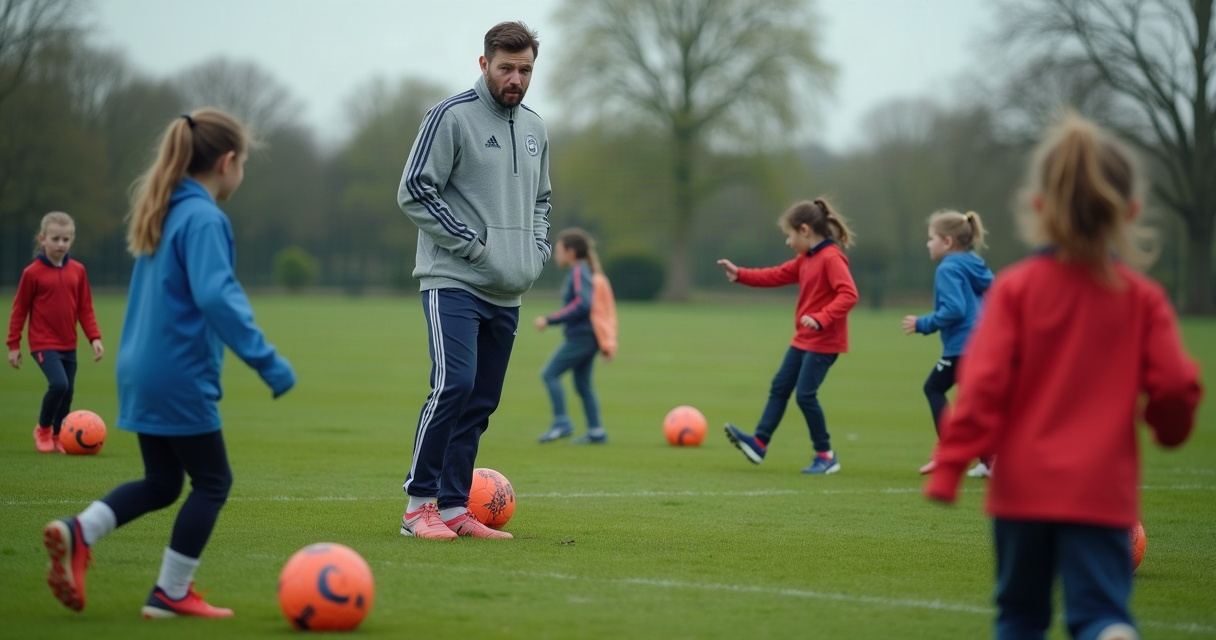
Help your U6 players think fast and touch the ball loads with this simple small-sided game built around quick decisions in tight spaces.
It happens at almost every U6 session. You set up a big pitch, kick off, and within thirty seconds six children are chasing the same ball in a tight cluster while two others are picking up cones near the far goal. The space is too big, the touches too rare, and the decisions never quite arrive. Shrink the space and everything changes. Suddenly every child is in the game, the ball keeps finding them, and those little moments of 'shall I pass or shall I go?' start happening all by themselves.
That is exactly what this session is built around: small spaces, loads of touches, and quick choices that feel like play rather than a lesson.
Session at a glance
- Age group: U6 (roughly 5–6 year olds)
- Ability level: Beginner
- Session length: 30–45 minutes including warm-up and cool-down
- Players: 6–8 (easily adapted for more)
- Space: 25 x 20 yards, divided into four equal zones
- Equipment: Cones or markers, bibs or bands, one football (a second ball optional for a progression), four small goals or pairs of cones set 4 yards apart
Why children enjoy this game
At this age, children want to touch the ball, be near their friends, and feel like something exciting could happen at any moment. Small-sided games in tight spaces deliver all three.
Because the area is compact, the ball arrives more often. A child does not have to wait long before they are involved again. That frequency matters enormously at U6. It keeps attention sharp, it builds confidence quickly, and it means a child who made a mistake two seconds ago gets another chance almost immediately.
The four-goal layout means there is no fixed end to attack. Children scan around naturally — not because you have told them to, but because a goal could appear in any direction. That gentle awareness is exactly what the weekly focus is about: noticing what is around you while you play. It happens without anyone needing to stop the game and explain it.
Children also feel safe in a small group. There are fewer people to worry about, more familiar faces nearby, and the pace stays manageable. That sense of belonging — of being a real part of something — is what makes them want to come back next week.
How to run the session
Set up the space. Mark out a 25 x 20-yard rectangle and divide it into four roughly equal zones using flat cones or coloured markers. Place one small goal (or two cones 4 yards apart) in each corner or zone entrance. Keep the markers low and soft where possible.
Organise the teams. Split children into two teams of three or four. Use bibs or wristbands in different colours so it is obvious who is who — at U6, children are still working this out.
Explain the aim simply. 'Score by getting the ball through any of the four goals. Any goal counts.' That is genuinely all they need. Demonstrate once with a child if it helps.
Start with a gentle kick-off or a roll-in. Keep restarts simple. If the ball goes out, the nearest child rolls or passes it back in. No lengthy set pieces.
Rotate every three or four minutes so everyone gets a rest and a chance to start fresh. Keep rotations brief and cheerful — 'great work, swap over' — so momentum does not drop.
Coaching cues to use during play:
- 'Find a space!'
- 'Who can you give it to?'
- 'Can you turn?'
- 'Look before you get it!'
Keep cues short and say them in a warm, encouraging tone rather than an urgent one. You want children thinking, not anxious.
Keep every child involved
If a child seems overwhelmed or hangs back, invite them to stand near one goal as a 'goal helper' who celebrates when their team scores. Give them a big thumbs up when they do. After a minute or two, gently bring them back into the flow. Never make it feel like a consequence — it is just a comfortable way in.
For a child who is more confident and ready for more, quietly ask them: 'Can you try to look up before you pass?' That is a personal challenge without drawing attention away from others.
Play without offsides. Let the game breathe. Every stoppage costs a touch and some enthusiasm, so only step in when you really need to.
What to notice and say
Watch for the moments when a child pauses, glances around, and then makes a choice — even if the choice does not work out. That pause is the thinking happening. It is worth more than any perfect pass.
When to hold back: If the game is flowing and children are engaged, do not stop it. A noisy, slightly chaotic cluster near a goal is not a problem — it is U6 football being U6 football.
When to step in: If one child is consistently being left out, or if the energy is dropping because the game has become confusing, pause briefly, reset, and restart with a smile.
Questions worth asking your players (keep them light and curious, not testing):
- 'Which goal did you score through? Was there another one you could have gone for?'
- 'What did you see when you had the ball?'
These questions invite children to notice their own decisions without feeling judged. You might get a shrug, a big grin, or a surprisingly thoughtful answer. All of those are good.
Easy ways to adapt it
Fewer players or a smaller space: Reduce to two goals and a 15 x 12-yard area. The choices stay quick, the touches stay frequent.
More players: Add a third team who rotate in after each scoring period. Keep waiting time to under two minutes.
Less confident group: Allow a gentle stop-and-place to count as a goal. Lower the bar so early success comes quickly.
Ready for a challenge: Introduce a second ball. The resulting joyful chaos forces children to look up constantly — and they usually find it hilarious.
Limited equipment: Use jumpers as goal posts. Mark zones with chalk lines if you have a hard surface. The game works with almost nothing.
Common coach questions
'What if they all just chase the ball?' That is completely normal at U6 and not something to fix through constant instruction. Let it happen. Over time, with more turns and more experience, children naturally start to spread. Your job right now is to keep the fun high and the pressure low.
'Should I keep score?' You can, but you do not have to. If keeping score adds excitement, go with it. If it starts to cause upset, quietly let it go and focus on celebrating the touches and the tries instead.
'How do I help a child who is scared of the ball?' Give them a lighter or slightly deflated ball to start with if you have one, and pair them near a patient, kind teammate. Let them take their time. Celebrate any contact they make, however small.
This session works because it puts children at the centre — loads of touches, real decisions, and a game that feels like theirs. When they leave the pitch chattering about the goal they scored through the corner goal, you will know it landed. Take a look at the full session plan when you are ready to run it, or browse more sessions for ideas to build on it next week.
Written and reviewed by the PlayTactiq Coaching Team
Practical guidance for grassroots coaches, shaped around age-appropriate sessions, clear coaching language and real match-day problems.
Put it into a session
Ready-to-run U6 and U7 session plans
Setup, animated diagrams, coaching points and player-number adaptations — every U6 and U7 session in one place.
U6 and U7 football session plans →