
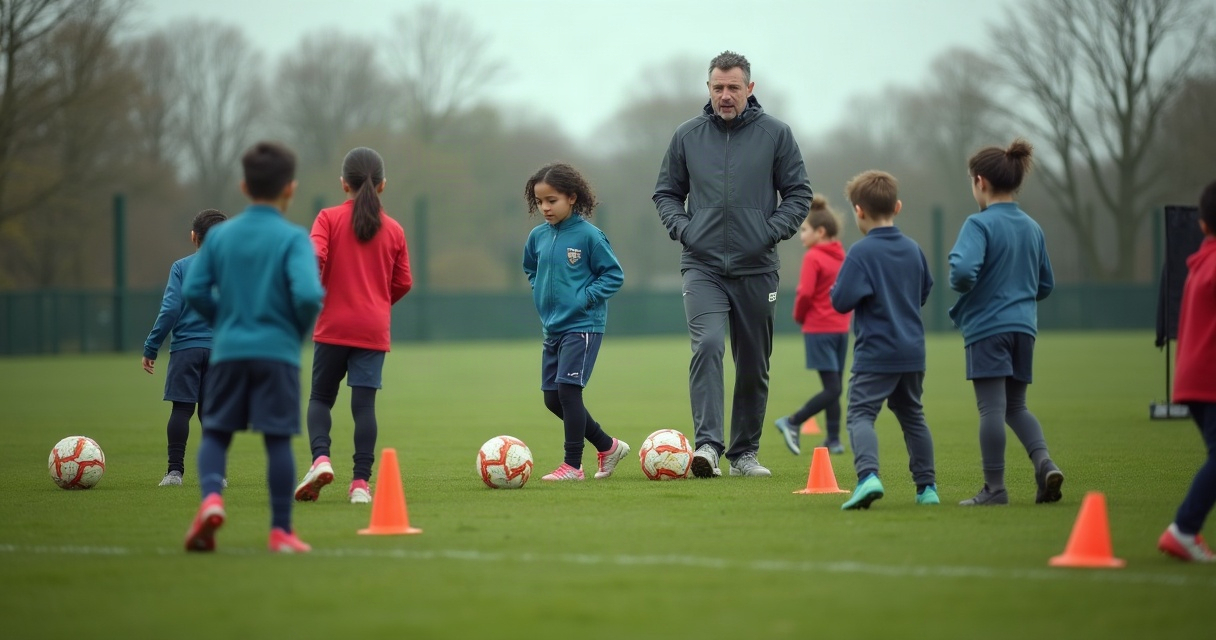
How to help young footballers fall in love with shooting through choice, confidence and lots of turns.
Shooting is the moment children feel the game reward them. A ball that goes where a child meant it to go — even if it only grazes the post — produces a look that no amount of classroom coaching can replicate. For U8s especially, that feeling is the whole point.
Before we talk about laces and follow-through, it helps to understand why shooting can feel difficult for young players. Many children at this age default to toe-poking because it feels powerful and safe. Asking them to change that habit means asking them to try something that might not work first time. That takes courage. Our job is to make the space safe enough that they are willing to be brave.
The Shooting Stars: Power and Placement practice is built around exactly that idea: lots of attempts, genuine choice, and no public pressure. This article adds the why behind those decisions, so you can carry the same spirit into any shooting session you design.
Why Technique Before Competition Matters
It can be tempting to jump straight into a shooting competition — first to five goals wins — because children love a game. But for beginners, a competitive frame too early creates one winner and several children who feel they have failed. That narrows risk-taking fast.
Instead, introduce shooting as a skill to explore rather than a performance to judge. When children are experimenting rather than competing, they try again naturally. They adjust. They notice what works. That cycle — attempt, notice, adjust, retry — is how technique actually develops, not from a coach correcting every contact.
The two concepts worth introducing at U8 are simple enough to hold in a child's mind during play:
- Laces contact: striking the ball with the broad, flat top of the boot rather than the toe gives more consistent direction and a cleaner feel underfoot. You do not need to name the bones or explain physics. 'Show me the laces on your boot, then try to hit the ball with that part' is enough.
- Follow-through: pointing the shooting foot toward the target after contact helps the body naturally orient toward where the child wants the ball to go. Again, language like 'point your foot at the goal after you kick' is concrete and memorable.
Neither of these needs to be perfect. A slightly better contact or a slightly more directed follow-through is genuine progress at this age.
Creating Conditions for Confidence
Inclusion is not an afterthought in a shooting session — it is the structure. If children spend long minutes waiting in a queue before their single attempt, the session belongs to the coach's plan, not to the children's learning.
Here is what works in practice:
Multiple stations, small groups. Three or four shooting zones around the space mean most children are active most of the time. Groups of three or four prevent long waits and let quieter children find their feet without an audience.
Choice of challenge. Offering a 'power' zone and a 'placement' zone lets children decide how to challenge themselves. This is not just variety — it is agency. When a child chooses harder or easier, they take ownership of their own learning. That ownership is what you want to nurture.
Closer targets for those who need them. Moving a child two metres nearer the goal is not lowering standards; it is finding the right starting point. Confidence earned from close range transfers outward over time. Embarrassment from repeated misses from too far away tends not to.
Quieter corners for shy children. Some children shoot freely when they think no one is watching. A simple arrangement — two children taking turns away from the main group — can unlock a child who looks disengaged in a bigger station.
The test of a well-structured shooting session is simple: look around the space after five minutes and count how many children are active. If most of them are, the structure is working.
What to Watch and When to Speak
Good observation during a shooting session is less about spotting errors and more about noticing what each child is ready to hear.
Look for small positives first: a child who glanced at the target before striking, one who tried to adjust their foot position between attempts, another who cheered a teammate's shot. Name these things specifically. 'I noticed you looked at the gap before you kicked — that's exactly the idea' lands better than a general 'well done' and teaches the child what to repeat.
When a child is clearly frustrated, resist the urge to offer a full explanation. A short question works better: 'What do you want the ball to do this time — go fast or go to a spot?' That returns decision-making to the child and gives the next attempt a purpose.
When a group has gone quiet or stopped trying, join them. Take a few shots yourself, chat about nothing important, and let them warm up in their own time. Belonging comes before technique. A child who feels comfortable in the group will attempt things a child on the edge of the group will not.
Avoid stopping the whole session to demonstrate to everyone. Quiet, individual conversations at the side of a station preserve momentum and protect children from public correction.
Carrying This Into Games
Shot attempts in small-sided games at U8 often look chaotic — wild swings, toe-pokes from the wrong angle, shots when a pass would be easier. That is fine. It means children are trying.
What you can do is give permission. 'If you can see the goal and you've got a bit of space, have a go' is a simple prompt that sticks. You are not telling children when to shoot; you are telling them that shooting is allowed, even encouraged, even when it misses.
After a game, the most useful conversation is a gentle one: 'When did you feel like having a shot today?' or 'Was there a moment when you thought about it but didn't go for it?' Children often know more about their own hesitation than we expect. Listening to that tells you more about what to work on next session than watching the ball.
A missed shot is a brave act. At U8, that is the message worth repeating most often.
If you are planning a session around these ideas, the Shooting Stars: Power and Placement practice gives you a ready-made structure with warm-up, stations, progressions and inclusive adaptations already built in. Or explore more practices by age and theme to find what fits your group today.
Written and reviewed by the PlayTactiq Coaching Team
Practical guidance for grassroots coaches, shaped around age-appropriate sessions, clear coaching language and real match-day problems.
Put it into a session
Ready-to-run U8 session plans
Setup, animated diagrams, coaching points and player-number adaptations — every U8 session in one place.
U8 football session plans →