
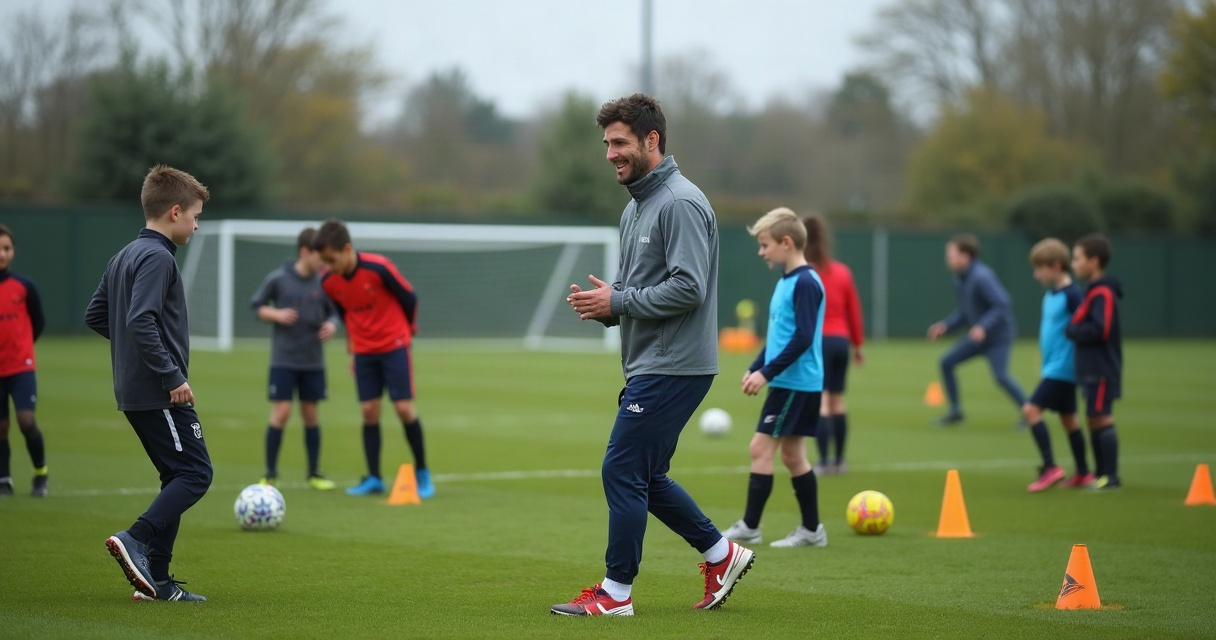
Help your U11s feel connected and confident by practising shape in 9v9 with a simple three-zone game they'll genuinely enjoy.
You know that moment when the ball gets played out from the back and half your team sprints towards it at once, leaving a huge empty space behind? Every grassroots coach has seen it. It's not a discipline problem — it's just that children haven't yet felt what it's like when three lines move together. Once they do, something clicks. The game feels easier, teammates feel closer, and the whole thing becomes more fun. That's exactly what this session is for.
Session at a glance
- Age group: U11 (suits mixed ability)
- Session length: 60–75 minutes
- Players: 6–16 (works across that range with simple tweaks)
- Space: 50 x 40 yards, divided into three zones of roughly 15 yards each
- Equipment: Cones or bibs to mark the three zones, one ball per game, spare balls nearby to keep the flow going
Why children enjoy this game
At this age, children love having a role. When a player knows they're 'the midfielder' or 'at the back today', they stop feeling lost. They have a place on the pitch and teammates around them. That sense of belonging makes a huge difference — especially for quieter or less confident children who sometimes drift to the edges of a game.
The three-zone structure keeps everyone involved. Nobody's standing on the halfway line watching the ball bounce around somewhere else. Every player has a job, every zone has people in it, and when the ball moves between lines, children feel that connection. It's satisfying in a way that's hard to explain but easy to notice — kids start calling for the ball rather than hiding from it.
There's also something genuinely enjoyable about defending when you're not alone. When your line is organised and your teammates are nearby, defending stops feeling scary and starts feeling like a game within a game.
How to run the session
Set up Mark out your 50 x 40 yard area and divide it into three equal zones with cones or coloured bibs on the ground. Label them simply — back zone, middle zone, front zone. Split into two teams. Each team puts two or three players in each zone.
The game The game is continuous. A point is scored when a team completes a pass in the attacking zone after the ball has moved through all three zones — back to middle to front. This creates a natural rhythm: the back players pass it out, the middle players connect play, the front players receive and finish or hold up.
Phase one — no pressure Start with no defenders pressing. Let the ball travel freely so children can see the shape working. Give them thirty seconds to just pass it through all three lines. Ask them to freeze and look: 'Where are your teammates? Can you see all three zones covered?' This short pause is worth its weight in gold.
Phase two — light pressure Introduce one defender who can press only within their own zone. This keeps things manageable and stops the game collapsing into chaos. Children still have time to think, but now there's a reason to move quickly.
Progression 1: Allow one defender to step into the middle zone. Attackers now have to make a decision — do they wait or change the angle?
Progression 2: Add a neutral 'free player' who can receive in any zone. This gives less confident children a simple passing option and keeps the ball moving.
Progression 3: Play a realistic 9v9 with the zones marked lightly. Teams must still move the ball through all three areas to score. The zones become a guide rather than a rule — and that's where shape starts to feel natural rather than forced.
Keep spare balls outside the area so you're not stopping to retrieve them every two minutes. Restarts should be quick.
Keep every child involved
Rotate players between zones every two or three minutes. Everybody attacks, everybody defends, everybody links play. This matters a lot for inclusion — no child should be stuck at the back for the whole session feeling like they've been parked there.
If you have a quieter child, start them in the middle zone. They'll get more touches, more support from both sides, and more chances to feel useful. A confident child who enjoys being on the ball can start up front with a clear finishing role.
If numbers are uneven, use a floating neutral player or simply adjust zone sizes. The structure is the point — the exact numbers are flexible.
What to notice and say
Watch for the moments when the three lines move together as the ball travels. You don't need to stop the game to celebrate that — a simple 'Yes, that's it!' while play continues is enough. Children feel seen without the game being interrupted.
When to hold back: If the ball is moving nicely through the lines and children are making good decisions, stay quiet. Let them feel it. Resist the urge to coach every touch.
When to step in: If a whole line disappears into one zone and the shape completely collapses, pause briefly, reset, and ask — 'Where do you think you should be when the ball is here?'
Two questions worth asking:
- 'When the ball's at the back, where do you want to be in the middle zone to help them?'
- 'What made that pass easy to receive?'
Let them answer. The best insights in a grassroots session often come from the children themselves.
Easy ways to adapt it
- Small group (6–8): Use two players per zone. Keep the zones slightly narrower so passing distances stay manageable.
- Large group (14–16): Run two separate games side by side. More touches, less waiting.
- Limited equipment: Bibs or jumpers on the ground work perfectly as zone markers. You don't need anything expensive.
- Mixed confidence: Adjust the pressing rule — less confident groups keep phase one for longer before adding pressure.
- Wet or windy day: Reduce the space slightly so passes stay accurate and children don't feel frustrated.
Common coach questions
'What if children keep leaving their zone?' That's completely normal early on. Don't punish it — just gently remind them with a cue like 'Back to your zone first, then you can help.' After a few rotations, most children naturally stay because they realise it actually works better.
'How do I explain shape without making it sound boring?' Try this: 'Imagine you're three groups of friends holding a long rope. If one group runs off, the rope breaks. Stay connected and it stays strong.' Children at this age respond really well to that kind of image.
'What if the game just turns into a scrum anyway?' Reset to phase one — no pressure — for a minute or two. Sometimes children just need a reminder of what the shape feels like when it's working. Don't see it as failure; see it as useful information about where to spend more time.
When children leave a session feeling like they understood the game a little better — and that their teammates knew where they were — they come back the following week ready to learn more. That's really what this is all about. If you'd like the full session plan, you can find it at Three Lines Moving Together in 9v9, and if you're looking for more ideas like this, browse all sessions on Playtactiq.
Written and reviewed by the PlayTactiq Coaching Team
Practical guidance for grassroots coaches, shaped around age-appropriate sessions, clear coaching language and real match-day problems.
Put it into a session
Ready-to-run U11 session plans
Setup, animated diagrams, coaching points and player-number adaptations — every U11 session in one place.
U11 football session plans →