
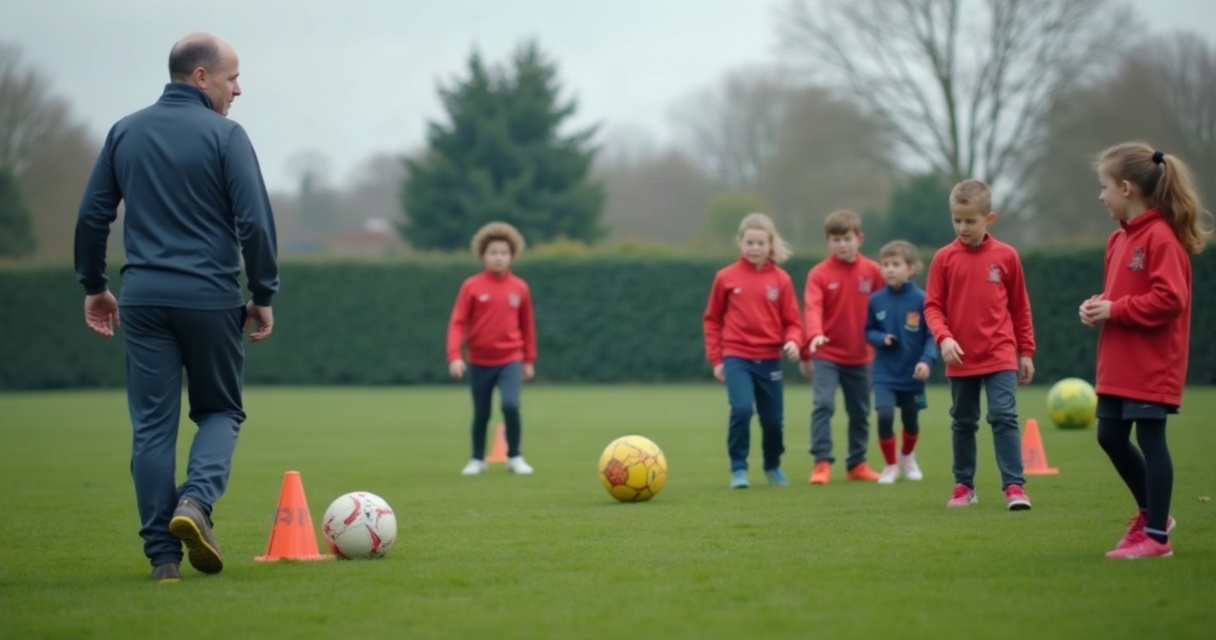
Simple ideas to help young footballers carry the ball forward, find room to move, and love every moment of it.
Teaching eight-year-olds to run with the ball is one of the most rewarding things a grassroots coach can do. The moment a child realises they can carry the ball across a big patch of grass, head up, at pace, and still keep control — their face changes completely. That feeling of speed and freedom is what keeps young players coming back week after week.
This article sits alongside the Running into Space: Finding Room to Move session and explores the thinking behind it, so you can use these ideas flexibly across different sessions and groups.
Why Space Is the Real Lesson
At U8, children are naturally drawn to the ball. They cluster around it, they chase it in packs, and they rarely drift away from the action. This is completely normal — the ball is exciting and they want to be near it. Your job is not to correct this instinct but to gently introduce a new and equally exciting idea: that the empty grass is where the magic happens.
Running into space is a concept that underpins almost everything in football. A child who understands it at eight will have a head start in every game they play for years to come. But at this age, the understanding needs to come through feeling, not instruction. When a child runs into an open area and the ball arrives, or when they carry it freely without being crowded, they experience the benefit directly. That experience teaches more than any explanation.
So rather than telling children where to go, design situations where running into space is the obvious and rewarding choice. Open fields, few defenders, gates to run through, simple targets to reach — these all make space feel like an opportunity rather than a concept.
Keeping Every Child Busy and Involved
One of the most common problems in junior football sessions is waiting. Children standing in a queue for their turn, watching others play, quietly losing interest. At U8, this is especially damaging because attention spans are short and enthusiasm can disappear in minutes.
The answer is straightforward: every child should have a ball or an active role at all times. If you have twelve children, run two smaller spaces rather than one large one. If a child is not carrying the ball, give them a cheering role, a spotting role, or a counting role — something that keeps them engaged and part of the session.
Small groups are better than large ones for this age group. A 4v4 or 5v5 game gives far more touches, decisions, and moments of success than an 8v8. More touches means more chances to run with the ball, which means more of those brilliant moments where everything clicks.
Inclusion also means thinking about different confidence levels. Some children will charge into space immediately. Others will hold back, unsure whether it is safe to try. Let hesitant children take a supporting role first — cheering, spotting, or being a walking defender — and gradually invite them into the action. Running alongside a child for a few moments, sharing the experience with them, can be all it takes to help them join in fully.
What to Look For and How to Respond
Coaching U8s well is largely about watching and choosing your moments carefully. You do not need to stop the session every time something goes wrong. In fact, stopping too often disrupts the flow and can make children feel self-conscious. Let the game breathe.
Instead, look for positive moments to highlight. A child who runs ten metres with the ball and keeps control deserves a quiet smile and a genuine word afterwards: 'I saw that run — you were flying and you didn't lose it once.' A child who glances up for even a moment deserves to hear that you noticed: 'You looked up — that's a clever habit.' These small acknowledgements land more powerfully than long explanations.
When something is not working — children are crowding, or nobody is using the wide areas — wait until a natural pause, then ask a curious question rather than giving an answer. 'What did you notice when everyone went the same way?' or 'Was there any space over on that side?' This encourages children to think for themselves and builds understanding that lasts.
Poor touches and lost balls are part of learning. Unless a child is unsafe or becoming frustrated, let play continue through these moments. The next attempt is the important one.
Making It Playful From Start to Finish
Young children learn through play. This sounds simple, but it has real implications for how you set up and run a session. Every activity should feel like a game with a purpose, not a drill with rules. When children are chasing a target, running through a gate, or competing in a light-hearted way, they are practising the exact same movements and decisions — but they are doing it with energy and joy.
Variety helps too. Running through cone gates in pairs feels different from carrying the ball into a target zone, which feels different again from a 4v4 game. Each version asks children to use their running and their awareness in a slightly different way, and each one feels fresh. Changing the activity every few minutes keeps energy high and means every child gets multiple chances to experience success.
End on a high. Whatever you do in the last five minutes, make sure children leave smiling. A simple competitive game, a favourite activity, or even just a moment of celebration — 'Who ran the furthest today? Everyone? Brilliant.' — sends them home wanting to come back.
The principles here apply across almost every theme at this age group. You can explore more sessions for young footballers to find activities that build on the same ideas in different contexts.
Ultimately, helping U8s run into space is about giving them the experience of what football can feel like at its best: fast, free, and full of good decisions. When they carry the ball into an open area, look up, and feel the game open up in front of them, they are not just learning a skill. They are falling in love with the game.
Written and reviewed by the PlayTactiq Coaching Team
Practical guidance for grassroots coaches, shaped around age-appropriate sessions, clear coaching language and real match-day problems.
Put it into a session
Ready-to-run U8 session plans
Setup, animated diagrams, coaching points and player-number adaptations — every U8 session in one place.
U8 football session plans →