
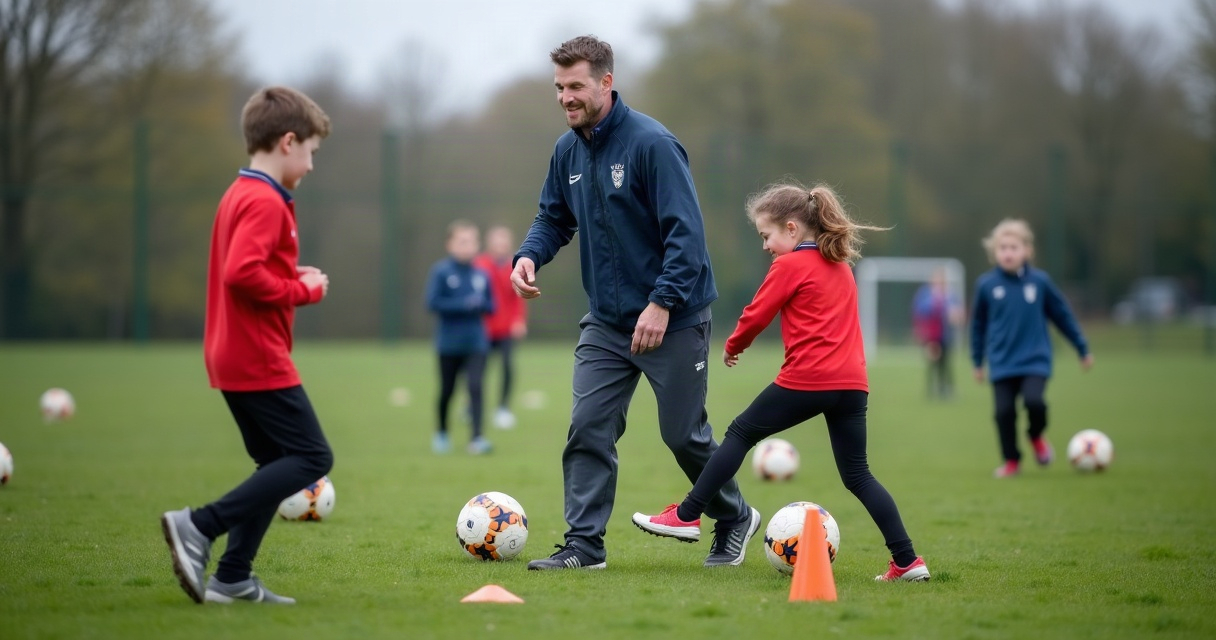
Help your U6 players fall in love with the ball through simple, joyful dribbling games that build confidence and keep everyone moving.
Picture this: it is a Tuesday evening, the cones are barely straight, half your group are still wearing their coats, and one child is already sitting on their football like a throne. That is grassroots football at under-sixes, and it is brilliant. The job tonight is not to produce technically polished dribblers. It is to help every child feel the ball at their feet, smile a lot, and walk away thinking, 'I want to do that again.' This session on U6 dribbling and 1v1 attacking does exactly that.
Session at a glance
- Age group: U6 (roughly 4–6 years old)
- Ability level: Beginner
- Total time: Around 55 minutes
- Players: 8–12 works best
- Space: One square roughly 20 m × 20 m, divided into four smaller 10 m × 10 m zones
- Equipment: One ball per child, cones to mark the zones, a few spare balls at the side in case one rolls away
Why children enjoy this game
At this age, the ball is a new and slightly mysterious friend. Children are genuinely discovering what their feet can do, and that discovery is exciting on its own. Games that give them lots of touches, clear choices, and the freedom to move without much instruction tap into exactly the kind of play they already love in the garden or the park.
The dribbling and 1v1 theme works so well at U6 because it is honest. There is no complicated structure to follow. A child either has the ball or they are trying to get it, and either way something is happening. When a child manages to wriggle away from a friend, even for a moment, the look on their face is the whole point. That small triumph — 'I did it with my feet' — is the seed of real confidence.
The 1v1 moments matter too. They are the first time many children face a challenge on their own in sport. Learning to try something brave, to wobble, and to try again without anyone rescuing them is genuinely valuable. Keep the pressure light and the time short so it feels like play rather than a test.
How to run the session
Follow the Ball — 10 minutes
Everyone has a ball. Children dribble freely around the big square while you call out simple, silly instructions: 'hop,' 'spin around,' 'walk backwards really slowly,' 'touch the ball with your heel.' This is warm-up and icebreaker in one. It settles any nerves, gives shy children something to focus on rather than the group, and immediately puts the ball at the centre of things. Keep your voice playful. If you do it with them for the first minute, most children will copy straight away.
Sharks and Minnows — 15 minutes
Choose one or two children to be 'sharks' — they have no ball. Everyone else is a 'minnow' with a ball, dribbling inside the big square. Sharks move around and try to give minnows a gentle tap on the shoulder. Tagged minnows swap roles and become sharks. The minnows' only job is to keep their ball and move away. There is no goal to score, no winner declared. The game just flows. This is where children naturally start experimenting — a quick turn here, a little swerve there — without you needing to teach anything.
King of the Ring — 20 minutes
Split into pairs and send each pair into one of the small squares. One child is the attacker with the ball, one is the defender. The attacker tries to dribble past or around the defender and reach the far edge of the square. The defender simply tries to stay between the attacker and that edge — no aggressive tackling, just positioning and presence. After 30 seconds, they swap. Keep things moving by rotating pairs between squares every few rounds so children meet different partners. The attacker wins by getting past; the defender wins by staying in the way. Both feel like real achievements.
Pass and Follow — 10 minutes
Bring everyone back together for free dribbling to wind down. No instructions, no sharks. Just feet and ball, moving at their own pace. Let it drift naturally towards the end of the session.
Keep every child involved
Minimise waiting at all costs. Running multiple small squares at once means no one stands in a line watching. If you have an odd number, jump in yourself as a gentle, deliberately slow defender — children love trying to get past a grown-up.
For a shy or less confident child, start them as a minnow with the ball in Sharks and Minnows rather than as a shark. Or take a moment to pair up with them yourself in King of the Ring for a round. Just being alongside you for 30 seconds can unlock something.
For a child who is clearly comfortable and wants more, invite them to use their weaker foot only, or to try using both feet in turns. You are not setting rules — you are offering a little personal adventure.
What to notice and say
Do not stop the game every time something goes wrong. If a child loses the ball, the game gives them the answer — they become a shark, or they try again in the next round. Let the activity do the teaching.
Watch for children who are keeping the ball close naturally, or who make a sudden change of direction. Name those moments warmly: 'Oh, I liked that little twist — what were you thinking?' You are not praising technique; you are noticing the child.
Two questions worth asking during a pause:
- 'What did you try when your friend got close to you?'
- 'Did anything feel different when you used a different part of your foot?'
Simple coaching cues to use in the moment: 'Keep it close,' 'Look where you want to go,' 'Try going the other way.'
Easy ways to adapt it
- Fewer than 8 children: Make the zones smaller so the games stay busy and compact.
- More than 12 children: Add a third or fourth square and run more simultaneous pairs in King of the Ring.
- Limited cones: Use jumpers or water bottles to mark corners — the shape matters, not the equipment.
- Nervous group: Skip King of the Ring the first week and repeat Sharks and Minnows twice. Introduce 1v1 when they are clearly comfortable.
- Very mixed confidence: Let children choose whether to be attacker or defender first in King of the Ring. Giving them that small choice makes a real difference.
Common coach questions
What if a child does not want to be the shark? Let them stay as a minnow for a while. Some children need longer to feel safe enough to be the one doing the chasing. There is no rush, and the game works fine with three sharks instead of two.
What if they all just kick the ball away instead of dribbling? That is completely normal at U6. Narrow the zone slightly so big kicks bring the ball back quickly, and use the cue 'little touches' rather than correcting the kick itself.
Should I explain the rules thoroughly before we start? Keep explanations to one or two sentences and then start. Children this age learn by doing. Adjust on the go rather than front-loading information they cannot yet hold.
Every child who leaves this session having laughed, chased, and tried something with their feet has had a good evening — and that is your measure of success tonight. When you are ready to run it, the full Wiggly Feet session plan is right here, and you can browse more sessions for every age and theme at Playtactiq.
Written and reviewed by the PlayTactiq Coaching Team
Practical guidance for grassroots coaches, shaped around age-appropriate sessions, clear coaching language and real match-day problems.
Put it into a session
Ready-to-run U6 and U7 session plans
Setup, animated diagrams, coaching points and player-number adaptations — every U6 and U7 session in one place.
U6 and U7 football session plans →