
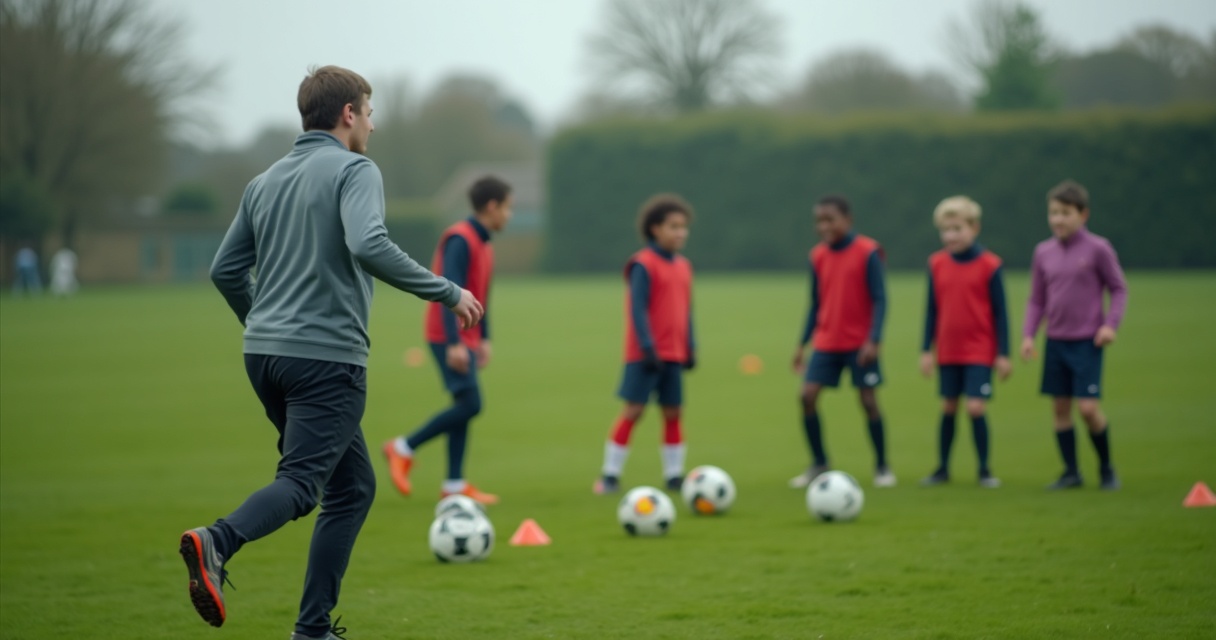
Master counter-attacking at U14 with this tactical drill. Teach players to exploit space fast, read transitions, and score from turnovers with intelligent
Counter-attacking is one of modern football's most devastating tactical weapons. At U14, your players are developing the cognitive ability to recognize possession transitions in real time and the physical capacity to execute at genuine pace. This session equips intermediate players with the skills to turn defence into attack, exploiting the opposition when they're numerically weak and stretched across the pitch.
Why Counter-Attacking Matters at U14
At this age group, players are at a critical developmental stage. They're moving beyond simple "run fast" football into tactical understanding. Counter-attacking teaches them that football operates in phases—transition moments are where matches are won and lost.
When your team wins the ball, opposition defenders are often committed forward chasing attacks. This creates space behind their defensive line. The counter-attack exploits exactly this vulnerability. Success demands three interconnected elements: quick ball recovery with situational awareness, rapid cognitive and physical transition from defensive to attacking mode, and intelligent positioning into dangerous spaces.
Young players frequently struggle with decision-making under pressure. They want to sprint everywhere or play the ball immediately. This drill trains them to read the game first, then move. Understanding positioning, timing runs, and knowing when to release versus carry the ball separates good counter-attackers from great ones.
Beyond attacking prowess, counter-attacking builds defensive discipline. When players understand their pressing might lose the ball and trigger a counter, they maintain shape more intelligently. This creates the foundation for explosive transitions—a tactical cycle that develops thinking players.
The Drill: Setting Up for Success
Space Requirements:
- 50 yards length × 40 yards width
- Clearly marked halfway line
- End zones at each end (attacking areas)
- Minimum 12 players (6v6 plus one neutral)
How the Drill Runs:
One team starts in possession while the defending team (plus a neutral support player) works to win the ball through pressing and intelligent interception. The moment possession changes, the new defending team becomes the attacking team and must immediately transition to exploit space.
The key mechanic: the neutral player always supports whoever has possession. This ensures the attacking team maintains numerical superiority for combinations.
Teams score by moving the ball into the attacking end zone—either via a pass or dribble. Award 1 point for entering the zone and 3 points for scoring. This incentivizes both penetration and finishing.
Coaching Cues That Develop Tactical Awareness
Your language shapes player understanding. Use these cues consistently:
'Transition' — Call this the moment possession changes. It heightens collective awareness and signals the shift from one phase to another.
First touch and head position — Immediately after winning the ball, players must scan for space. Their first touch should move them forward and open their vision. A heavy touch sideways loses the transition advantage.
Speed of thought before speed of movement — This is the golden principle. Intelligent positioning beats pace every time. Runners must identify space before sprinting into it, not after.
Attacking players sprint into space, not toward the ball — This shifts defensive focus and creates separation. Teach runners to sprint into identified gaps while the ball-carrier decides whether to pass.
Progressions: Building Complexity
Progression 1: Introduce Offside Add a flexible offside rule where attacking players cannot be deeper than the second-last opponent when the ball is played forward. This forces timing of runs and prevents defenders from simply camping in attacking zones. Players must coordinate movement—a fundamental counter-attacking skill.
Progression 2: Time Pressure Introduce a 5-second rule for transition. If the attacking team hasn't entered the end zone within 5 seconds of winning possession, the ball reverts. This creates urgency and forces quick decision-making under realistic match conditions. It prevents players from over-thinking.
Progression 3: Target Player Complexity Designate one attacking player as a 'target striker' who must receive the ball in the attacking zone to score. This adds combination play requirements and teaches players that counter-attacks often need multiple passes through specific positions, not just direct runs.
Coaching Points to Emphasize
Watch your defensive shape during possession loss. Use this drill to diagnose where your defensive structure breaks. If counters always come through one flank, your shape isn't balanced.
Celebrate smart decisions, not just goals. Praise the player who recognizes an overloaded lane and plays backwards to reset, rather than forcing a poor pass. Build a culture where tactical intelligence gets rewarded.
Use video or freeze-frame moments to show players exactly when space appears and disappears. U14 players respond well to visual feedback—show them the gap they missed.
Vary starting positions. Sometimes begin defending team with players in advanced positions; sometimes deep. This teaches pattern recognition—counters look different depending on where opposition commits players.
Developing Match-Ready Players
This session prepares U14 players for higher competitive levels where transitions determine outcomes. They'll learn that football is rhythmic—periods of build-up, moments of defensive shape, then explosive transitions. Understanding this rhythm and exploiting it is what separates recreational football from competitive football.
Counter-attacking also builds confidence. When young players experience the buzz of turning defence into attack and scoring, they develop belief in their tactical capabilities. This confidence transfers across all phases of play.
By emphasizing reading the game over pure pace, you're developing thinking players who'll continue improving beyond U14. That's the real measure of effective coaching.
Written and reviewed by the PlayTactiq Coaching Team
Practical guidance for grassroots coaches, shaped around age-appropriate sessions, clear coaching language and real match-day problems.
Put it into a session
Ready-to-run U13 and U14 session plans
Setup, animated diagrams, coaching points and player-number adaptations — every U13 and U14 session in one place.
U13 and U14 football session plans →