
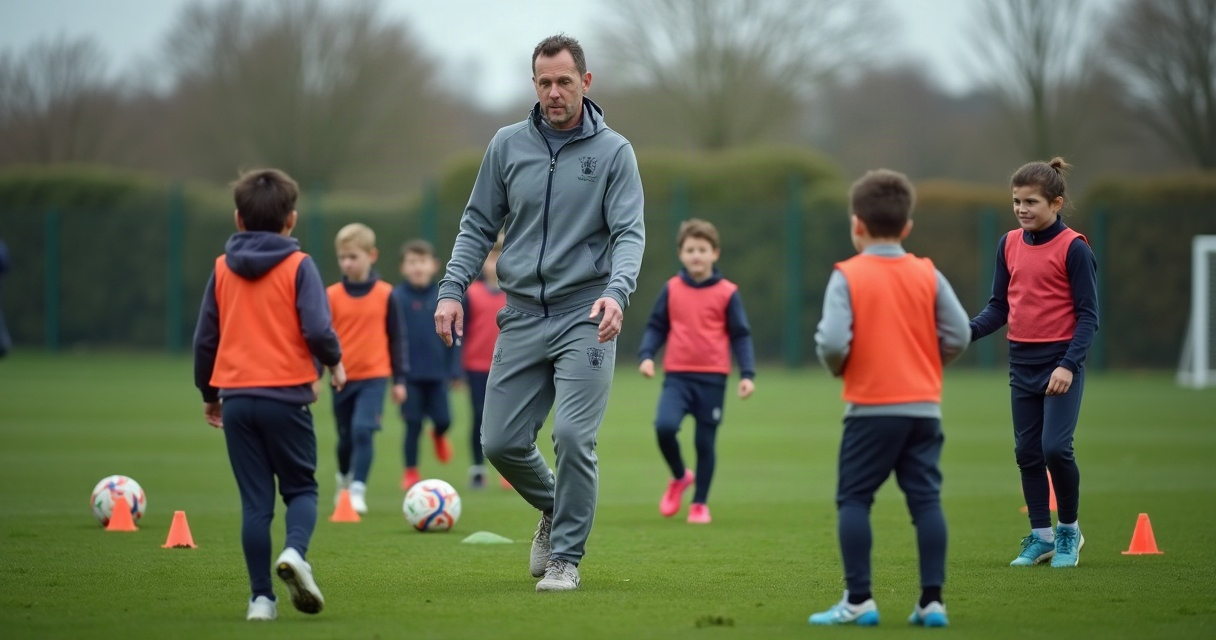
Help your U10s feel the thrill of counter-attacking with a fast, fun session that keeps every child moving and builds confidence in transition.
Picture the moment: one of your U10s wins the ball back, looks up, and just… stops. Sole planted on top of it, waiting for life to slow down and offer instructions. Meanwhile the space ahead closes. You have seen it a hundred times, and so have I. The good news is that this session is built around exactly that moment — winning the ball and going forward quickly — and it turns that hesitation into instinct through lots of repetition that children actually enjoy.
Session at a glance
- Age group: U10
- Ability level: Intermediate
- Session length: 45–60 minutes
- Players: 8–12 (run two identical games side by side for larger groups)
- Space: Approximately 40 x 25 metres, marked with cones
- Equipment: One ball per pair, cones or bibs for goals
Why children enjoy this game
Counter-attacking is one of those ideas that children understand immediately in their bones, even if they have never heard the word. You win the ball, there is space ahead, and suddenly you are racing towards it. It feels alive. It feels like doing something.
At this age, children love speed and surprise. They love being brave and direct. This session gives them lots of moments where they can feel that switch from defending to attacking — that sudden freedom — without needing a long explanation first. The structure is simple enough that they are playing within a few minutes, but varied enough that nobody gets bored.
There is also something quietly brilliant about the way transitions build belonging. When a child makes a quick forward pass and a teammate runs onto it, that connection — brief and unplanned — is its own little celebration. You do not need to point it out every time. They feel it.
How to run the session
Set up your rectangular space and split the children into pairs. One pair starts as defenders in the middle third of the area. The other pairs line up along the side as attackers, waiting their turn.
Play begins when an attacking pair passes the ball in and tries to score on either end goal. When the defending pair wins the ball back, the game flips immediately: they attack into the space behind where the other pair started, and the attacking pair drops back to defend. Goals can be scored with a shot from inside the area or by dribbling over the end line.
Keep each round to two or three minutes so everyone cycles through quickly. Short rounds mean fresh legs, fresh minds, and no one standing around feeling forgotten.
Coaching cues to use in the moment:
- 'Win it, look up, go forward'
- 'First touch, quick pass'
- 'Find the space behind them'
- 'Run into the gap'
The laces cue — encouraging children to take their first touch with the laces rather than the sole — is worth having in your pocket for this session. Some children will still stop the ball dead with the sole of their boot rather than letting it run forward. A quiet word about using laces to push it into space ahead of them can land immediately with some players, especially once they see how much quicker it makes everything feel. Do not make it a big correction; just offer it and let them try.
Keep every child involved
The rotating queue structure means no pair waits long, but you can do more. For children who are less confident, pair them with a bolder partner and let them be the passer first — receiving and distributing before they are asked to also defend at pace. That small adjustment builds confidence before demanding speed.
For children who are a little shy about running hard into space, try framing it as a puzzle rather than a sprint: 'Where is the empty bit? Can you find it before they do?' That reframe turns it from a physical test into a game of reading, which many children find far more appealing.
If a child needs more of a challenge, ask them to make two consecutive forward passes before shooting. That small condition adds a decision-making layer without changing the shape of the game for anyone else.
What to notice and say
The best moments in this session are the ones you do not interrupt. When you see two children complete a quick transition — ball won, head up, forward pass, teammate running on — let it play out. The feeling of it landing is the coaching. You can mention it gently afterwards: 'Did that feel fast? That is exactly what we are after.'
What to look for:
- Children who look forward immediately after winning the ball — even if the pass is not perfect yet, the habit is forming
- Pairs who start anticipating the transition before they have even won the ball, shifting their weight and glancing ahead
- Any child who is consistently waiting rather than moving — not to correct sharply, but to ask a question
Two questions worth trying:
- 'When you won it back there, what did you see first?'
- 'Where do you think the space will be before you get the ball?'
Those questions invite children to think rather than just do, and the answers often tell you a lot about how they are experiencing the game.
Know when not to stop play. If children are bunching, a brief pause is fine for safety. But if the transitions are happening and bodies are moving, stay quiet and watch. Your silence tells them they are getting it right.
Easy ways to adapt it
More space, more time: Enlarge the area and allow one extra touch before passing. Good for children still finding their feet with the concept.
Support runner: Bring in a third child to join the transition attack for a few seconds, creating a 2v1 advantage. Children love the feeling of outnumbering the defender momentarily — it makes the forward pass feel much more possible.
Add a countdown: Once the group is comfortable, transitions must happen within five seconds of winning the ball. This sharpens urgency without making the game feel pressured, especially if you frame it as a challenge rather than a rule.
Common coach questions
What if they keep losing the ball trying to go forward quickly? That is fine — it means they are trying. Encourage the intent first, then gently revisit the first touch. The instinct to go forward is harder to teach than the technique to do it cleanly.
What if one pair dominates every round? Quietly reshuffle pairings mid-session. You can do this naturally when you add a progression, so it does not feel like a consequence for the stronger pair.
Do I need goals or nets? No — two cones a metre apart work perfectly. Children are just as excited to score through two cones if the game around it is alive and fair.
This session works because it puts children in a situation they instinctively understand and gives them lots of chances to feel it going right. When it does, they want to do it again — and that is when the real learning happens. Find the full session plan here, or browse more sessions to find something that fits your group this week.
Written and reviewed by the PlayTactiq Coaching Team
Practical guidance for grassroots coaches, shaped around age-appropriate sessions, clear coaching language and real match-day problems.
Put it into a session
Ready-to-run U10 session plans
Setup, animated diagrams, coaching points and player-number adaptations — every U10 session in one place.
U10 football session plans →