
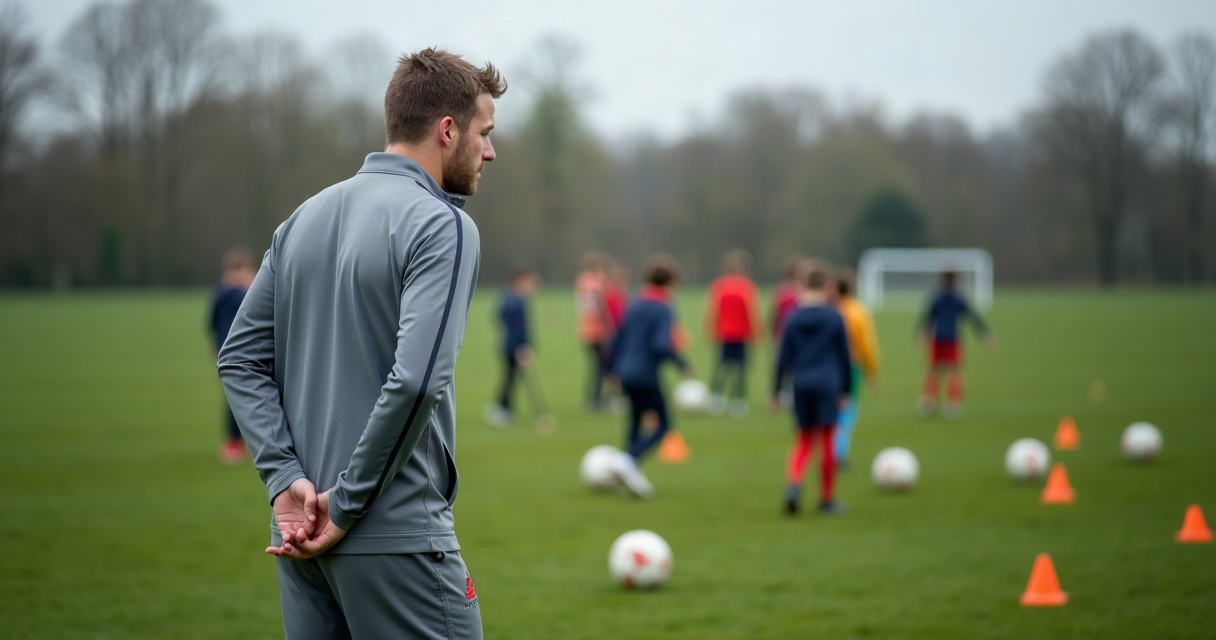
Help your U12s use the flanks with a crossing and support-run session that keeps every child busy, confident and wanting more.
You know that moment when a move breaks down because everyone has drifted into the middle and the wide areas are completely empty? It happens constantly at U12, not because the children are doing something wrong, but because no one has yet shown them how good it feels to play on the wing. This session does exactly that — and once they experience a winger beating a defender and whipping a cross to a teammate arriving at the back post, you will struggle to get them off the pitch.
Session at a glance
- Age group: U12
- Session length: 60 minutes
- Players: 8–14 (adaptable)
- Space: 50 × 40 yards, with outer wing zones marked on each flank
- Equipment: Footballs (one between two for the opening drill), bibs in two colours, cones
Why children enjoy this game
Wide play gives children something the middle of the pitch rarely offers: room. Wingers get to run at speed, take a defender on one versus one, and deliver something into the box that their teammates can actually attack. That combination — the run, the cross, the arrival — feels brilliant when it clicks, and every child on the pitch has a clear job.
Players in the box love the idea of arriving late and scoring. That is a special feeling at any age. Wingers love having space to express themselves without being surrounded immediately. Even the child who is still building confidence can find a role here, because the session is designed so that everyone gets lots of turns, lots of touches, and no one stands watching for long.
At this age, children are also starting to notice that football is a team game in the truest sense — that something one player does on the far side of the pitch creates space somewhere else entirely. Wide play makes that visible, which is genuinely exciting for curious twelve-year-olds.
How to run the session
Opening drill — cross and finish (15 minutes)
Pair every child up. One player starts on the wing with the ball; their partner moves into a small box marked 15 yards wide and 10 yards deep, roughly where a six-yard box sits in a full game. The winger runs forward, looks up, and delivers — driven, rolled, or floated, their choice. The player in the box finishes. Swap roles every four or five crosses.
Keep the tone light. Celebrate a well-weighted cross just as loudly as a good finish. Both skills matter equally here, and children quickly notice when a coach means it.
Small game — wide-zone rules (30 minutes)
Split into two teams of four or five. Play across your 50 × 40 yard area. Mark the outer third on each side as a wing zone. The rule is simple: a goal only counts if the ball was played from a wide position for the final pass or cross.
That one rule does the coaching for you. Children start looking for the wide player, holding runs into the box, and timing their arrival. You do not need to stop the game every two minutes to explain it — the constraint makes the lesson obvious.
Rotate the scoring rule after fifteen minutes: award a bonus point for any cross that reaches a teammate in the box without being intercepted. This rewards quality delivery and sharp movement off the ball.
Rounding off — free play (10 minutes)
Remove the rules entirely and just let them play. You will often see the wide habits carry over naturally. If they do, say nothing — that is the best possible outcome.
Keep every child involved
Use multiple small areas if numbers allow, so no one is waiting on the sideline. In the opening drill, every pair works at the same time.
In the small game, rotate players through different positions every few minutes. The child who is quieter or less confident often thrives as a receiver in the box before they are ready to be the winger under pressure — that is a perfectly sensible place to start, and it builds genuine belief rather than forcing them into a role too soon.
If a group is significantly mixed in ability, put less confident players in the wide zone against a passive defender initially. They get the experience of crossing with space and time, which builds the movement pattern before you add real pressure.
What to notice and say
The moments worth noticing are not always the goals. Watch for a child who checks their shoulder before receiving, a winger who waits for a teammate's run rather than crossing immediately, or a player arriving late into the box with good timing. These deserve a quiet word.
Short cues work best during the game. Try:
- 'Look up before you cross' — said once, clearly, then leave them to it
- 'Get forward when your teammate has the ball' — said to the player making the support run
- 'Use the space' — paired with a quick point to the empty wide area
Know when not to stop play. If the game is flowing and children are problem-solving on their own, your most useful job is to watch. The temptation to intervene is strong, but a game that keeps moving teaches more than a game that keeps stopping.
Two questions worth asking at the end: 'What made it easier to cross when you had more space?' and 'What did you do differently when you knew a teammate was arriving late?' Children often surprise you with what they have already worked out for themselves.
Easy ways to adapt it
Smaller group (6 players): Run three versus three with the same wide-zone rule. Reduce the area to 35 × 30 yards so the game stays tight and touches stay high.
Larger group (16 players): Set up two simultaneous small games side by side. Rotate a team between games every ten minutes so everyone stays fresh.
Less confident players: Begin the crossing drill with the winger standing still and the receiver collecting a simple pass before finishing. Add movement only when they feel ready.
More confident players: Ask them to cross with their weaker foot, or to receive the ball and deliver it first time without taking a touch to control. Both add a genuine challenge without removing them from the flow of the session.
Limited space: The wing zones can shrink, but keep them clearly marked. One practical lesson from running this with U12s is that the area for any possession or crossing work needs to be a little more generous than you first think — if the space feels too tight and the game is collapsing, try widening it by a couple of metres before you change anything else. It is often all that is needed.
Common coach questions
What if children keep ignoring the wide zones and playing through the middle? Hold the rule firmly for a few minutes — no goal counts unless it came from wide. The children will adapt quickly because they want to score. You rarely need to say much beyond pointing to the zone.
How do I stop the more confident players dominating the wing positions? Rotate positions on a timer rather than waiting for a natural break. Every three or four minutes, players shift. It keeps things fair and means everyone experiences crossing, receiving, and defending in the wide areas.
What if the crossing quality is really poor? Go back to the pairs drill for a few minutes without any pressure. Let them find the weight and angle of a good delivery before returning to the game. Technique improves faster when children are calm and have lots of repetitions.
Wide play sessions tend to produce some of the loudest, most natural celebrations you will see at grassroots level — because a timed run into the box, met by a well-placed cross, feels like something the children created together. Set the session up well, keep the turns coming, and let the game do the teaching. You can find the full session plan here or browse more sessions by age and theme to plan your next few weeks.
Written and reviewed by the PlayTactiq Coaching Team
Practical guidance for grassroots coaches, shaped around age-appropriate sessions, clear coaching language and real match-day problems.
Put it into a session
Ready-to-run U12 session plans
Setup, animated diagrams, coaching points and player-number adaptations — every U12 session in one place.
U12 football session plans →