
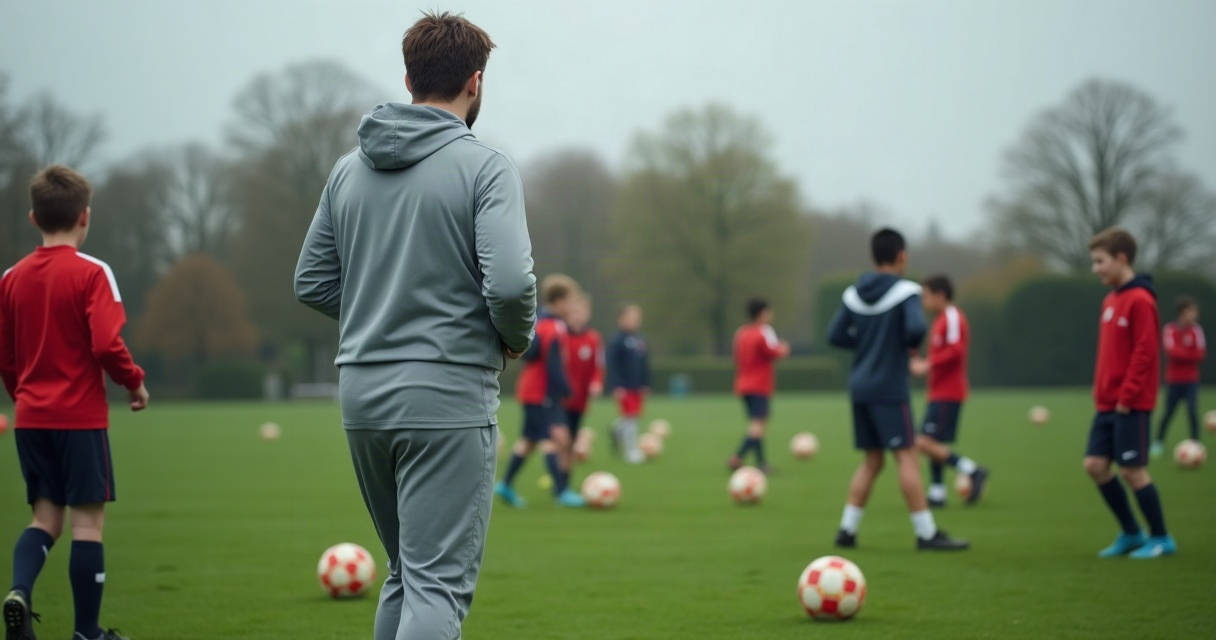
Help your U16s discover the joy of creating space for teammates with this practical third-man runs session built around movement, timing and connection.
There is a moment most grassroots coaches recognise: your midfielders receive the ball, look up, and the only option they can see is a square pass back. Everyone else is standing still, watching. Nobody is moving to help. You know the answer is movement off the ball, but telling teenagers to 'find space' rarely produces anything useful.
This session gives that idea a shape players can actually feel and enjoy.
Session at a glance
- Age group: U16
- Total time: 55 minutes
- Players: 12–16
- Space: 50 x 40 yards, split into three zones
- Equipment: Bibs, balls, cones
Why children enjoy this game
At sixteen, players are ready to see football differently. When a third-man run works — when someone makes a quiet, angled run at exactly the right moment and a perfectly weighted pass finds them — there is a genuine buzz. The runner feels found. The passer feels clever. The player who linked the two feels part of something.
That is the feeling this session chases. Not a complicated tactical shape, but the simple satisfaction of creating something together that none of them could have done alone. Players who sometimes feel peripheral — who do not always win headers or score goals — discover that intelligent movement is its own kind of skill, and that it matters enormously.
How to run the session
Activity 1 — Passing patterns with a running third (15 minutes)
Arrange five players in a loose structure: two wide, two in midfield, one up front. Player A passes to Player B in midfield. Before that pass lands, Player C — coming from the opposite wide position — makes a forward run into a gap between the remaining players. Player B then plays into C's run.
Run this for ten passes, then rotate. Keep it unhurried at first. The whole point is that players see the timing: C moves as the pass is being played, not before it and not after the ball arrives.
If a run keeps arriving too early, simply ask the group: 'What was C reacting to — the passer's body shape or the ball itself?' That question usually sorts it within a few repetitions.
Activity 2 — Three-zone combination game (25 minutes)
Divide the area into three zones: defensive, midfield and attacking. Play 6v6 with one rule: to score, the team in possession must complete a third-man combination. The ball goes to one player, immediately to a second, and that second player must find a third — not return it to the first passer. The third player alone can shoot.
This single rule does something useful: it makes waiting passive and moving active. Players quickly realise that standing still means nobody can use them as a third option. The game teaches the habit without the coach having to repeat it constantly.
Progression 1: Limit everyone to two touches. The game speeds up and rewards players who have already scanned before the ball arrives.
Progression 2: Add one 'pressing defender' who can move freely to close down the ball carrier. Runners now have to find smarter angles to stay available.
Progression 3: Add a goalkeeper and allow goals. Third-man runs begin to end with shooting opportunities, which sharpens the timing considerably.
Activity 3 — Free small-sided game (15 minutes)
Play 5v5 or 6v6 with no rules about combinations. Just football. Watch what happens. The movement that felt deliberate in Activity 2 tends to appear naturally here. Players have felt the rhythm; they no longer need the rule to prompt the behaviour. Let it breathe — resist the urge to stop and coach.
Keep every child involved
In the passing pattern activity, rotate positions every ten passes so no one is standing wide for too long. During the combination game, a quieter or less confident player often thrives in the midfield zone — they touch the ball frequently, play simple combinations, and the two-touch rule puts everyone under equal pressure. Celebrate a well-timed run even when the pass does not arrive perfectly; the movement itself is the skill.
For players ready for a challenge, give them a specific task: make a third-man run that draws a defender away, without ever receiving the pass. Creating space for a teammate by running into it — and then not getting the ball — is a genuinely sophisticated action, and naming it as valuable changes how they see it.
What to notice and say
During the combination game, watch the moment just before Player B receives the ball. Are any teammates already moving? If everyone is static, that is your coaching moment — but pause the game briefly, ask the question, and restart quickly. Long stoppages cool the session down.
Useful cues to drop in on the move:
- 'Check your shoulders before you move — where is the space?'
- 'Run as the pass is played, not before.'
- 'If you are not on the ball, you should be on the move.'
One question worth asking the group mid-session: 'What tells you it is the right moment to run?' Their answers will reveal more about their understanding than any amount of explaining.
Easy ways to adapt it
Smaller group (8–10 players): Run Activity 1 with three players and a target, then play 4v4 in Activity 2 across two zones rather than three.
Limited space: Shrink the combination game to 30 x 25 yards. Tighter space actually sharpens the timing of runs because the margins are smaller.
Mixed confidence levels: In Activity 1, let less confident players start as the 'third man' — they only need to run and receive, which is lower pressure than being the one who must pick the final pass.
No bibs: Use two different coloured cones to mark teams and keep the game moving.
Common coach questions
'My players keep making the run too early — how do I fix it?' Give them something specific to react to rather than a general instruction. Ask them to watch the passer's hips: when the hips turn to play the ball forward, that is the trigger to go. A named trigger produces faster results than 'move later.'
'What if my players ignore the combination rule and just shoot?' Restart the attack from the beginning rather than stopping to lecture. The consequence is natural and brief — they lose the chance — and most groups self-correct within a few minutes.
'Is this too complicated for some of my players?' The pattern in Activity 1 is intentionally simple: three people, one run, one pass. Start there and let the complexity grow only when that feels comfortable. Some sessions the group never leaves Activity 1, and that is fine.
When third-man runs click, the players feel it before you say anything. A midfielder finds a teammate in a pocket of space, a forward spins onto a perfectly timed ball, and the group starts to understand why movement off the ball is the foundation of how good teams play together. Find the full session plan here, or browse more sessions to build the week around it.
Written and reviewed by the PlayTactiq Coaching Team
Practical guidance for grassroots coaches, shaped around age-appropriate sessions, clear coaching language and real match-day problems.
Put it into a session
Ready-to-run U15 and U16 session plans
Setup, animated diagrams, coaching points and player-number adaptations — every U15 and U16 session in one place.
U15 and U16 football session plans →