
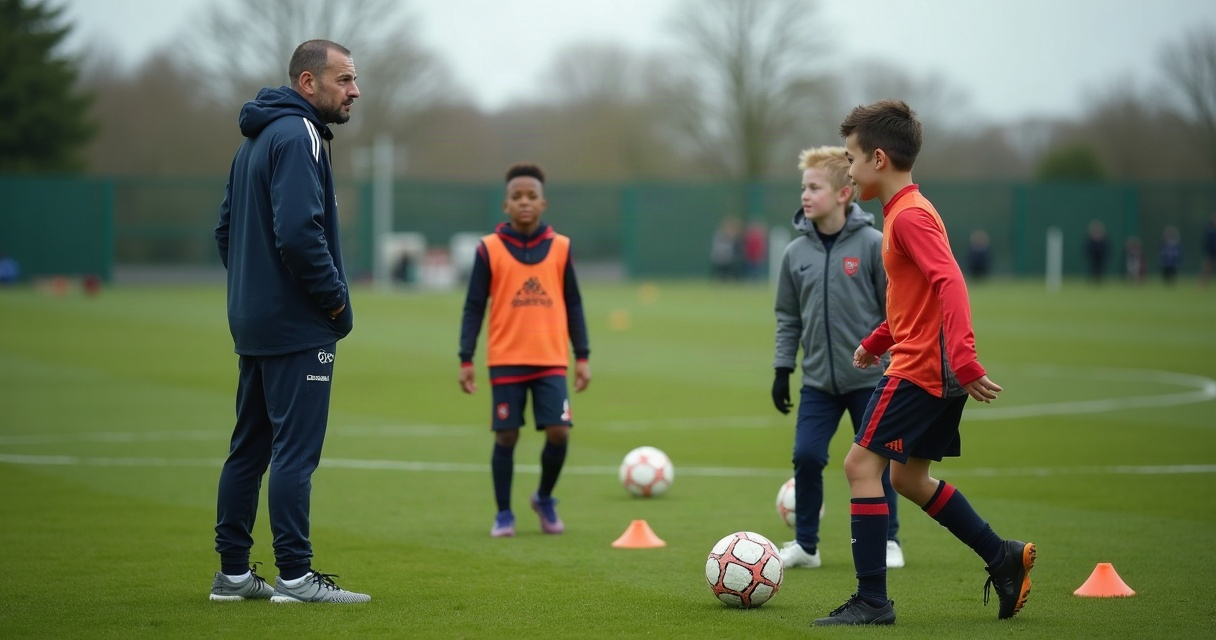
Help your U10 forwards lead the press with confidence, smart movement, and plenty of turns for everyone.
Why Pressing Starts with the Striker
At under-10 level, most teams focus their pressing talk on midfielders and defenders. Yet the striker is actually the best place to start. They are already closest to the ball when the opposition build from the back, they are naturally energetic and keen to chase, and when they press with purpose they set the tone for everyone behind them. A forward who rushes towards the ball the moment the defender receives it forces a hurried decision. That hurried decision often becomes a loose pass, a poor touch, or a long ball that your team can win. Even when the press does not lead to a turnover, it slows the other team's rhythm and tells your players: we work hard together.
The key word here is together. Children this age can easily fall into the habit of pressing alone and leaving big spaces behind. That is not a reason to avoid pressing — it is a reason to teach it clearly, in small steps, using games where the trade-off is obvious. When a child runs hard and the ball goes over their head, they notice. You do not need to lecture; you just need to ask the right question at the right moment and let them work it out.
This article sits alongside the Leading the Press practice session, which gives you the full activity structure. Here we look at the why and how of coaching the behaviour itself.
What Good Pressing Looks Like at This Age
Forget tight defensive lines and coordinated high presses for now. At U10, good pressing looks like this: a forward sees the ball go to a defender, takes two or three quick steps towards them, and positions their body to block the easiest pass. That is it. The whole skill is attention, movement, and body shape.
Three simple things make pressing effective at grassroots level:
Timing. Moving as the ball travels, not after it arrives, is the habit to build. When children wait until the defender has already settled on the ball, the defender has time to look up and pick a pass. When they move the moment the ball is released, the defender suddenly feels rushed.
Angle. Running straight at a defender just lets them roll it past you. Stepping to one side — the side that blocks the easiest pass — forces the defender towards a less comfortable option. Show children this on the pitch with a physical demonstration; it clicks much faster than any explanation.
Recovery. A forward who presses and loses the ball needs to recover their position quickly. Celebrate that sprint back just as much as the original press. It teaches children that pressing is a commitment, not a gamble.
None of this requires footballing genius. It requires curiosity, a bit of bravery, and a coach who notices the right moments.
Keeping Every Child Involved
One of the biggest risks in any pressing drill is that a couple of children end up doing most of the work while others watch. Waiting kills energy and learning at this age. A few practical habits help.
Use small groups. Four to six children per game area is ideal. If your squad is larger, set up two identical areas side by side so everyone is active at once. Rotate roles every two minutes on a clear signal — this keeps it fair and means every child gets equal turns as the presser, the defender, and the support player.
Offer different entry points. A child who is hesitant or new to the concept can start by simply moving into a marked spot when they see the ball played out, rather than sprinting into a full press. That positional awareness is the same skill; it just removes the physical pressure until they feel ready. A more confident child can progress to pressing a defender who is allowed to move sideways, making timing and angles more demanding.
Make the wins visible. When a forward presses and forces a poor pass — even if they do not win the ball themselves — call it out immediately. 'Did you see that? She rushed forward and the defender had to hurry — that pass went nowhere.' Children need to see that effort without a direct result still counts.
You will find many more ideas for structuring small-sided games across different ages and abilities over at /explore.
Coaching Language That Builds Confidence
How you speak during pressing practice shapes how willing children are to try. Pressing involves risk — the forward leaves a space, commits to a challenge, and might get it wrong. If children sense that mistakes will be highlighted, they stop taking risks. So your language matters enormously.
Praise the behaviour, not just the outcome. 'I loved how you stepped forward the moment the ball moved' is more useful than 'well done for winning it'. It tells the child exactly what to repeat.
Ask questions rather than giving answers. 'Where do you think the easy pass was?' or 'What would you do differently next time?' invites the child to think rather than just listen. At U10, this thinking habit is more valuable than any tactical detail.
Avoid the phrase 'too much' when a press goes wrong. Saying 'you pressed too hard' can make a child feel they did something bad. Instead, use curiosity: 'What did you notice after you ran forward?' Let them spot the gap themselves. Then offer one small adjustment: 'Next time, try angling your run a little to the right — see what that does.'
For shy or less confident children, start with a signal system. Tell them: when I clap, that is your moment to step forward. This gives them a clear trigger without the cognitive overload of reading the whole game at once. Gradually reduce the signals as their awareness grows.
Never let a goal conceded from a press become a reason for blame. Treat it as shared information: 'Interesting — what happened there? What could we try next time?' Keep the tone light and curious. A child who tries, struggles, and returns ready to try again has learned something real.
The Habit That Carries Forward
Teaching strikers to press from the front does something bigger than win the ball high up the pitch. It teaches children that defending is everyone's job, that their movement affects teammates, and that football rewards effort and bravery as much as technical skill. A forward who presses becomes a leader — not because someone told them to be, but because their actions changed the game.
At U10, that feeling of mattering on a pitch is the thing that keeps children coming back. Keep the sessions active, the praise frequent, and the questions open. The tactical detail will sharpen over time. The confidence to act boldly needs to start now.
Written and reviewed by the PlayTactiq Coaching Team
Practical guidance for grassroots coaches, shaped around age-appropriate sessions, clear coaching language and real match-day problems.
Put it into a session
Ready-to-run U10 session plans
Setup, animated diagrams, coaching points and player-number adaptations — every U10 session in one place.
U10 football session plans →