
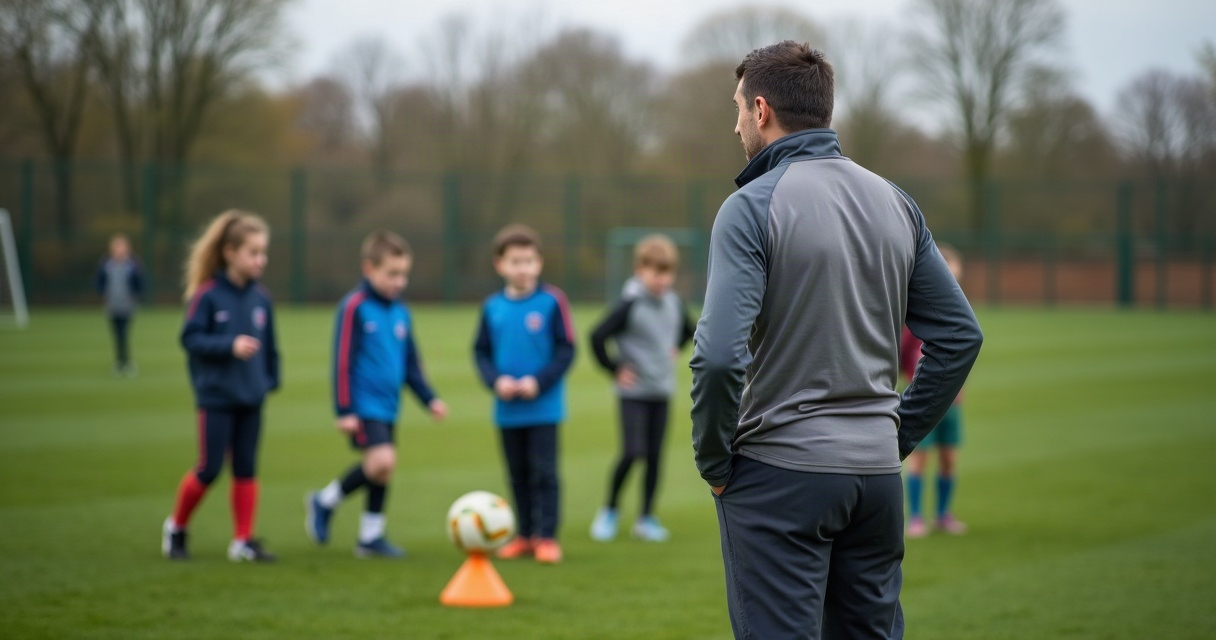
Help young children learn when to win the ball with confidence, patience, and clean challenges that keep everyone playing happily.
Teaching children to tackle is one of those moments in grassroots coaching that can go one of two ways. Done well, it produces a child who feels clever and brave, someone who reads the game a little ahead of everyone else. Done poorly, it produces a rushed lunge, a foul, a tearful opponent, and a session that loses its joy quickly. The good news is that at U6, children are genuinely ready to learn the idea of timing—they just need the concept wrapped in play, not instruction.
If you are looking for a structured session to bring these ideas to life straight away, the Timing Your Challenge: When to Win the Ball practice has everything laid out for a 60-minute session with beginners.
Why Timing Matters More Than Strength at This Age
Young children often assume that winning the ball means being quicker or more forceful than the person who has it. The moment you replace that idea with timing, everything improves. Timing means reading a situation: watching where the ball is, noticing when the carrier is slightly off-balance or reaching for their next touch, and choosing that exact window to step in calmly.
At U6, bodies are still developing coordination and balance, so any challenge that relies on physical force tends to end badly for both children involved. A well-timed challenge, however, relies on observation and decision-making—skills that young children can genuinely develop with the right kind of practice. When a child steps in at exactly the right moment and taps the ball away cleanly, they experience something better than a tackle: they experience being clever. That feeling is deeply motivating and builds the kind of intrinsic confidence that keeps children coming back to the game.
It is also worth understanding what patience looks like at this age. Staying close, watching, waiting for the moment—this is not passivity. It is active decision-making, and children who learn it early tend to become thoughtful, composed players who are far more effective than those who simply chase and lunge.
What Good Timing Actually Looks Like in Practice
Breaking timing down into observable behaviours helps enormously when coaching young children. There are three things to look for and point out when you see them.
First, position. A well-timed challenge almost always comes from beside the ball-carrier or slightly ahead of them, never from directly behind. Being alongside gives the challenging child the best angle to play the ball without making contact with the opponent's legs. When you see a child naturally drift into this position, name it and praise it: 'You got yourself right next to them—really smart.'
Second, the trigger moment. Every ball-carrier has a vulnerable instant—the moment between one touch and the next, when the ball is slightly away from their feet. Teaching children to watch for this is far more useful than telling them to 'go in now.' Ask them to watch the ball, not the other child's face or feet, because the ball tells them everything they need to know. When it rolls a little loose, that is the window.
Third, staying upright. A standing challenge is almost always safer and more successful than a sliding or lunging one at this age. When a child stays on their feet, they can adjust if they misjudge the moment, and they recover quickly to play on. When they throw themselves into a challenge, a mistimed attempt leaves them on the floor and the ball gone. Praise upright, balanced challenges loudly and often.
How to Include Every Child in a Tackling Session
Tackling can feel intimidating, and some children will hang back rather than try. This is not a problem to fix—it is a coaching opportunity. Observation is a genuine part of learning. A child who watches five well-timed challenges carefully is building understanding even without yet having tried one themselves.
Pairing is important. Put a less confident child with a calm, encouraging partner rather than the most enthusiastic player in the group. Reduce the speed of the keeper's movement if a child is struggling to spot the timing window. Slowing things right down is not making it easier in a dismissive sense—it is making the learning visible, which is good coaching.
Make sure no child is standing in a queue watching others play. The most important thing you can do for a young child's development is give them as many repetitions as possible. Pairs rather than large groups, spare balls at the side, and activity always continuing in parallel all help enormously. When every child is active most of the time, confidence builds quickly because children get many chances to try, adjust, and try again without the added pressure of an audience.
When praising a challenge, be specific. 'You waited, then you went—brilliant timing' means far more to a child than a general 'well done.' Specific feedback tells them exactly what to repeat.
Asking Questions Instead of Giving Answers
One of the most effective things a grassroots coach can do with young children is replace instructions with gentle questions. After a successful challenge: 'When did you decide to go in?' After an unsuccessful one: 'What did you see just before you stepped in?' These questions do not put a child on the spot—they invite reflection, which builds genuine understanding rather than dependency on being told what to do.
Children who can answer 'I went in when the ball came loose' have developed real game awareness. They are not following a rule you gave them; they are applying something they understand. That transfers to every game they play from now on, long after this session is over.
If a challenge results in a foul, curiosity is far more productive than correction. 'That didn't quite work—what might you try differently next time?' keeps the mood positive and keeps the child thinking. Children who feel safe to try, fail, and try again learn fastest of all.
Exploring tackling as part of a broader development programme gives coaches and children many more opportunities to build on these ideas. Browse all available practices at PlayTactiq to find sessions that connect naturally with timing, defending, and decision-making as children grow through the age groups.
Written and reviewed by the PlayTactiq Coaching Team
Practical guidance for grassroots coaches, shaped around age-appropriate sessions, clear coaching language and real match-day problems.
Put it into a session
Ready-to-run U6 and U7 session plans
Setup, animated diagrams, coaching points and player-number adaptations — every U6 and U7 session in one place.
U6 and U7 football session plans →