
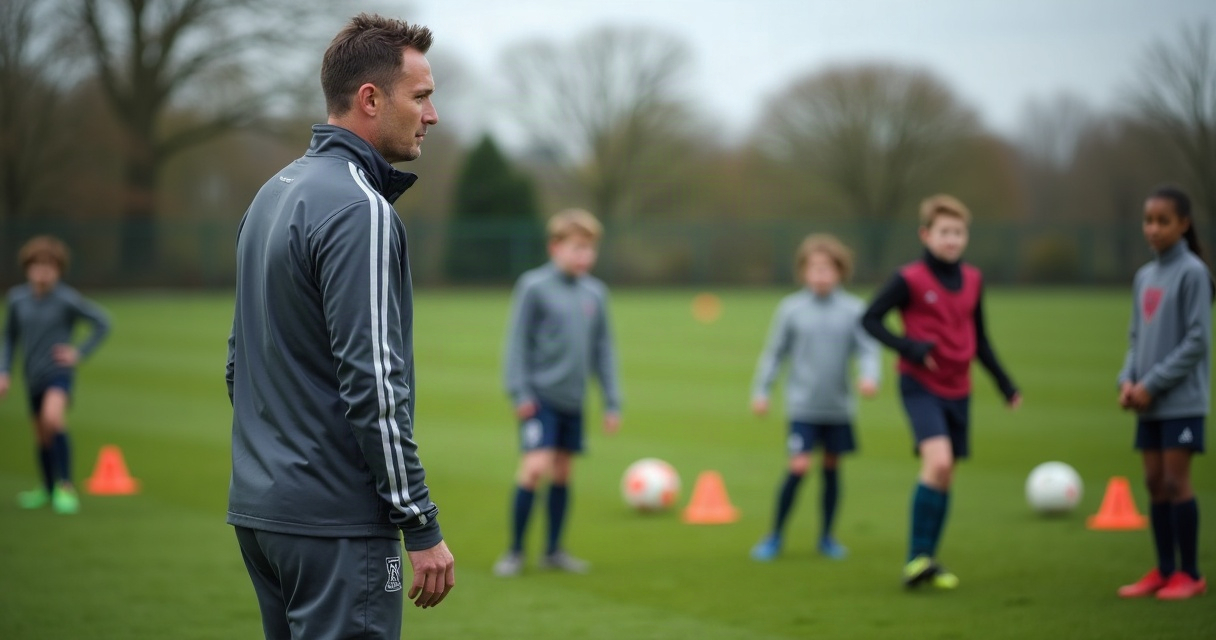
Help your U12 forwards lead the press with smart movement, good timing, and the confidence to chase the ball back.
Why Forwards Are Your First Line of Defence
There is a moment in almost every junior football match when a centre-back receives the ball from their goalkeeper and looks up, completely unopposed. No pressure. No rush. All the time in the world to pick a pass or carry the ball forward. For the team without the ball, that moment feels helpless — unless the striker has been taught what to do about it.
Presenting pressing as something forwards do changes the way children think about their role. Instead of standing still and waiting for the ball to arrive, they become active, purposeful, and genuinely useful to their team from the very first second the opposition have possession. That shift in mindset is enormously good for confidence, especially at U12, when players are beginning to understand that football works in two directions.
The good news is that effective pressing at this age is not complicated. It does not require a fixed formation or a detailed tactical briefing. It requires movement at the right moment, an awareness of where the next pass might go, and the courage to step forward rather than hang back. These are things any child can learn with the right environment and a little encouragement.
What Good Pressing Actually Looks Like
Coaches sometimes describe pressing as chasing the ball, but that framing can lead children to sprint around without purpose, exhausting themselves and leaving gaps. A more useful picture is this: the pressing striker is a blocker, not a tackler.
When the opposing defender receives the ball, the forward's job is to step into the space between that defender and the direction they want to pass. They do not need to slide in or lunge. They just need to be there — close enough to make the defender feel rushed, angled in a way that makes one passing lane more difficult than another.
Good pressing has three layers that U12 players can genuinely grasp:
Timing. Press early, before the defender has settled. A defender who receives the ball and has a second to look up is already comfortable. A forward who steps in immediately takes that second away.
Angle. Approach from an angle that blocks the most dangerous pass, usually the one that goes centrally or forward. If the striker runs straight at the defender, they can simply knock the ball sideways. If they approach from a slight angle, they cut off one option and force the defender toward the other.
Decision. Not every ball needs a full press. A defender who is facing their own goal and under pressure deserves every bit of attention the striker can give. A defender with acres of space and plenty of time is better managed by holding a position and blocking the next pass rather than charging in and being beaten.
These three ideas — timing, angle, decision — give children a framework they can return to when they are thinking things through between sessions.
Creating the Right Practice Environment
The Press and Retrieve practice builds these habits through short, repeated bursts of realistic pressing situations in a small grid. The design is deliberately simple so that coaches can focus their attention on the players rather than the setup.
A few principles are worth keeping front of mind whenever you run this kind of session:
Keep turns frequent and waiting minimal. Children learn pressing through doing it, not watching it. If you have enough players for two small grids side by side, use them. Rotate groups every two or three minutes so everyone gets repeated goes at being the pressing striker, not just one long turn followed by a long wait.
Let mistakes teach. When a forward presses and gets beaten, resist the urge to stop play and explain. Let the consequence — the opposition moving forward, perhaps even scoring — do the teaching. Afterwards, a short question works better than a long correction: What did you see when you stepped in? What might you try next time?
Build in shadow pressing for less confident players. Some children at U12 are not yet comfortable going into challenges. Letting them press in a shadow role — staying close, affecting the defender, without committing to a tackle — keeps them active and building confidence without pressure. This is not a lesser version of the task; it is a genuine skill and worth celebrating.
Celebrate the quiet wins. A forward who presses and forces a rushed pass has done something valuable even if they never touched the ball. Make sure children hear that. You made them rush that pass — that's exactly what we're after. Praise effort and bravery specifically and often.
Helping Children Choose When to Press in a Match
The gap between a well-run training session and a match is often this: children know how to press when they are told to, but they do not yet know when to press on their own. Bridging that gap is partly about the questions you ask during practice and partly about the images you give them to carry onto the pitch.
One helpful image is a traffic light. Green means press hard — the defender is facing away, they are under pressure from a teammate nearby, or they have received a poor touch. Amber means approach carefully — they have the ball under control but have not yet looked up. Red means hold — they have time, space, and a clear picture of the game, so dropping into a blocking position is smarter than charging forward.
You do not need to use those exact words with every group. The underlying idea is what matters: pressing is a choice, and making that choice well is a skill in itself. A striker who reads the game and decides not to press is showing real footballing intelligence. Tell them so.
As U12 players grow more comfortable with pressing from the front, the habit begins to pull the rest of the team along naturally. Midfielders start to shift when the striker steps up. The shape tightens. This happens best not through instruction but through playing small-sided games and letting children see and feel how it works.
Browse more practices across all themes and age groups to find sessions that build on this pressing work and help your group keep developing.
The most lasting thing you can give a young striker who is learning to press is not a tactic — it is the belief that stepping forward is brave, useful, and worth doing again.
Written and reviewed by the PlayTactiq Coaching Team
Practical guidance for grassroots coaches, shaped around age-appropriate sessions, clear coaching language and real match-day problems.
Put it into a session
Ready-to-run U12 session plans
Setup, animated diagrams, coaching points and player-number adaptations — every U12 session in one place.
U12 football session plans →