
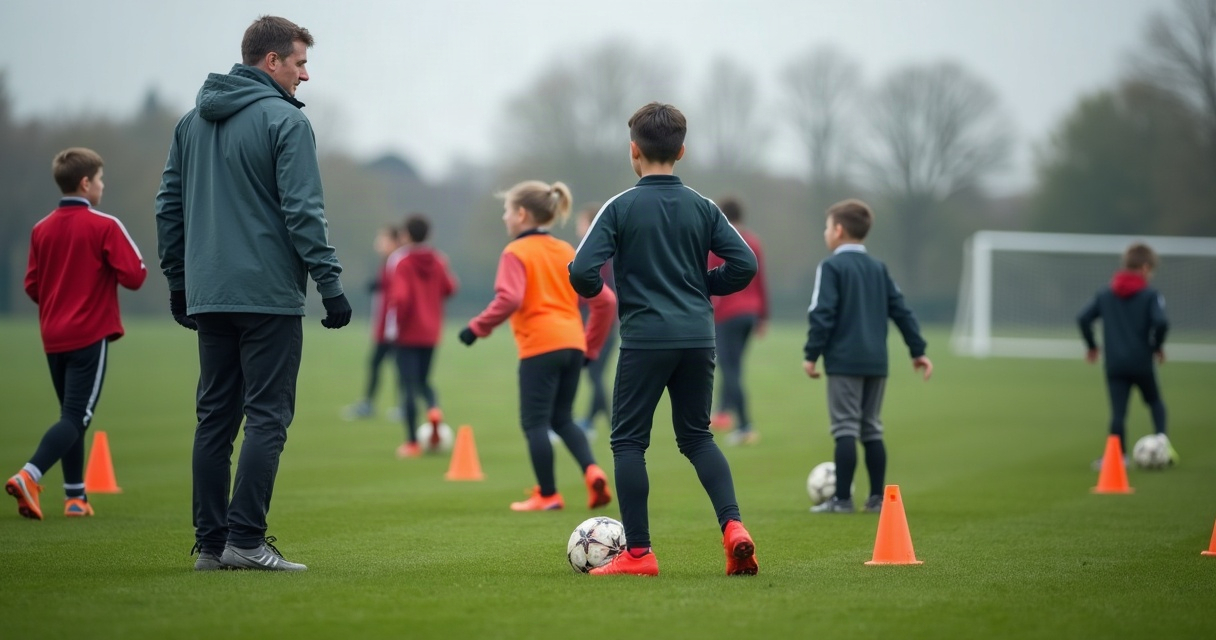
Simple ideas to help young players react the moment possession changes, recover their shape, and defend with confidence.
Defensive transitions are one of those moments in football that feel almost electric. One second your team is attacking; the next, the ball has flipped and everyone needs to sprint, think, and reorganise — all at the same time. For U12 players, that challenge is genuinely exciting, and with the right coaching it becomes one of the most rewarding skills they develop.
This article sits alongside the Quick Feet: React When the Ball Flips practice and explores the thinking behind teaching transitions well — why certain approaches work, how to keep every child involved, and what to say in the moments that matter.
Why Transitions Feel Difficult for Young Players
The challenge of a defensive transition is not really physical — it is cognitive. Children have to notice the moment possession is lost, override the natural urge to stand and watch, and immediately do something useful. That switch from one mental mode to another takes practice, and it is completely normal for young players to freeze or drift at first.
At U12, children are beginning to understand the game as a whole rather than just chasing the ball. That makes this a brilliant age to introduce transition concepts, but it also means the ideas need to stay simple. Telling a child to 'drop into a mid-block' means very little. Telling them to 'get back between the ball and the goal' makes immediate sense.
The other reason transitions can feel hard is that losing the ball sometimes carries an emotional sting. A child who has just had the ball taken from them may feel embarrassed or frustrated. If the first thing they experience is a teammate shouting at them to run back, the emotional learning and the tactical learning get tangled together unhelpfully. Creating a calm, purposeful culture around transition — where getting back is celebrated rather than losing possession being blamed — makes a huge difference.
The Shape Idea: Keep It Visual, Not Technical
Children do not need to memorise formations to defend well in transition. What they need is a clear mental picture of what good looks like.
One useful image is a sliding door. When your team has the ball, your defensive shape moves forward together. The moment the ball is lost, that same shape slides back, recovering ground as a unit. Nobody is left isolated; nobody sprints off in a completely different direction. The group moves together, like a door closing across the pitch.
Another simple picture is the line between the ball and the goal. When transitioning, players want to place themselves in that space — not necessarily marking a specific opponent every time, but ensuring there is a barrier between the opposition and your goalkeeper. Ask children where the goal is, where the ball is, and whether they are between the two. That question alone starts building the right spatial awareness.
Avoid introducing too many positional names or tactical terms in the same session. Repetition of one clear idea — recover quickly, stay together, cover the space — is far more valuable than a broad overview that leaves children unsure what to focus on.
Getting Every Child Active and Confident
One of the great things about transition training is that it naturally rewards awareness, effort, and communication rather than pace or physical size alone. A quieter child who spots where the opposition is setting up and calls it out early is contributing just as much as the fastest sprinter recovering their position. Make sure children hear that message regularly.
To keep everyone involved:
- Give specific roles to children who need clarity. Telling a less confident player 'your job in transition is to cover the space behind your teammate' gives them a defined task rather than a vague responsibility. That specificity removes anxiety and helps them feel useful.
- Use a buddy system early on. Pairing children during transition means one focuses on recovery runs and the other focuses on marking an opponent. Swapping roles each round means both develop different aspects of the skill, and neither child is ever trying to work out everything on their own.
- Praise the things that are often invisible. Calling a name, pointing to a space, tracking an opponent even when the ball is far away — these are the habits that make a team defensively solid, and they are easy to miss if you are only watching the ball. Make a habit of noticing them and saying so.
- Keep waiting time to zero. Long queues and substitutions that take minutes teach children that their attention is optional. Restart immediately, rotate smoothly, and make the environment feel continuous. The more transitions each child experiences, the faster the learning.
For children who pick things up quickly, add layers. Ask them to observe the opposition's shape before the ball is lost, so they are already anticipating where to recover. This is leadership and awareness work, not just extra running, and it keeps faster learners genuinely stretched.
What to Say in the Moment
Coaching language during transitions needs to be short, clear, and calm. Children are already processing a lot; a long instruction mid-play is not going to land.
A few cues that work well:
- 'Ball's gone — move!' This is the trigger. It acknowledges the moment and prompts action without blame.
- 'Get back into shape' — a reminder to recover as a unit rather than chasing individually.
- 'Who's closest? Mark them' — individual responsibility without singling anyone out negatively.
- 'Spread and cover' — a prompt to take up space intelligently rather than bunching.
When children respond well, be specific about what you saw. 'You reacted the moment the ball went and got back behind it — that's exactly it' tells them precisely what to repeat. 'Well done' on its own is kind, but it does not build understanding.
When transitions go wrong, resist the urge to pause and correct immediately unless the same mistake is happening repeatedly. Messy, real-time learning where children reorganise themselves is often more valuable than a coaching stoppage. Trust the process, watch for patterns, and choose your moments to intervene thoughtfully.
If you want to explore more sessions built around these principles, the PlayTactiq practice library has plenty of ideas organised by age, theme, and ability level.
Defensive transitions are not just a tactical topic — they are a confidence topic. When children feel capable of reacting quickly, communicating clearly, and helping their team get back into shape, they feel like footballers. That feeling is worth building carefully, one session at a time.
Written and reviewed by the PlayTactiq Coaching Team
Practical guidance for grassroots coaches, shaped around age-appropriate sessions, clear coaching language and real match-day problems.
Put it into a session
Ready-to-run U12 session plans
Setup, animated diagrams, coaching points and player-number adaptations — every U12 session in one place.
U12 football session plans →