
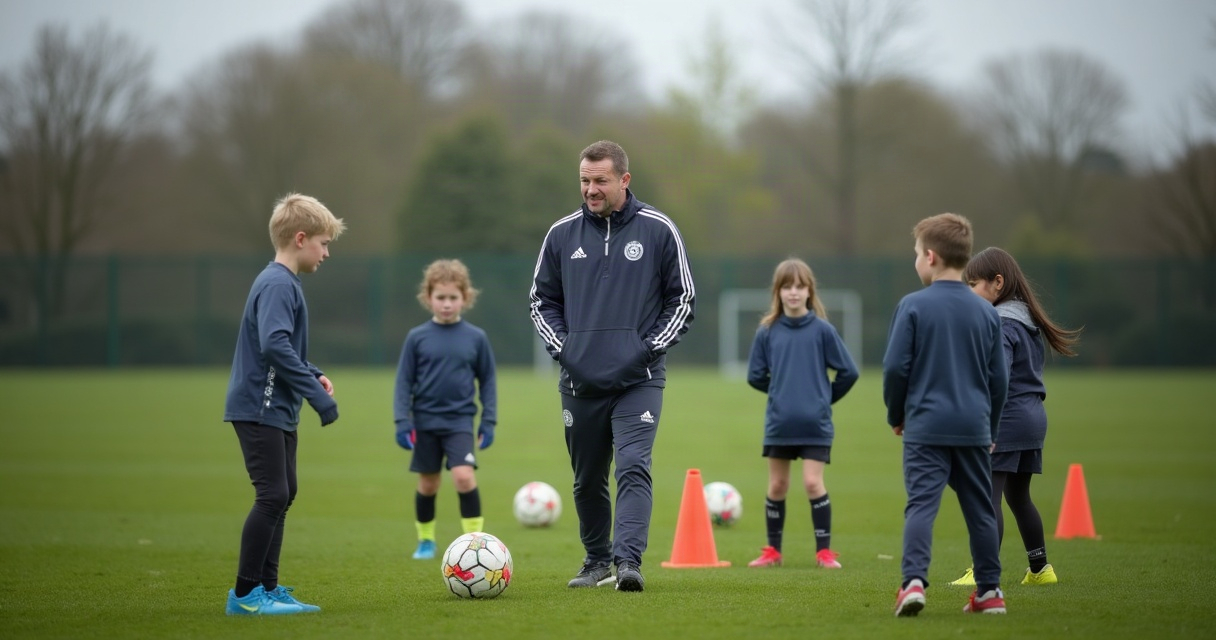
How to run a first-ever football session for U8s so every child leaves confident, smiling, and ready to come back.
Why the Very First Session Is the One That Counts
Children arrive at their first football session carrying a mixture of excitement and quiet worry. Some will have been asking about it for weeks. Others will be standing just behind a parent's leg, unsure whether they belong here. Both feelings are completely normal, and both deserve the same response: warmth, lots of movement, and a ball at their feet within the first two minutes.
At U8, children learn through doing, not through listening. Their attention span for instruction is short, but their capacity for play is enormous. The job of the coach in that first session is not to teach football—it is to help every child feel that football is for them. If they leave having touched the ball dozens of times, heard their name said with encouragement, and had at least one moment of genuine fun, the session has succeeded. Everything else can come later.
The Welcome to Football: Your First Kicks practice is built entirely around this idea. The structure below explains the thinking behind it so you can adapt it confidently, whatever your group looks like on the day.
Set Up the Space So Success Is Built In
Before anyone arrives, your space does a lot of the coaching for you. A small, clearly marked area—roughly 25 metres by 20 metres, or even smaller for a very young or nervous group—tells children exactly where they are meant to be. Cones or training bibs as boundaries work well because children can see them at a glance without needing an explanation.
Aim for one ball per child. This single decision removes the biggest source of frustration and standing around at this age. When every child has their own ball, there is nothing to wait for, nothing to share anxiously, and no moment where someone feels left out. If you are short of balls, pairs work fine, but keep pairs together and moving rather than taking turns.
Arrange your cones as gates and targets before the session starts. Scattered gates—pairs of cones placed at random angles around the space—give children something to aim for without making it competitive. Children will naturally weave between them, through them, and around them according to what feels right, which is exactly what you want at this stage.
Helping Quiet or Less Coordinated Children Feel Included
Inclusion at U8 is not a separate agenda item. It runs through every choice you make: the language you use, where you position yourself, how you structure activities, and what you praise.
For a child who is hesitant or nervous, the best thing you can do is stand near them and mirror what they are doing. If they are rolling their ball slowly with their toe, roll yours the same way. This signals, without words, that what they are doing is exactly right. It removes the feeling of being watched and judged, and it often brings a quiet child into the activity more gently than any amount of encouragement.
For a child who is finding coordination difficult, two small adjustments make a big difference. A larger, softer ball gives more contact surface and moves a little more slowly, which means there are more moments of success. A slightly reduced space means the ball stays closer and there is less chasing. Neither of these needs to be announced or made into a thing—just quietly use them.
For a child who is very confident and moving quickly through everything, offer a simple progression: try it with the other foot, or push the ball and then touch it again before moving on. This keeps them challenged without separating them from the group or making a performance of it.
The language you use matters as much as the structure. Praise that is specific and honest lands better than generic cheering. 'Your ball stayed really close to your feet that time' tells a child what worked. 'You kept going even when it rolled away—that's the kind of thing that really helps you improve' tells them that effort and resilience are what matter here.
Games That Teach Without Feeling Like Teaching
The activities that work best at this age share a few common features. They have simple rules that can be explained in one sentence. They have funny or memorable names. They let children move almost continuously. And they feel like games, not drills.
Traffic Lights is a good example. Children dribble freely, and you call out colours: green means go, yellow means slow, red means stop. The stopping challenge—balance on one foot, or simply stand near the ball—gives a tiny moment of stillness without making it feel like a formal exercise. Children who find balance tricky can just stand still, and no one needs to notice or comment. The game carries on around them.
Gates and targets work well because they are self-directed. Children push their balls through as many gates as they can, and there is no score and no winner. The choice of which gate to aim for, how fast to go, and whether to try a new angle all belong to the child. This sense of agency—'I decided to do that'—is quietly important for building intrinsic motivation. They are not just following a coach's instructions; they are exploring.
When you introduce the idea of rolling the ball to a friend and having them roll it back, you are introducing passing without calling it that. The word does not matter at this age. The experience of making the ball travel to another person and having it return is what stays with them.
Ending Well and Handing Off to Parents
The final five minutes are worth protecting. A simple circle, with each child getting one question—'what was your favourite bit?' or 'what did your ball do today?'—does several things at once. It slows the energy down gently, it makes every child feel heard, and it gives you a genuine insight into what landed.
When parents come to collect, try to mention something specific about their child. Not a general 'they did really well,' but something you actually noticed: 'She tried pushing it with her left foot in the last game,' or 'He helped his partner find the ball when it rolled away.' Parents remember these moments. Children, when they overhear them, remember them too.
That specificity is what makes a first session feel different from a standard activity session. The child goes home knowing that someone paid attention to them as an individual, not just as part of a group.
If you are planning your first session or looking for other structured practices, explore more sessions for young beginners across different ages and abilities.
Written and reviewed by the PlayTactiq Coaching Team
Practical guidance for grassroots coaches, shaped around age-appropriate sessions, clear coaching language and real match-day problems.
Put it into a session
Ready-to-run U8 session plans
Setup, animated diagrams, coaching points and player-number adaptations — every U8 session in one place.
U8 football session plans →