
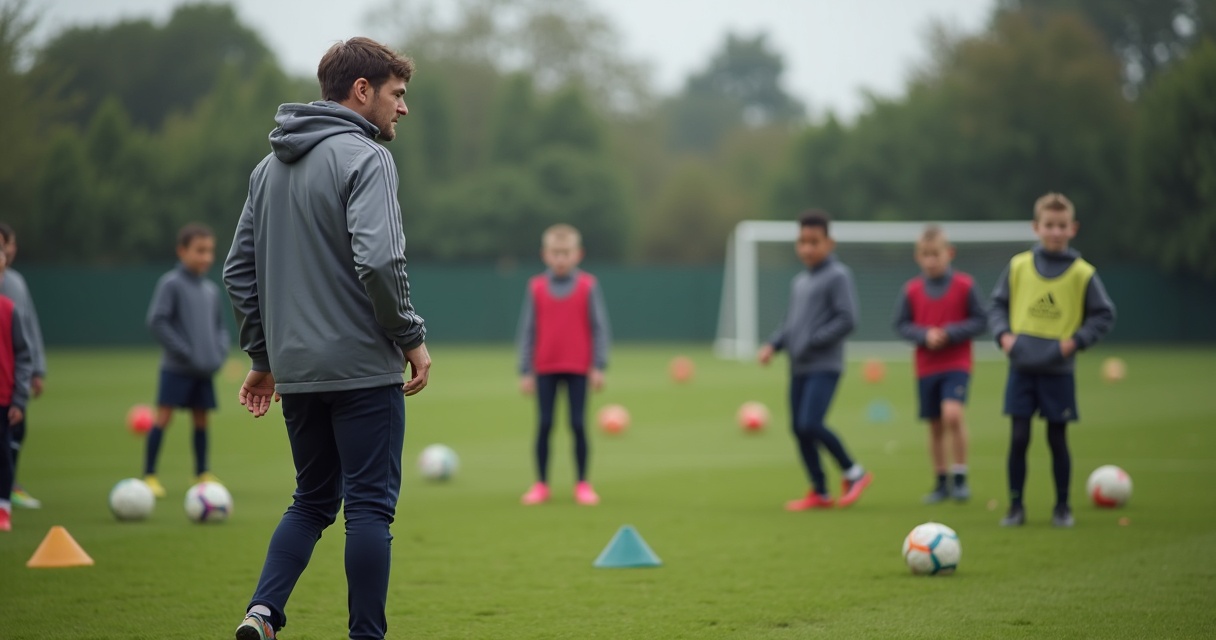
Rondo training accelerates passing development at U12 by combining technical work with tactical decision-making. Learn how to structure this essential dril
The rondo is one of football's most valuable training tools, yet many grassroots coaches underestimate its power. It's simple to set up, engaging for players, and delivers measurable improvements in passing accuracy, first-touch quality, and tactical awareness—all in a single drill.
At U12, your players are at a critical development stage. They're building their technical foundation while beginning to understand tactical positioning and decision-making. Rondos accelerate this dual development by forcing repeated touches in realistic game conditions: limited space, constant pressure, and fatigue.
Here's why rondo training works so well at this age group, and how to structure it for maximum impact.
Why Rondos Are Essential for U12 Development
On the surface, a rondo is simple: keep the ball in a defined area while defenders try to win it. But underneath, something more sophisticated happens.
Rondos replicate match demands in miniature. Your players experience:
- Limited space: Players learn to receive and pass in tight areas, forcing accurate technique under pressure
- Constant pressure: Defenders closing them down teaches quick decision-making and composure
- Repeated decisions: Body shape, angle selection, pass weight, and pressing triggers—all practiced within minutes
- Active defending: Young players discover that keeping possession isn't passive; it requires intelligent positioning and anticipating pressure
For intermediate U12 players, rondos bridge the gap between isolated technical drills and full-sided tactical play. They build confidence in possession while teaching players that football is about reading pressure and making informed choices.
Players develop passing accuracy, first-touch quality, movement patterns, and coordinated pressing—skills that transfer directly into matches.
Setting Up Your Rondo: Basic Structure
Keep setup simple and time-efficient.
Area: 15x15 yard square (adjust based on your squad's ability)
Players: 5-6 in possession, 2-3 pressing (8-10 outfield players total, plus optional goalkeeper)
Duration: 3-4 minute blocks with 1-minute recovery between sets
Key rule: If defenders win the ball, they become the attacking team and the original attackers immediately press
This continuous rotation keeps all players engaged and prevents fatigue from becoming an excuse for poor performance. Fatigue is part of the learning—players discover how to maintain quality under pressure.
Progression One: Foundation Rondo (5v2)
Start here with intermediate U12 players to build confidence and passing accuracy.
Setup: 5v2 in the 15x15 yard area
Focus: Possession team maintains the ball using one and two-touch passing. Pressing players work actively but without extreme intensity.
Key coaching cues:
- "Receive with your body open" (players should position to see the field)
- "Pass before the press arrives" (encourage quick decision-making)
- "Show for the ball" (make yourself available as a passing option)
- "Move into space after passing" (create passing lanes for teammates)
What to watch for: At this stage, look for clean passing and players receiving the ball in a balanced position. If you see heavy touches or sloppy passes, slow the tempo and reduce the area slightly. Quality always comes before speed.
Progression Two: Directional Play
Once players execute the foundation rondo confidently, add directional rules to deepen tactical understanding.
Rule: The ball must go backward or sideways before moving forward.
Why this works: It forces patience and positional discipline. Players learn that football isn't about rushing forward—it's about creating angles and finding the right moment to penetrate.
Pressing evolution: Defenders now focus on pressing triggers. When a forward pass becomes available, they intensify pressure to force a mistake. This teaches pressing players when to attack aggressively versus when to hold shape.
Key coaching cues:
- "Feel the pressure and turn away from it" (body awareness)
- "First defender closes, second blocks the passing lane" (coordinated defending)
- "Weight your passes to match the space" (heavier passes in tight areas, softer when space opens)
Progression Three: One-Touch Only
For your most confident intermediate players, remove the safety net.
Rule: One touch only for the possession team.
Impact: This dramatically increases intensity and demands exceptional first touch, positioning, and vision. Defenders become more aggressive because opportunities multiply.
When to use: Only introduce this after players have mastered progressions one and two. One-touch passing exposes poor positioning immediately, so use it to highlight the importance of movement and awareness.
Practical Coaching Tips
Start slow, build intensity: Don't rush through progressions. Spend 2-3 sessions on the foundation rondo before introducing directional play.
Rotate positions: Make sure defenders get regular breaks in possession. Defending a rondo is intense—tired players make poor defensive decisions.
Use realistic numbers: If your squad is 20 players, run two rondos simultaneously so everyone is active.
Provide specific feedback: Instead of "better," say "that pass was too heavy—use a shorter touch and softer weight." Connect feedback to match performance.
Finish with quality: End rondo blocks before players are completely exhausted. You want them making good decisions in the final reps, not just surviving.
Bringing Rondo Learning Into Matches
The rondo's value only matters if it transfers to matches. After your drill, explicitly connect what players practiced:
- "In that rondo, you showed for the ball under pressure. Do that in the game."
- "You managed two touches well there. Use that rhythm in central midfield."
- "Your pressing triggered when a forward pass became available. That's match intelligence."
Rondos develop football intelligence faster than any other drill. They're demanding but rewarding, and players see results quickly. Use these progressions with your U12 intermediate group and watch your passing accuracy and tactical awareness improve week on week.
Written and reviewed by the PlayTactiq Coaching Team
Practical guidance for grassroots coaches, shaped around age-appropriate sessions, clear coaching language and real match-day problems.
Put it into a session
Ready-to-run U12 session plans
Setup, animated diagrams, coaching points and player-number adaptations — every U12 session in one place.
U12 football session plans →