
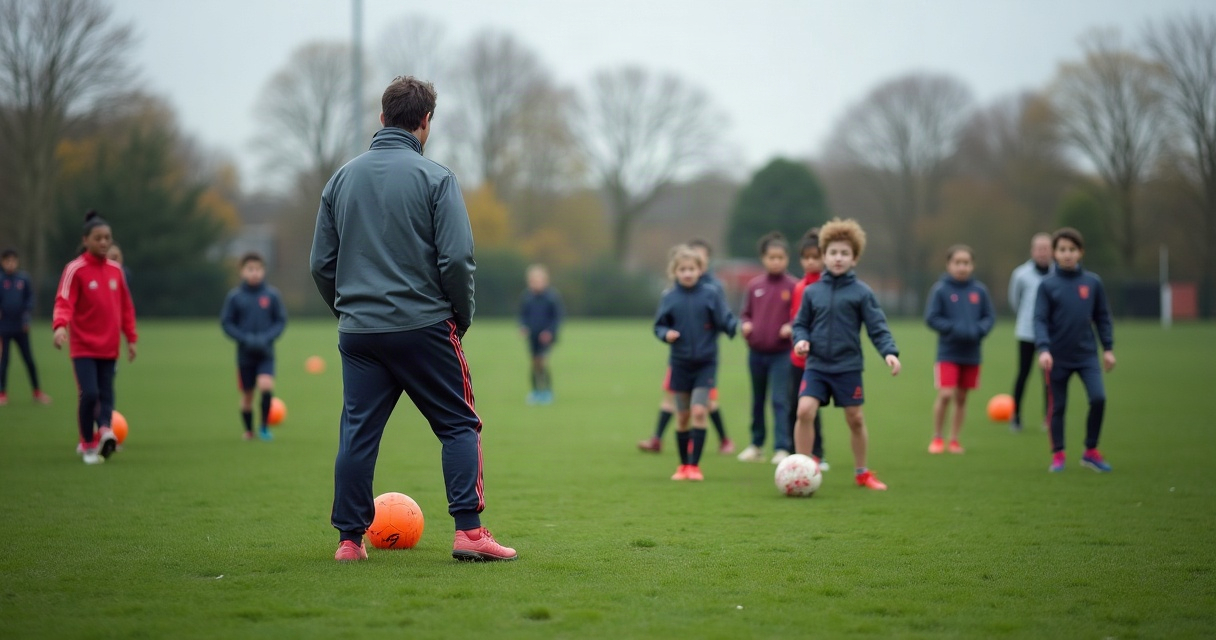
Teach young players to finish decisively in crowded penalty areas with timing, awareness and confidence-building drills.
Understanding the Challenge of Finishing Through Traffic
At U9 level, children naturally learn to strike the ball cleanly in open space. However, real matches often require finishing through congested areas where defenders block paths and space is limited. This challenges players to process multiple cues—ball position, defender positioning, and finishing options—in rapid succession. Without practice, young players may either hold their shot too long or abandon the chance altogether when confronted by traffic. The solution lies in structured scenarios that build familiarity with spatial awareness and timing, while reinforcing the confidence to act decisively.
To introduce this concept, start with low-pressure situations. For example, place a single attacker near the penalty spot with a defender positioned between them and the goal. The aim is not to score, but to encourage the attacker to find a way to shoot despite the defender's presence. Coaches can use soft targets like cones, buckets, or even their legs for the attacker to aim at, allowing children to focus on technique rather than fear. Over time, this builds the mental resilience needed to translate controlled practice into match confidence, ensuring players see traffic not as a barrier but as part of the natural flow of game decisions.
Creating the Right Scenarios to Practice
Designing effective practice scenarios requires balancing realism with achievable goals for young players. Begin with 1v1 or 2v1 exercises in the penalty area to simulate real match situations while prioritising safety. Position attackers with the ball at the top of the box, facing a lone defender with the goal as a target. The attacker must assess the defender's movements and choose the optimal moment to shoot, whether that means timing a run past a marker or finishing before the defender closes down. This encourages natural problem-solving while reinforcing the importance of reading body language and space.
Progress to small-sided games where multiple defenders attempt to block shooting lanes. A 4v2 game in a 20m by 20m box with two central defenders works well. The attacking team tries to create shooting opportunities by drawing defenders out of position, while the defenders work to restrict space. Coaches should avoid penalising defenders for blocks, instead rewarding defenders who make attackers rethink their finishing approach. This fosters a learning environment where traffic is a normal game dynamic rather than an artificial obstacle. As children become more comfortable, introduce rolling defenders who follow the shooter’s initial shot, adding a layer of movement to simulate match-level pressure.
Building Decision-Making Skills Through Awareness
The ability to finish through traffic relies heavily on a player’s ability to process information and react decisively. At U9 level, this means developing players' capacity to 'scan' before and during a shot. Teach players the simple habit of glancing around after receiving the ball to identify defender positions, open spaces, and potential shooting angles. Use exercises like 'Target and Move' where attackers must first run to a cone (representing a shooting zone) before receiving a pass and immediately attempting a shot. This habit trains eyesight and body orientation without requiring advanced technical skills.
Integrate timing into these scenarios by varying defender speed. For instance, have defenders start stationary, then gradually allow them to move closer to the ball-carrier. This controlled escalation helps players practice adjusting their decision-making under increasing pressure. Coaches should praise all attempts to find a way through traffic, whether a direct shot or a quick run to adjust positioning. Over time, players learn to trust their instincts and commit to their decision early rather than delaying their action until it’s too late. This mindset shift is crucial for turning practice successes into match-winning confidence.
Maximising Touch Time and Rotations
At grassroots level, ensuring every child feels involved and valued is as important as technical development. To achieve this, structure sessions with frequent rotations—after every few scoring attempts, swap attackers and defenders to ensure balanced participation. Use multiple penalty-area zones simultaneously. For example, divide a large group into three teams each working on a separate 10m by 15m playing area. This maximises continuous play while minimising downtime, keeping all children engaged and focused on decision-making.
Incorporate fun elements like colour-coded targets (red for low shots, green for high finishes) to make technical goals visual and achievable. Award small incentives for completing shooting challenges, such as accumulating 'goal points' for each effort aimed at these targets. This encourages players to practice timing and placement naturally, without feeling overcoached. As sessions end, invite older players to demonstrate their techniques for their peers, using peer-to-peer learning to reinforce confidence and inclusion. For further ideas, explore the live Penalty Area Movement session plan or our full U9 Finishing collection to expand your practice toolkit.
Written and reviewed by the PlayTactiq Coaching Team
Practical guidance for grassroots coaches, shaped around age-appropriate sessions, clear coaching language and real match-day problems.
Put it into a session
Ready-to-run U9 session plans
Setup, animated diagrams, coaching points and player-number adaptations — every U9 session in one place.
U9 football session plans →