
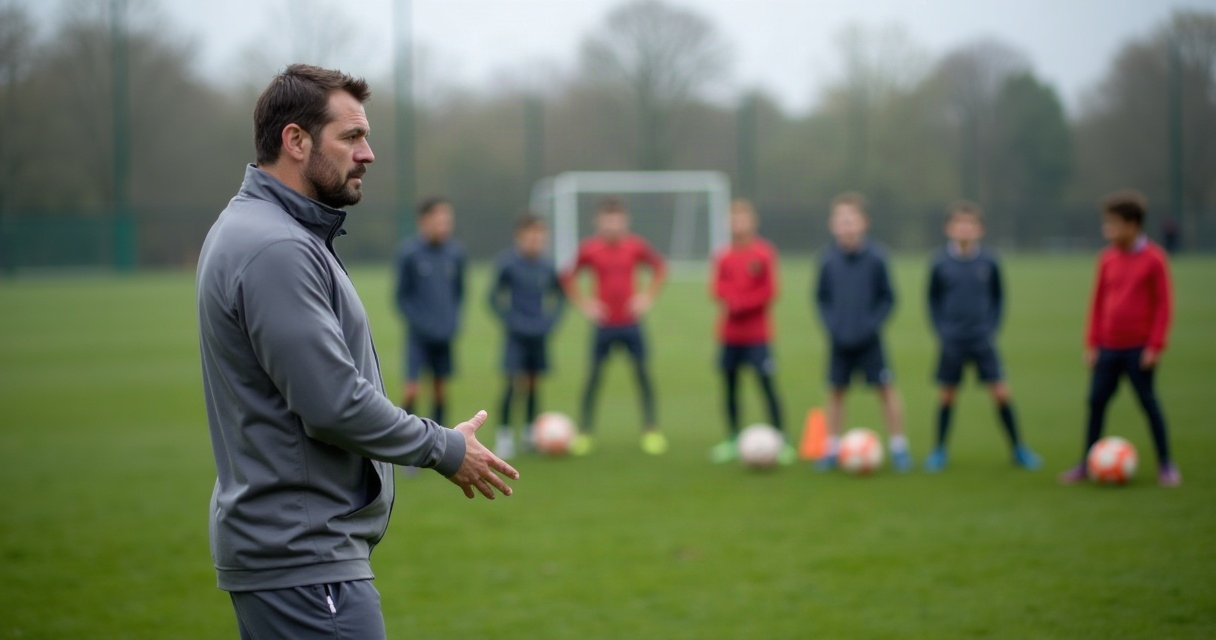
Help young players discover space on the other side of the pitch with simple cues, smart progressions and plenty of turns.
Switching play is one of those ideas that sounds tactical but feels magical the moment a child actually does it. The ball is on the left, defenders are scrambling across, and then—one diagonal pass—and suddenly a teammate is free on the right with the whole pitch opening up ahead. For U10s, that moment of realisation is worth more than any drill.
This article sits alongside the Switch It: Finding Space on the Other Side session and gives you the background thinking to coach it well. You do not need a whiteboard or a long team talk. You need good questions, short bursts of activity, and the confidence to let children figure it out for themselves.
Why U10s Are Ready for This Idea
Children at this age are beginning to lift their heads and read what is around them, not just chase the ball. They can hold a simple rule in mind—if everyone is there, look over here—and they love the feeling of being clever without having to be the fastest or strongest player on the pitch.
Switching play rewards curiosity. A quieter child who scans the pitch and plays a well-timed diagonal can unlock a goal as effectively as the player who dribbles past four opponents. That matters for inclusion. When you praise the thinking rather than the outcome, every child in your group has a chance to shine.
The key is keeping the concept concrete. Avoid phrases like playing out wide or switching the point of attack. Instead, point to one crowded side and say, 'If lots of players are here, where is the space?' Children will point to the other side almost instantly. You have just taught switching play.
The Biggest Coaching Mistake to Avoid
The temptation when introducing any new idea is to stop play constantly and explain. Resist it. Children learn switching play by doing it, losing the ball, trying again, and suddenly feeling it work. Each stoppage costs them a turn and a chance to discover something.
Instead, pause briefly and specifically. When a switch works, freeze the game for ten seconds and ask, 'Who spotted the empty side first?' Then restart. When a switch fails, let play continue unless there is a clear teaching moment—and even then, ask a question rather than provide the answer. 'What do you think went wrong?' followed by silence is far more powerful than a two-minute explanation.
Keep your interventions short enough that no child stands still for long. Waiting is the enemy of learning at this age.
Making Every Child Feel Included
Switching play involves three things happening in sequence: spotting the space, deciding to switch, and executing the pass. Not every child will be comfortable with all three at the same time, and that is completely fine.
If a child is hesitant to receive the ball under pressure, give them a role that uses their strength first. Ask them to be your space spotter—their job is simply to call out where the empty side is during a game. 'Space right!' is a real contribution and builds the habit of scanning without the anxiety of being the one to make the pass.
For children who find the passing distances challenging, bring the cones closer together. The concept is identical in a smaller area, and success breeds confidence. Once they feel the diagonal working over fifteen yards, they will naturally want to try it over twenty-five.
For more advanced players, add a condition rather than a longer explanation. Three touches maximum before switching forces quicker thinking. A bonus point for reaching a wide target player adds purpose to the diagonal without you having to say a word.
The principle throughout is simple: adjust the task, not the child. Everyone works on switching play together, and everyone gets roughly the same number of turns.
Questions That Open Minds
The language you use as a coach shapes how children think about the game. Questions that invite thinking are more useful than statements that deliver answers, especially when you want children to own the idea rather than just copy it.
Try these during and after activities:
- 'Where was the space when you switched?'
- 'What helped your teammate receive it cleanly?'
- 'If you were the defender, which side would you rather the ball went?'
- 'What could you do differently if the switch got intercepted?'
None of these questions has one correct answer, and that is the point. Children start to argue gently with each other, test ideas, and build their own understanding. You become the person who asks good questions, not the person who holds all the knowledge. That shift is subtle but enormously valuable over a full season.
When praising, be specific about the thinking rather than the result. 'I noticed you checked the right side before you passed—that is exactly the awareness switching play needs' lands better than 'Great pass.' The first comment tells a child what they did well so they can do it again on purpose.
Carrying It Into Match Day
A session that introduces switching play well will start to show in matches within a few weeks, but only if you keep nudging it gently. During a game, a quiet word to a player on the ball—'Other side?'—is often enough. You are not instructing; you are prompting them to look.
Do not worry if switches are clumsy or misplaced at first. A child who attempts a diagonal and overhits it has understood the idea. A child who never tries it is still waiting for permission. Your job is to make the attempt feel safe and worth celebrating.
Over time, you will see players checking across the pitch before they receive the ball, not after. That moment—when the scan happens before the touch—is the sign that switching play has genuinely become part of how a child thinks about football.
Browse other sessions and themes if you want to build on this idea with complementary practices around width, movement and creating space in different areas of the pitch.
Written and reviewed by the PlayTactiq Coaching Team
Practical guidance for grassroots coaches, shaped around age-appropriate sessions, clear coaching language and real match-day problems.
Put it into a session
Ready-to-run U10 session plans
Setup, animated diagrams, coaching points and player-number adaptations — every U10 session in one place.
U10 football session plans →