
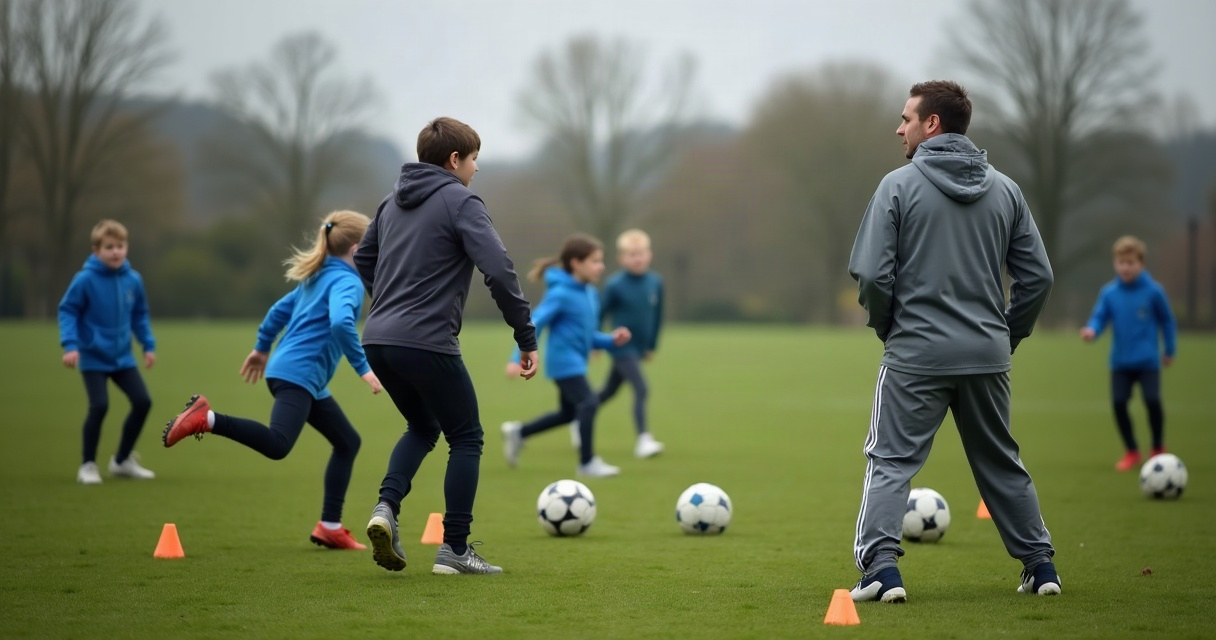
Help young beginners find team-mates and weight passes accurately with these simple coaching ideas for five-yard passing.
The Connection That Makes Football Feel Good
At under-8s, football is really about people. A child who passes the ball to a friend and watches them control it has just done something remarkable—they made a choice, aimed carefully, and trusted someone else. That moment of connection is worth more than any tactical lesson you could plan.
Short passing over five yards is where beginners discover this feeling for the first time. The distance is close enough that children can see their target clearly, adjust naturally, and actually succeed. Success matters enormously at this age. A child who feels competent will try again. A child who feels lost will disengage, and often nobody notices until weeks later when their enthusiasm has quietly faded.
So before thinking about technique, think about experience. Does every child in your session get lots of turns? Do they feel the ball often enough to build a sense of what 'just right' feels like? If the answer is yes, you are already coaching well.
What 'Accurate' Actually Means for a Beginner
For adults, accuracy means hitting a target precisely. For an eight-year-old, accuracy is a much more forgiving idea—and that's how it should be taught.
A good pass at this level arrives at a height the receiver can deal with, moves at a pace they can match, and lands close enough to their feet that they don't have to lunge or scramble. It doesn't have to be perfect. It has to be usable.
This distinction changes how you coach. Instead of correcting every wayward pass, you start noticing intent. Did the child look at their team-mate before passing? Did they try to take the pace off the ball? Did they aim at the feet rather than blasting it? If the answer to any of these is yes, praise that specifically. 'I could see you were trying to make it easy for them—that's exactly right' tells a child what to repeat next time far better than 'good pass' ever could.
Three things tend to go wrong for beginners with short passing, and they are nearly always fixable:
- Distance misjudgement — the ball is kicked too hard for the space involved. Remind them gently: 'Easy feet—it's only five yards.'
- Looking down — children watch the ball rather than where they're sending it. Encourage them to glance up before they pass.
- Nerves — overthinking produces stiffness and mishits. A calm 'you've got this, nice and easy' often unlocks more than any technical cue.
When you can see which of the three is causing the problem, your intervention becomes precise and quiet rather than general and loud. Children respond better to one clear idea than to a list of corrections.
Building Turns Into Your Session
One of the most common reasons U8 sessions lose energy is waiting. Children stand in lines, watch others go, and gradually switch off. By the time their turn arrives, their attention is somewhere else entirely.
The solution is simple: give every pair their own ball and their own space. When each partnership is working simultaneously, everyone is active, and you can move around observing rather than managing a queue.
Pass It Right: Finding Your Team-Mate is built around this idea. Partners work in their own grid, one passing and one receiving, swapping roles after a short set of attempts. Nobody waits. Nobody watches. Everyone is feeling the ball.
If you have an odd number of children, make one group of three and rotate the extra role naturally. If a child arrives late or leaves early, the structure absorbs it without drama. Pairs-based work is robust in that way, which matters on a muddy Tuesday evening when three parents are running late and someone has forgotten their boots.
Adapting So Every Child Can Succeed
Inclusion in grassroots coaching isn't a special extra—it's the whole job. A session that works for the most confident child in your group but leaves two others frustrated or invisible hasn't worked.
Short passing over five yards is already a gentler ask than most football activities, but you can adjust further without drawing attention to individual children:
Closer distance. If a child is finding five yards difficult, quietly suggest they try from four yards, or even three. Accuracy at three yards still builds the same habit. Increase the distance when confidence grows.
Different starting action. For a child who is very new to kicking, let them start by pushing the ball along the ground with the inside of their foot rather than swinging at it. The mechanical feeling is similar; the fear is much lower.
Movement for children who find stillness hard. Some children simply cannot stand still and wait—it's not misbehaviour, it's how they're wired. Let the receiving player jog gently on the spot. They are still a target; they are just a moving one, which actually leads naturally into later progressions anyway.
Praise the attempt, not the outcome. 'I noticed you aimed carefully' is available to every child in the group, regardless of where the ball ended up. This kind of specific, effort-based praise keeps reluctant players engaged because they know their thinking is being seen.
The goal of every adaptation is the same: keep the child in the game, feeling the ball, and wanting to try again.
Carrying the Habit Into Match Play
Everything that happens in training is a rehearsal for what children do when a real game is in front of them. But the link between practice and match play isn't automatic—you have to help children see it.
In small-sided games at U8, short passing opportunities appear constantly. A child receives the ball near the edge of play. A team-mate is five yards away with space. The natural response, for a beginner, is often to kick it long or run with it—not because they don't know how to pass, but because the game feels fast and a short pass feels risky.
The question that helps most is: 'Who's close to you?' rather than 'Why didn't you pass?' One question opens thinking; the other closes it down. Ask it before the next restart, not in the moment of the missed opportunity.
Over time, children begin to scan for nearby team-mates as a habit—not because you told them to, but because they've done it successfully in training and it felt good. That's the real result of good U8 passing work: not a perfect technique, but a confident instinct.
For more session ideas across different ages and themes, browse /explore and filter by age group and ability level.
Written and reviewed by the PlayTactiq Coaching Team
Practical guidance for grassroots coaches, shaped around age-appropriate sessions, clear coaching language and real match-day problems.
Put it into a session
Ready-to-run U8 session plans
Setup, animated diagrams, coaching points and player-number adaptations — every U8 session in one place.
U8 football session plans →