
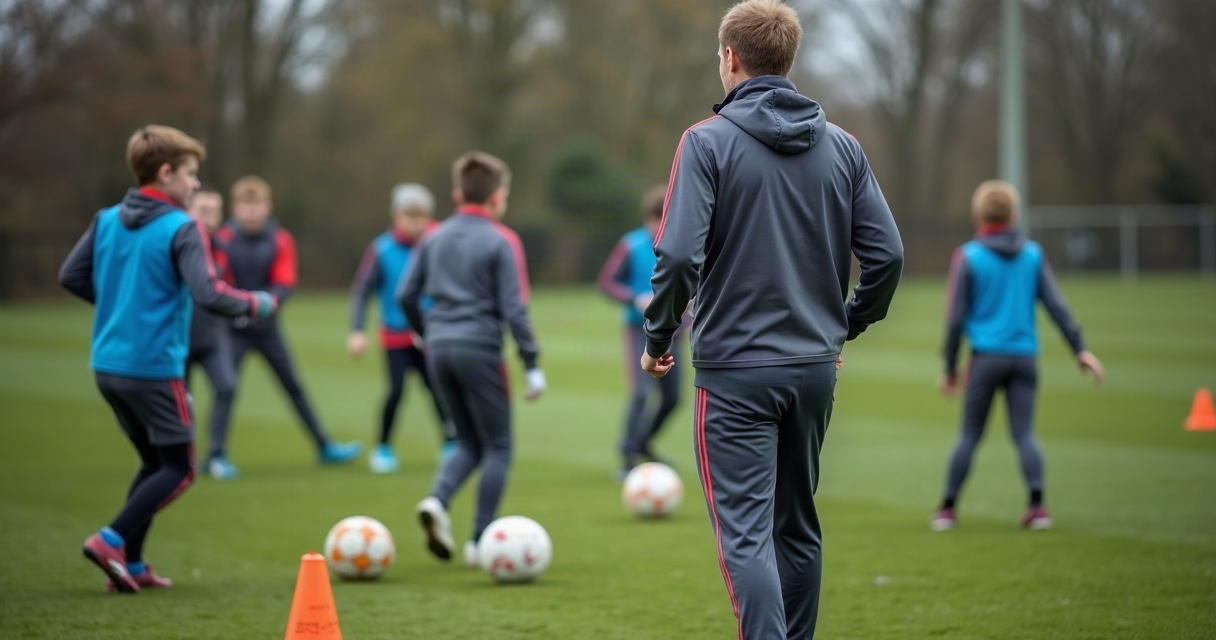
Help your U14 defenders read passes and step across early—so they win the ball smartly without leaving themselves on the floor.
Why Interceptions Beat Sliding Tackles at This Age
Ask a group of 13- and 14-year-olds what a great defender looks like and they'll usually mime a slide tackle. It's dramatic, it looks athletic, and they've seen it on television. The problem is that diving in—whether that's a full slide or just a lunge—tends to leave defenders on the ground, out of position, and hoping for the best. At this age, the physical gaps between players are already noticeable. A defender who commits too early will get beaten by pace almost every time.
Interceptions are different. When a player reads where a pass is going and moves across the passing lane before the ball arrives, they're using information rather than speed. That levels the playing field. A quieter, less physically dominant player who has learned to watch the passer's body shape can regularly beat more powerful opponents simply by being in the right place. That's a deeply satisfying feeling, and it's one worth chasing in training.
This matters for confidence too. When a young player makes a good interception, there's a moment of genuine pride—they saw something, they acted on it, and it worked. Reinforce that moment every time you see it, even when they don't win the ball. 'You read that early' is worth saying out loud.
What Players Need to Watch For
The habit to build is watching the passer, not the ball. This sounds simple but takes real repetition to stick. Most young players fix their eyes on the ball as soon as it's moving, which means they're always reacting late. Teach them instead to look at the passer's hips, shoulders, and eye line. These give away the direction of the pass before the foot even strikes the ball.
Once they're watching the right thing, the next step is moving early. 'Early' doesn't mean guessing—it means committing to a position as the pass is being shaped, not after the ball leaves the foot. The difference between stepping across a passing lane at the right moment and arriving a beat too late is often just a matter of reading the signs sooner.
Communication is the third piece. Defenders don't work in isolation. In a back four, a centre-back stepping across to intercept a through-ball needs their partner to know about it so the space they've left isn't suddenly exposed. Short, clear calls—'I'm stepping,' 'yours,' 'drop'—become habits when you build them in training. The Read and React practice builds exactly this kind of awareness through rondo work and small-sided games where defenders must cover for each other.
Making This Work in Training
The principle to keep front of mind when you're planning is maximum turns, minimum waiting. Every minute a player spends watching rather than doing is a minute the habit isn't forming. That means keeping groups small, keeping the activity moving, and keeping explanations short.
For introducing the idea, pairs work brilliantly. Two players, eight metres apart, one passing and one reading—the receiver watches, anticipates, and steps across an imaginary line before receiving. Everyone's active, there's no pressure, and you can move around the group offering individual cues. 'What did you see before the ball moved?' is a question worth asking rather than telling. It encourages players to process what they observed rather than just following an instruction.
For building the skill under pressure, rondo formats—three attackers against two defenders, or four against two—add decision-making without overwhelming anyone. The defending pair have to communicate, shift position, and resist the urge to both chase the same ball. When one of them reads a pass and intercepts cleanly, make a point of pausing play to acknowledge it. Young players at this age respond well to being noticed for thinking, not just for physical effort.
For players who are less confident or still finding their feet positionally, reduce the pressure initially. One attacker, one defender in a small space, with the task simply being to shadow the attacker's passing direction and stay goalside. Success at a smaller scale builds the composure to step up into fuller exercises.
What to Reinforce and What to Avoid
Praise the behaviour you want to see more of, even when it doesn't produce an interception. 'I loved how you moved across there' or 'you stayed calm when you could have dived in' are comments that build the habit. If you only praise successful interceptions, players learn to gamble—they'll lunge in and hope. What you want them to do is make smart decisions consistently, so reward the decision-making.
When someone does dive in and lose position, resist the urge to correct them in front of everyone. A quiet question at a natural pause—'what were you watching before you went?'—is far more useful than a public critique. It invites reflection without embarrassment, which matters a great deal at this age when self-consciousness is already high.
Avoid lengthy stoppages to explain tactical concepts mid-session. Keep the ball moving. Brief coaching moments of ten or fifteen seconds are usually more effective than extended explanations, partly because the players stay warm and switched on, and partly because what they've just experienced is fresh. 'Did you notice where he looked just before the pass? That's the tell'—said in the moment, after a good interception—lands better than a diagram shown before the session even starts.
End with a short reflection. Asking the group 'who saw a defender do something clever today?' gives players a chance to notice each other's thinking, which reinforces the idea that reading the game is a skill worth having. It also gives quieter players a moment in the spotlight without putting them on the spot.
Carrying This Into Matches
Formation shapes shift at this age—some teams play a back three, some a back four, some have a midfield line that defends aggressively. The specific shape matters less than the principle: every defender, wherever they are on the pitch, is looking for passing lanes to step into rather than attackers to chase down.
Full-backs benefit particularly. A winger running at pace is genuinely difficult to stop with a tackle at U14. But wingers usually have limited options—they pass across goal, they cut back, or they try to play in a runner. A full-back who has learned to read those options early can position themselves to intercept the most likely pass rather than commit to stopping the dribble. One or two of those per match changes the dynamic completely.
Browse more defending and transition practices to find sessions that pair well with this one and keep the theme developing across your coaching programme.
Written and reviewed by the PlayTactiq Coaching Team
Practical guidance for grassroots coaches, shaped around age-appropriate sessions, clear coaching language and real match-day problems.
Put it into a session
Ready-to-run U13 and U14 session plans
Setup, animated diagrams, coaching points and player-number adaptations — every U13 and U14 session in one place.
U13 and U14 football session plans →