
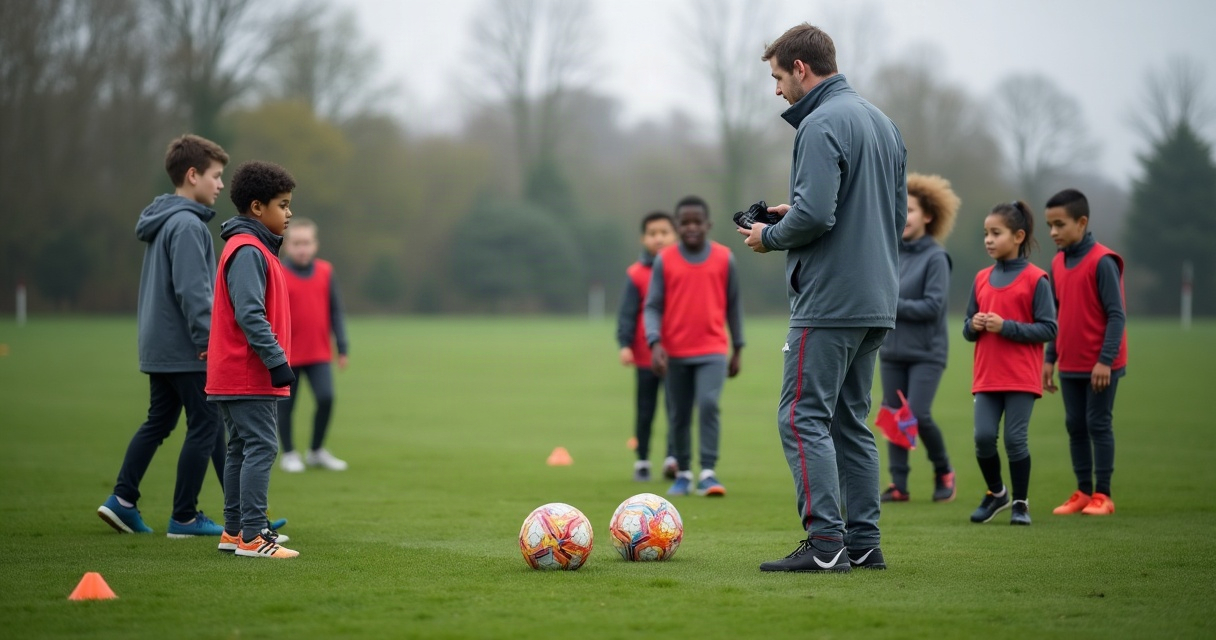
Help young beginners feel in control of the football from their very first session with these simple, confidence-first coaching ideas.
There is a moment in every young player's early sessions when the ball does exactly what they wanted. They stretch out a foot, the ball stops, and their face changes. That moment — small, quiet, completely ordinary to anyone watching — is the whole point of coaching at U8. Your job is to make it happen as often as possible.
Stopping and starting the ball are the two movements that make everything else in football possible. Before a child can pass, dribble, or play in a small-sided game with any enjoyment, they need to feel that the ball responds to them. This article explains why those two skills matter so much at this age, and how to set up a session where every child gets plenty of chances to experience that feeling of control.
The Stop It, Move It practice is designed for exactly this purpose, and the ideas here sit alongside it — offering a bit more of the 'why' behind the choices.
Why These Two Skills Come First
At U8, children are not yet thinking about tactics or positions. They are trying to understand a basic physical relationship: what do I do with my body, and what does the ball do in response? That cause-and-effect connection is the foundation of all football learning, and it only develops through lots and lots of touches.
Stopping is the more important of the two skills to establish first. When a child can reliably bring a ball to rest, they gain a moment of stillness — time to look up, notice a friend, and make a small decision. Without that pause, football becomes chaotic and tiring. Children end up chasing rather than playing, and the fun drains away quickly.
Starting — pushing the ball gently into space — teaches them that small, controlled movements are more useful than big ones. This is genuinely counterintuitive for many young children, who associate effort with big kicks. Helping them discover that a soft push gives them more choices than a hard one is one of the most useful things you can do in these early sessions.
Neither skill needs to be perfect before children move on. What you are looking for is a growing sense of ease — a child who stops and looks around rather than stops and panics.
One Ball Each, All the Time
The single most important structural decision in any U8 session is this: every child should have a ball in their zone or at their feet at almost all times. Waiting is the enemy of learning at this age. Children switch off quickly when they are standing in a queue, and the child who most needs practice is usually the one who hangs back and gets fewer turns.
Zone-based rotation solves this neatly. Four small zones, one ball each, children rotating every few minutes — that structure means there is always something happening, always a new stimulus, and never a reason to stand still and wait. It also means you can position yourself at the zone where a particular child needs a quiet, encouraging word, rather than projecting instructions across the whole group.
Keep the zones small. A smaller space means the ball is never far away, children are not running long distances between touches, and you can see everyone easily. The physical effort stays manageable and the practice stays focused on skill rather than fitness.
Making Stops Feel Safe and Starts Feel Satisfying
Two coaching images tend to unlock these skills more quickly than technical explanation. The first is catching. When you ask a child to 'catch it with your foot', something shifts in how they approach a rolling ball. They soften, they reach, they make contact gently — and the ball stops. The sole-of-the-foot stop becomes intuitive when it is framed as catching rather than blocking.
The second image is a small push, not a big kick. If children hear 'push', they tend to use the right part of their foot and the right amount of force. A gentle nudge forward, then a stop. Two pushes, then a stop. That rhythm — move, control, move, control — begins to feel natural after only a few minutes of practice, and it directly mirrors what happens in a real game.
When you see a child make a clean, soft stop, say something specific: 'You caught that beautifully' or 'I saw your foot relax — that's exactly it.' Specific praise is far more useful than general encouragement, because it tells the child what they actually did well and helps them repeat it intentionally.
When a stop goes wrong and the ball bounces away, resist the urge to show or tell immediately. Ask instead: 'What happened there? How might you try it differently?' Children who find their own answers remember them. Children who are told often forget by the next attempt.
Bringing It Into a Small-Sided Game
The practice skills transfer naturally into a game when the game is set up to reward control rather than speed. A small pitch — something around 25m × 20m for a 3v3 — keeps the ball close and gives children plenty of moments to receive, stop, and make a small decision.
At this age, do not worry about positions or shape. The game is simply: stop the ball when you get it, then choose — pass to a friend, or push it forward yourself. That is all. Children who have spent time in the practice zones will find those two actions feel familiar. They stop, they look up briefly, they move. That is football, and it is enough.
Watch for the moments when a clean stop gives a teammate time to find space. You do not need to explain this as a tactic. You can just point it out afterwards: 'Did you see what happened when you stopped it and waited a moment? Your friend had time to move.' Small observations like that, offered with warmth rather than instruction, start to build football understanding without overloading young minds.
Ending Well
Before children leave, ask one simple question: 'What's one thing you got better at today?' Listen. Let them answer in their own words, even if what they say sounds small or sideways. That moment of reflection tells a child that their experience matters, and it plants a reason to come back.
Sessions like this one work because every child leaves having done something real. They stopped a ball. They pushed it somewhere. They felt clever. Build enough of those moments and football becomes the thing they want to do — not the thing they are made to do.
Browse more beginner sessions across different sports at /explore.
Written and reviewed by the PlayTactiq Coaching Team
Practical guidance for grassroots coaches, shaped around age-appropriate sessions, clear coaching language and real match-day problems.
Put it into a session
Ready-to-run U8 session plans
Setup, animated diagrams, coaching points and player-number adaptations — every U8 session in one place.
U8 football session plans →