
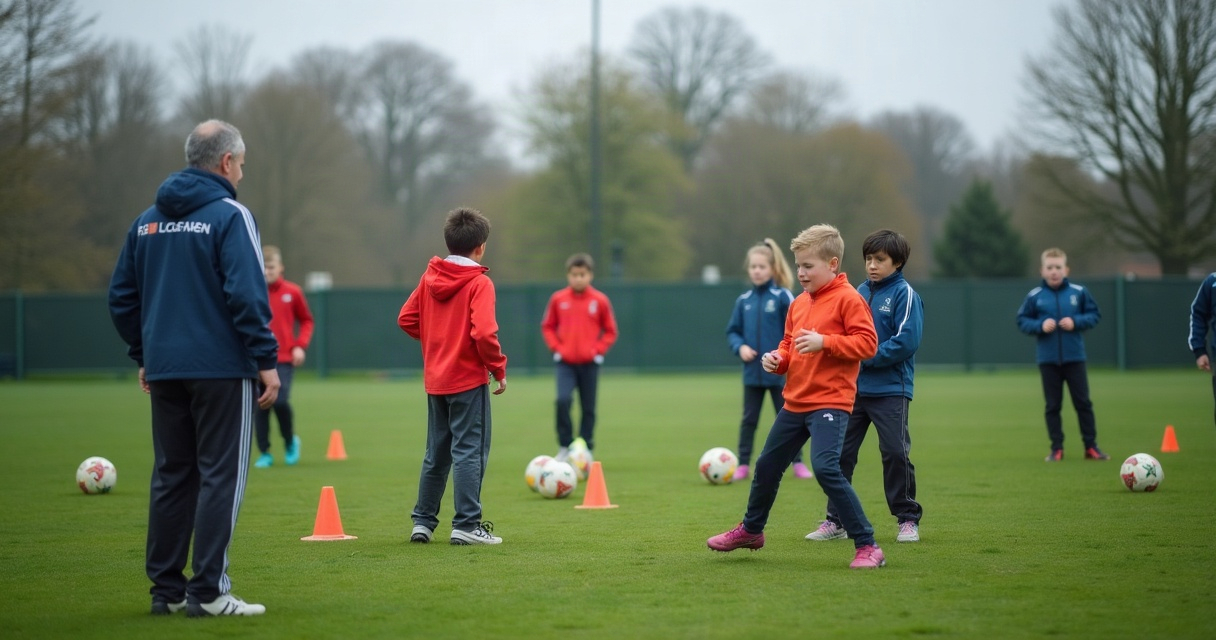
Help your U14s feel genuinely quicker by coaching the five-yard burst that decides most real football moments.
Most football races are over before they look like races. A defender intercepts a through ball not because they are the quickest player on the pitch, but because they got moving half a second before everyone else. An attacker bursts clear not because of top-end pace, but because their first two steps were decisive. At U14, your players are sharp enough to notice this pattern—and motivated enough to do something about it once you show them.
This article sits alongside the First Two Steps session on PlayTactiq and explains the thinking behind it: why short-burst acceleration matters at this age, how to coach it without turning a session into a tedious athletics lesson, and what to watch for when things are flowing well—or not.
What Actually Happens in Five Yards
Five metres sounds tiny. In a 90-minute game it is almost everything. Think about the moments that actually decide things at youth level: a centre-back stepping to cut out a pass, a winger checking and going, a midfielder getting to a loose ball first. None of those moments involve 30 metres of open ground. They all involve a tiny window where the first player to commit, lean and drive gets there.
That lean-and-drive is learnable. It is not just raw speed, which is largely genetic at this age. It is body position, readiness and reaction—three things that improve with good practice and feel immediately rewarding when they click. A player who discovers they can get somewhere half a second faster than they did last week will want to do it again. That is the motivation you are building on.
Be careful not to confuse this with sprint training. Sprinting is a separate discipline and, frankly, a dull one to coach in a grassroots setting. What you want is game-like sharpness: small competitive moments where a quick first step has an immediate outcome. A cone tagged before someone else. A ball reached. A line broken. The brain learns fastest when the stakes are real and the feedback is instant.
The Coaching Habits That Help Most
Before you even think about drills, the way you run the session matters more than anything on the clipboard.
Keep queues very short. At U14, players can handle more complex tasks than younger age groups, but they still disengage the moment they are standing around. Aim for maximum two players waiting at any station. Running two or three lines of the same activity simultaneously is almost always better than one tidy demo line.
Use reaction cues, not standing starts. Acceleration from a stationary, set position is athletics. Acceleration in response to a call, a movement, or a loose ball is football. Your warm-up cue, your coloured cone call, your 'go' command—these all train the reactive part of the first step, which is the part that transfers to a match.
Name what you see, quickly. When a player drives off their front foot and gets there first, say so immediately and specifically. 'Sharp first step, that is exactly it' is more useful than 'well done'. The player then has a label for what they did, and they can repeat it intentionally. Praise the effort to accelerate even when the player does not win the race—'I saw you really commit there'—so confidence is not tied to outcome.
Ask questions more than you give answers. 'What made that hard?' 'How did your body feel when you got there quickly?' 'Who reacted faster and why?' Asking does two things: it keeps players thinking rather than waiting to be told, and it tells you what they already understand so you are not explaining things they have already worked out.
Inclusion and Confidence at This Age
U14 is an interesting age socially. Some players are physically ahead of others, confidence varies enormously, and a session built entirely around direct one-on-one races can quietly crush the players who most need building up. A few habits prevent this.
Mixed pairings work better than competitive pairings done instinctively by the players themselves, which usually groups friends and skill levels together. Pair a less confident player with someone patient, not with someone who will sprint away from them every time and make them feel slow.
Give players roles that are involved but lower pressure when they need it. Counting repetitions, calling the go signal, timing a partner—these are not sidelining tasks, they are genuine jobs, and a shy player who spends two minutes as the caller before they compete often arrives at their own turn feeling part of things rather than anxious.
For Break the Line specifically, a static defender role works well as an entry point. The player is active, they are part of the competition, and the pressure sits on the attacker. Move a less confident player into the attacker role once they have had a few successful defensive turns and have something to build on.
When you run these activities, watch for the player who hesitates at the start. Hesitation is almost never about physical speed. It is usually about not yet trusting themselves to go. Say: 'React first, think second.' Repetition, not instruction, is what fixes it. Give them more turns.
Taking It Into the Game
The session work only sticks if players start to see the same moments in a real game context. When you move to a small-sided game, do not lecture about first steps—let play run and then gently pause at moments where you saw it matter.
'Did you notice what happened when she went early there?' is enough. Let the players describe what they saw. They will identify the pattern faster than you expect at this age, and because it came from them, they will hold onto it.
In transition moments particularly—the turnover, the quick counter, the loose ball after a set piece—first-step sharpness is decisive. Watch for it, name it warmly when it happens, and ask a question when it does not: 'Who could have gone earlier there?'
Avoid fixing players into rigid positional roles during this kind of session. 'Who can get there first?' is a better question than 'you are the striker, go'. It trains tempo awareness alongside acceleration, which is the habit you want at U14 and beyond.
For more session ideas built on the same principles, explore the full PlayTactiq library and filter by age group and theme.
Written and reviewed by the PlayTactiq Coaching Team
Practical guidance for grassroots coaches, shaped around age-appropriate sessions, clear coaching language and real match-day problems.
Put it into a session
Ready-to-run U13 and U14 session plans
Setup, animated diagrams, coaching points and player-number adaptations — every U13 and U14 session in one place.
U13 and U14 football session plans →