
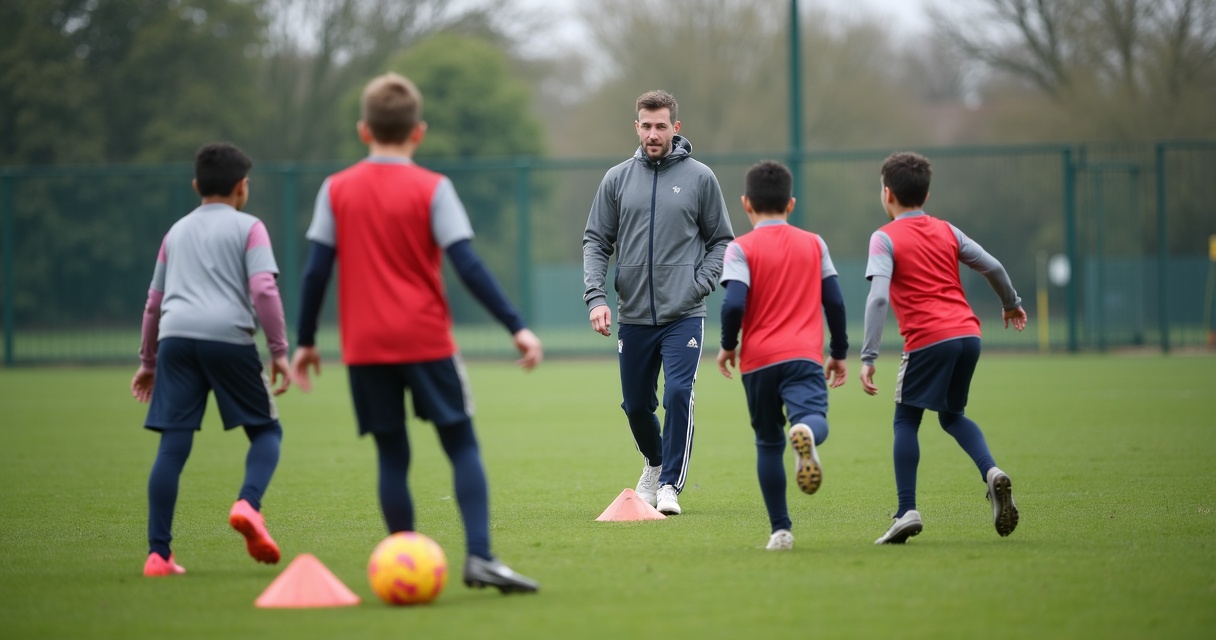
Teach young goalkeepers to command their area with confidence. This U12 drill builds decision-making, communication, and distribution skills that transform
Goalkeeping at U12 is about far more than making saves. The most influential young keepers aren't always the ones with the quickest reflexes—they're the ones who command respect through clarity, positioning, and vocal leadership. A goalkeeper who confidently owns their area reduces defensive confusion, builds team cohesion from the back, and transforms the entire defensive unit's shape and reaction time.
This session focuses on developing the decision-making framework that separates average keepers from leaders: when to claim crosses with certainty, when to punch under pressure, how to organise defenders through communication, and how to distribute quickly to launch counter-attacks. These principles work across any formation or tactical system.
Why Area Command Matters at U12
Young goalkeepers often hesitate when crosses arrive. They're uncertain whether to advance, stay on the line, or leave it for defenders. This hesitation creates a ripple effect through your entire defensive unit. Defenders don't know whether to clear, mark space, or compete for the ball. Attackers sense this uncertainty and exploit loose balls or unmarked runners.
When a keeper communicates decisively—calling for the ball, directing defenders into position, and taking ownership—everything changes. The defensive shape becomes tighter. Players know their roles. Confidence spreads from the back forward.
Beyond defence, commanding the area unlocks attacking potential. A goalkeeper who can quickly scan the field and distribute to an outlet launches fast transitions that catch opponents off-guard. At U12, this combination of defensive stability and attacking speed is a major competitive advantage.
The foundation you build now directly enables progression into advanced goalkeeper play at older age groups. Young keepers who learn to command their area become natural leaders, elevating their entire team's performance.
The 60-Minute Session Structure
This drill runs across three phases, each building complexity and game-realism while keeping young goalkeepers engaged through variety.
Phase 1: Static Crosses and Decision-Making (15 minutes)
Set up a 40x30 yard area with a full goal at one end. Position your goalkeeper in goal, four outfield defenders in a realistic defensive shape, and 4-5 attackers around the box.
Deliver crosses from the byline while the keeper focuses purely on decision-making. This is about clarity, not pressure.
The keeper's three options:
- Claim: Advance confidently and catch the ball at its highest point when it's catchable and the path is clear.
- Punch: Use a firm, two-fisted punch when crowded or when catching isn't safe.
- Allow: Let defenders clear when the keeper can't reach or when a defender is better positioned.
Before each cross, the keeper communicates aloud: calling "keeper" when claiming, or directing defenders ("Mark your man," "Space at the back post").
Rotate crosses between the right and left flanks. Vary the height, pace, and depth to keep the keeper making real decisions. Change which goalkeeper is working every 5 minutes so all get quality reps.
Coaching cue: Emphasize that communication must happen 2-3 seconds before the cross arrives. The keeper is organising, not reacting.
Phase 2: Adding Movement and Pressure (20 minutes)
Now attackers actively move to attack space as crosses are delivered. Defenders must react to the keeper's organisation. This introduces game-realistic chaos while the keeper learns to maintain clarity under pressure.
The goalkeeper's role expands:
- Organise the defensive line ("Step up," "Drop," "Squeeze")
- Call out danger ("Attacker left," "Far post open")
- Claim balls decisively, punching when necessary
- Reset mentally between each phase
The tempo increases. Decisions must be faster. Communication becomes louder and more urgent.
Coaching cue: Early decision-making matters more than perfect execution at this age. A keeper who decides quickly and communicates clearly will organise their defence effectively, even if their footwork isn't textbook.
Phase 3: Game-Realistic Progression with Distribution (15 minutes)
Add the final layer: quick distribution. After claiming or punching the ball, the goalkeeper must immediately scan for an outlet and distribute to begin a counter-attack.
Use a rolling service of crosses with realistic attacking pressure. After the keeper distributes (ideally to a defender's feet), quickly serve another cross. This simulates the rapid transitions in real matches.
Distribution principles: Distribute with purpose to a defender's feet when possible. Avoid clearing aimlessly. A quick, accurate pass to a full-back or centre-back starting a transition is far more valuable than a long clearance.
Reset quickly. Between each phase, the keeper must refocus mentally and physically.
Coaching cue: Emphasise that distribution speed matters more than distance. A 10-yard pass played quickly to feet is more effective than a 30-yard clearance that gives opponents time to reset.
Key Coaching Principles
1. Claim the ball early at its highest point. This gives defenders confidence and eliminates loose ball contests.
2. Communicate before the cross arrives. Organisation happens in advance, not during the moment.
3. Distribute to feet when possible. Build transitions from solid foundations.
4. Rotate regularly. Ensure all goalkeepers get meaningful game-time and reps. Sitting out teaches nothing.
5. Emphasis clarity over aggression. Commanding the area isn't about physical dominance—it's about confidence, positioning, and vocal leadership.
Building Leaders from the Back
Goalkeepers who master area command become leaders on the pitch. They elevate their entire team's defensive shape, reaction time, and transition speed. At U12, this foundation is invaluable. Young keepers who develop these skills now will have a significant advantage as they progress to older age groups and higher levels of play.
Focus this week on building decision-making confidence, vocal communication, and quick distribution. These principles apply across all systems and formations. The payoff—a cohesive defence and faster attacks—is worth every minute invested.
Written and reviewed by the PlayTactiq Coaching Team
Practical guidance for grassroots coaches, shaped around age-appropriate sessions, clear coaching language and real match-day problems.
Put it into a session
Ready-to-run U12 session plans
Setup, animated diagrams, coaching points and player-number adaptations — every U12 session in one place.
U12 football session plans →