
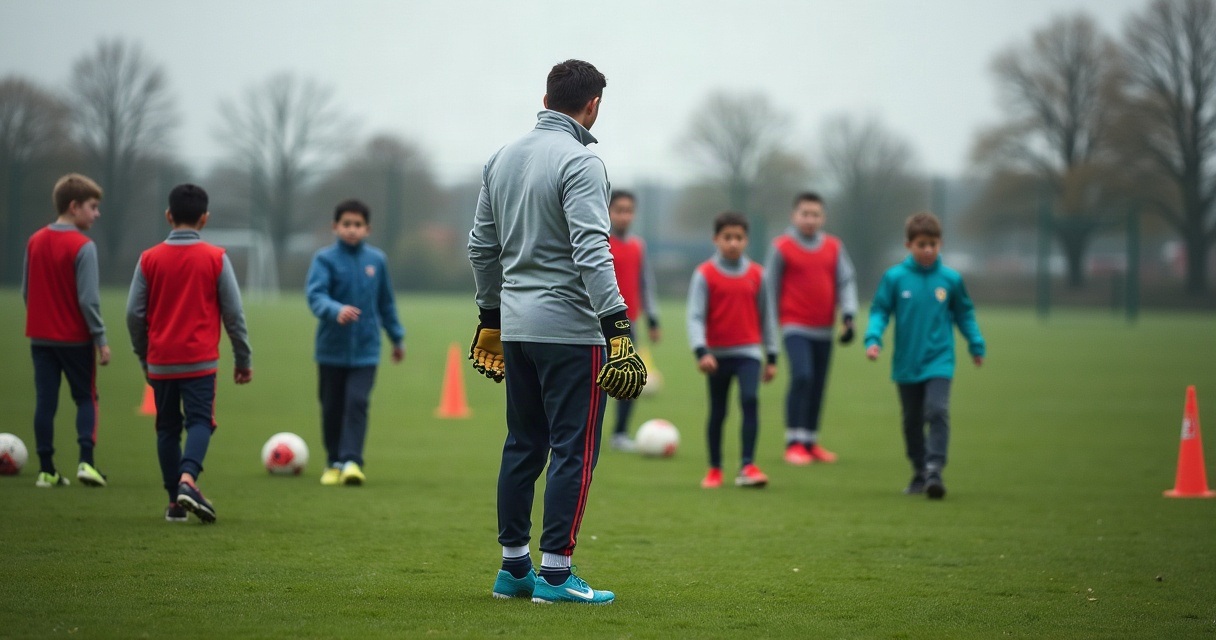
Help your U14 goalkeeper claim crosses, organise defenders and start attacks with a session built around real decisions and lots of repetition.
There is a moment in almost every grassroots match when the cross comes in, nobody calls, and the ball drops between goalkeeper and defender for a tap-in that nobody wanted to give away. If you recognise that moment, this session is for you — and for the keeper who is ready to own that box rather than just occupy it.
At U14, goalkeepers are starting to understand that their role is about more than stopping shots. They can lead, organise, and start attacks. This session gives them the repetition and the permission to do exactly that, in a way that feels exciting rather than daunting.
Session at a glance
- Age group: U14
- Ability level: Intermediate
- Total time: Around 50 minutes of active practice
- Players needed: 1 goalkeeper, 4–6 outfield players, 1–2 servers
- Space: Half-pitch or a box roughly 40 x 30 yards
- Equipment: Good supply of balls, cones to mark the area, goalkeeper gloves and padding
Why children enjoy this session
The honest answer is that the goalkeeper gets to be the most important person on the pitch for an hour, and that feels brilliant.
Rather than standing between the posts waiting for shots, the keeper is constantly moving, calling, deciding, and setting the tempo. Outfield players enjoy it too because every cross becomes a contest — the kind of small battle that children find genuinely absorbing.
The key word is decisions. Children at this age want to feel trusted. When you hand a goalkeeper real choices — come or stay, punch or claim, roll it or throw it long — and then back whatever they decide, their confidence grows in a way that telling them what to do never quite manages.
Just one thing worth keeping in mind from experience with this age group: if one part of the session runs too long, the energy drops noticeably. Shorter blocks with a clear scoring element — even something simple like 'a point for a clean claim, a point for a successful quick distribution' — keeps the intensity where you want it without you having to push for it.
How to run the session
Game One — Cross and Claim (around 6–8 minutes)
Position one or two servers wide on each flank with a pile of balls. Two or three defenders stand in the box. Each cross is a fresh decision for the goalkeeper: come and claim it, hold the line and stay big, or punch clear if the cross is dangerous and crowded.
The single most useful habit to build here is the early call. Encourage your keeper to shout 'Keeper!' or 'Mine!' the moment they decide to come — not when they arrive, but the moment the decision is made. Defenders can then react accordingly. If this feels awkward at first, just model it yourself from the sideline: 'What would you shout there?' is usually enough to prompt it.
For a keeper who is finding the timing difficult, start with slower, looping crosses from a closer distance. Let them feel a clean claim two or three times before you add pace or awkward bounce.
Game Two — Claim and Distribute (around 6–8 minutes)
Same setup, but now add a target player on each side of the pitch. After claiming, the goalkeeper distributes immediately — roll it, throw it, or kick it long depending on where the target is. Mix the delivery so they are not always doing the same thing.
The aim here is to connect claiming with starting an attack. Children enjoy this because it feels like a complete action: they win the ball and do something useful with it. That sense of control is very motivating.
Game Three — Game Pressure (15–20 minutes)
Move into a small-sided game, 5v5 or 6v6, on the same area. Ask the attacking team to cross whenever they can. The goalkeeper makes all the decisions live — no freezing the game to instruct. After each cross situation, if something brave happened, name it: 'Good call, you committed early and held it.' If something went wrong, ask rather than tell: 'What were you thinking when the ball came in?' You will often find they already know.
Keep every child involved
Rotate servers regularly so no player is standing around watching. If you have an extra outfield player, give them a specific job — tracking the keeper's distribution, for example — so they stay engaged. Keep a fresh ball ready for the next cross before the previous one has settled. Minimal waiting is what keeps the session alive.
If a player wants to try in goal, let them have a go during Game One where the demands are more contained. It helps everyone understand the goalkeeper's perspective, and it takes no time at all.
What to notice and say
Watch for the moment the keeper starts calling before they move rather than after. That is the real sign things are clicking, and it is worth naming quietly.
Try not to stop the session every time something goes wrong. If a cross is missed, start the next one. Children learn more from repetition than from interruption.
Two questions worth keeping in your back pocket:
- 'When did you decide to come for that one?'
- 'Where were you looking when you caught it?'
Neither question has a wrong answer. Both invite the child to think, which is far more useful than being told.
Safety: Brief all outfield players on goalkeeper protection before you start — no challenges after the keeper has two hands on the ball, and no contact in the air unless it is clearly accidental. Make sure gloves and any padding are on before the first cross is served.
Easy ways to adapt it
- Less confident keeper: Reduce the area, use more predictable crosses, pair them with an outfield player who calls alongside them to model the communication.
- More confident keeper: Add a pressing forward who closes down the distribution, or serve two crosses in quick succession to test movement and recovery.
- Fewer players: Use a smaller area and serve all crosses yourself so the keeper still gets plenty of repetitions.
- More players: Run two groups simultaneously, with one keeper working crosses while the other works distribution at the other end.
- No servers available: Use corner kicks or free-kick positions instead of open-play wide balls — it adds variety and mimics match situations children will recognise.
Common coach questions
'My keeper keeps coming too early and misjudging the flight — how do I fix it?' Try asking them to wait until the ball is just past the far post before moving. That one cue often sorts the timing without overcomplicating it. Patience comes with repetition.
'The outfield players keep ignoring the keeper's calls — what do I do?' Set a simple rule before the session: if the keeper calls, defenders clear the space immediately, no questions asked. Frame it as helping the keeper practise rather than a rule about hierarchy — children respond better to that framing.
'What if my goalkeeper is too shy to shout?' Start with a raised arm rather than a shout. Once the physical habit is there, the verbal call usually follows. Some children need to feel confident in the action before they add the voice to it.
A goalkeeper who claims, calls, and distributes quickly gives their whole team something to lean on — and children notice that feeling immediately. Brave decisions are what this session is really about, and your job is simply to make it safe enough to take them.
You can find the full structured session plan at Playtactiq, or browse more sessions by age group and theme if you are planning the weeks ahead.
Written and reviewed by the PlayTactiq Coaching Team
Practical guidance for grassroots coaches, shaped around age-appropriate sessions, clear coaching language and real match-day problems.
Put it into a session
Ready-to-run U13 and U14 session plans
Setup, animated diagrams, coaching points and player-number adaptations — every U13 and U14 session in one place.
U13 and U14 football session plans →