
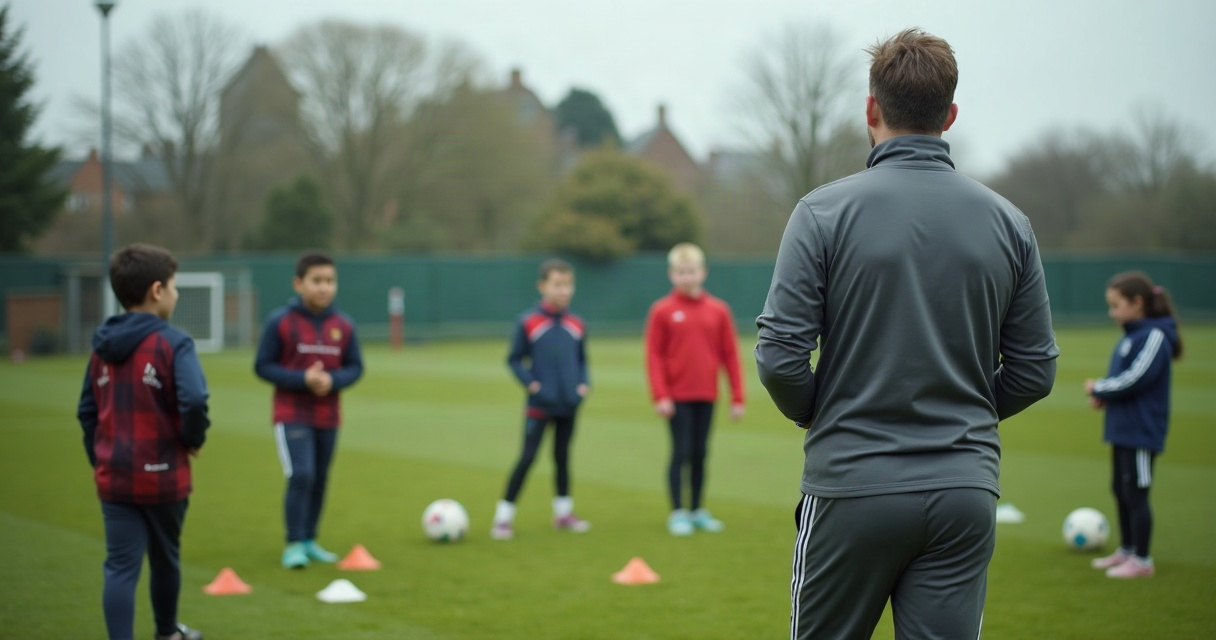
Help your U14s press as a unit with a fun, fast drill that builds game intelligence, trust, and the buzz of winning the ball high.
It happens in about the fourth minute. Their goalkeeper rolls it to a centre-back, your striker half-jogs towards the ball, nobody else moves, and suddenly the other team are playing through you as if you're not there. Sound familiar? Most of us have stood on the touchline thinking, there was a moment there. This session is about helping your players see and feel that moment — together.
Pressing isn't frantic running. At U14, players are ready to understand when to press, not just that they should. When it clicks, they feel genuinely clever. That shared feeling — moving as one, turning defence into attack in a heartbeat — is exactly why this session is worth building your week around.
Session at a glance
- Age group: U14 (approximately 13–15 year olds)
- Ability level: Advanced
- Session time: 65 minutes including warm-up and review
- Players: 16 (adaptable for 10–20)
- Space: 60x40m pitch with a 10x5m build-up zone marked at one end
- Equipment: Cones, one ball per game, bibs in two colours; optional goalkeeper
Why children enjoy this game
There's a very specific pleasure in doing something together that requires timing. Think of it like a well-timed song — when everyone comes in at the right moment, it sounds brilliant. That's what coordinated pressing feels like for a group of 14-year-olds who are ready for it.
This session gives them agency. They're not just following instructions; they're reading the game and making a collective decision. Is this the trigger? Are we going? When they get it right and win the ball high, the reaction is immediate and genuine — celebrations, laughter, the kind of energy that makes players want to do it again.
Equally important: when it doesn't quite work, they've tried something real and learned something real. That's a very different feeling from being told off for pressing at the wrong time. Here, the drill itself teaches them through experience.
How to run the session
The setup: Mark your 60x40m space and add a 10x5m build-up zone at one end using cones. Split into two teams of eight — builders and pressers. Builders start inside or around the build-up zone with the ball. Pressers position themselves around midfield.
What happens: The building team has ten seconds to play out of their zone and complete three passes. The pressing team watches for a pre-agreed trigger. Before each round, agree together what the trigger is — for example, 'the ball leaves the zone,' 'a midfielder receives facing backwards,' or 'a back pass is played.' When the trigger happens, pressers move as a unit to win the ball or force a turnover.
- If builders complete three passes: they score one point
- If pressers win the ball: they attack the opposite end
Rotate roles every three minutes so every player experiences both pressing and building. This matters. The children building under pressure will quickly understand why pressing works, which makes them smarter pressers when it's their turn.
Two progressions when they're ready:
- Add a goalkeeper and change the trigger to 'when the goalkeeper rolls it out' — this is a very realistic moment they'll recognise from matches
- Introduce a 'press trap' rule where pressers cannot engage until the ball reaches midfield, sharpening their patience and timing
Short coaching cues to use:
- 'Watch for your trigger'
- 'Move together, not one at a time'
- 'Close the space, not the player'
- 'Hold... hold... now!'
Safety note: Before you start, walk the players through the space and remind them to press with control. Pressing runs can build speed quickly — make sure there's enough room between groups and that everyone understands contact isn't the aim.
Keep every child involved
Waiting is the enemy of a good session. With role rotations every three minutes, nobody should be standing for long. If numbers are uneven, add a floating neutral player who always plays with the builders — this gives you an odd number solution and keeps everyone busy.
For players who are less confident with pressing:
- Give them a specific, manageable job: 'Your job is to block the easy sideways pass option'
- Pair them with a more experienced player and ask them to follow that player's lead for the first round
- Praise decision-making, not just outcomes — 'I liked that you checked your teammates were moving before you went'
For your most confident players, ask them to lead the trigger call. Giving them that responsibility develops communication and keeps them challenged without changing the drill structure.
What to notice and say
Watch the pressing team in the moments before they press. Are they scanning? Are they talking to each other? Are one or two pressing while others stand still? The quality of pressing is decided before anyone moves, not during the run.
Try not to stop the game every time pressing doesn't work. Let a few rounds play out and then pause for a group conversation. Children learn more from a brief group discussion than from constant interruptions that drain the energy.
Two questions worth asking your players:
- 'What told you that was the right moment to go?'
- 'What could the builders have done to make it harder for you to press?'
That second question is particularly good — it gets players thinking from both sides and deepens their understanding of the game beyond this single session.
Easy ways to adapt it
| Situation | Adjustment |
|---|---|
| Fewer than 16 players | Reduce to 8–10 players and shrink the pitch to 40x30m |
| Mixed ability within the squad | Give less confident players the 'build' role first so they experience being pressed before pressing |
| Limited equipment | Use jumpers or water bottles for the build-up zone boundary |
| Short on time | Run two-minute rotations and skip the goalkeeper progression |
| Players really flying | Ask them to press using only two players initially, then release the rest — teaches selective pressing |
Common coach questions
'What if my players just all rush at the ball together?' That's the most common early problem and it's a good sign — it means they're engaged. Pause play, draw a quick diagram with cones, and show them one presser going tight while another covers the escape route. One practical demonstration beats ten verbal instructions.
'How do I know when to move to the progressions?' When you see players starting to wait for the trigger rather than reacting to the ball, they're ready for the next step. It usually takes a full rotation or two. Don't rush it — confident pressing in the base version is more valuable than confused pressing in a complex one.
'What if the builders keep losing the ball before they can even play three passes?' Reduce the pressing team by one player for a round, or give the builders an extra two seconds. The builders need enough success to feel the game is fair — that balance matters for both groups' learning.
When this session works, you'll see it in the players' faces — that brief, shared delight when the press holds and the ball is won exactly where they wanted it. That moment is worth every cone you laid out. You can find the full session plan and diagrams right here, or browse more sessions at Playtactiq to build the rest of your week around it.
Written and reviewed by the PlayTactiq Coaching Team
Practical guidance for grassroots coaches, shaped around age-appropriate sessions, clear coaching language and real match-day problems.
Put it into a session
Ready-to-run U13 and U14 session plans
Setup, animated diagrams, coaching points and player-number adaptations — every U13 and U14 session in one place.
U13 and U14 football session plans →