
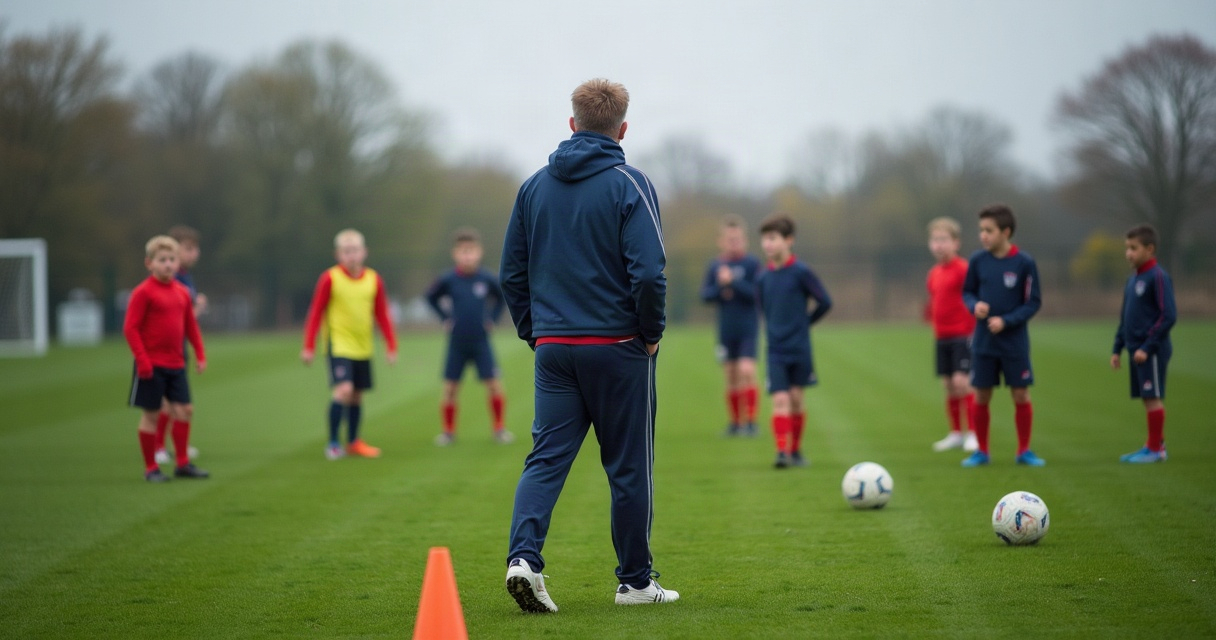
Help U12 players feel ownership of set pieces with simple routines that build timing, trust, and confidence together.
Free kicks are one of those rare moments in a match when the game genuinely pauses. Every player on the pitch has a second to breathe, look around, and think. For young players at U12, that pause can feel either exciting or overwhelming — and which one it becomes depends largely on how you've prepared them in training.
This article sits alongside the Dead Ball Masters practice and explores the thinking behind good free kick coaching at this age: why routines matter, how to run sessions that keep everyone involved, and what to actually look for when things go wrong.
Why Routines Are About More Than the Ball
It's tempting to think of a free kick routine as a tactical instruction — player A passes to player B, who shoots. But at U12, the real value of a routine is what it does to a group of children before the ball is even struck.
When a group of players rehearse a routine together, they build shared understanding. They learn to read each other's body language, anticipate movement, and trust that a teammate will be where they're supposed to be. That trust is genuinely difficult to build in open play, where everything is unpredictable. A free kick routine gives children a structure they can practise, refine, and eventually own.
Ownership matters enormously. A child who helped come up with a routine, or who has rehearsed it enough times to feel confident, will try it in a match. A child who has simply been told what to do will hesitate. Giving players input — even just asking 'Where do you think the space is?' — shifts the energy from passive to active.
Keeping Everyone Involved at Every Turn
One of the most common problems with set piece training is that it quietly becomes a spectator sport. The confident player takes the free kicks. Everyone else stands and watches. After twenty minutes, the watching children have touched the ball twice and learned very little.
The fix is structural. Rotate roles every few minutes so that every child experiences being the taker, the runner, and the finisher. If your group is six players, you have enough people to run two simultaneous routines with different balls. Keep a spare ball close to hand so that the moment a routine finishes, the next one begins. Waiting is where engagement dies.
For children who are less confident in delivery — perhaps they're newer to the game, or they struggle with technique under any kind of pressure — pair them with a steadier player during the kicking phase and ask them to focus on their run instead. A well-timed run into space is genuinely useful and genuinely teachable, and it keeps that child contributing meaningfully rather than dreading their turn. Success at a smaller task builds the appetite for bigger ones.
It's also worth building in a brief moment of genuine choice. Ask your group to design one element of a routine themselves — which direction the runner goes, whether the pass is to feet or into space. Children invest more deeply in something they've had a hand in shaping, even if that hand is small.
What Good Delivery Actually Looks Like
Coaches often focus on the finish — the shot, the goal, the celebration — but the delivery is where most routines succeed or fail. At U12, good delivery means one specific thing: the ball reaches a teammate's feet at a pace they can control. Not a blast. Not a cross into a crowded area. A calm, accurate pass that gives the receiver time to think.
This is worth making explicit with your players, because children often assume free kicks should involve power. They've seen strikes from distance on television and naturally want to replicate that feeling. The coaching task is to help them understand that a pass to a teammate's feet, perfectly weighted, is harder to defend than a speculative shot — because it requires defenders to react to two players rather than one.
When you watch delivery in a session, look for the taker's head position. Are they looking at their teammate before they pass, or are they looking at the ball? A player who glances up, picks their target, and then executes is demonstrating real decision-making. Praise that specifically: 'You looked up first — that's exactly right.' It tells them what to repeat.
Also watch for timing between the taker and the runner. Does the runner move too early, giving themselves away? Do they check their run when a defender follows? These small adjustments are the building blocks of intelligent play, and noticing them — out loud, warmly — teaches your whole group at once.
How to Guide Without Taking Over
The instinct when a routine breaks down is to stop play and explain. Sometimes that's right. But often, the more useful move is to let the moment pass and then ask a question rather than give an answer.
'What happened there?' is a powerful coaching phrase because it hands the thinking back to the children. They usually know what went wrong. They need space to articulate it, not a correction fired at them before they've had a chance to process. If they can't identify it themselves, you can narrow the question: 'Where was the space when the ball arrived?' or 'Did the runner go at the right moment?'
When things go right, celebrate the teamwork rather than the outcome. A routine that works because everyone did their part — runner timed it, taker found them, receiver controlled it — deserves more recognition than a lucky deflection into the net. If children learn that the team's coordination is what's being valued, they'll focus on the coordination.
Keep your tone curious and warm throughout. You're helping a group of eleven and twelve-year-olds solve a puzzle together. The session works when they feel like puzzle-solvers, not like pupils being tested.
Free kick sessions done well are some of the most memorable training sessions children have at this age — because they involve real decision-making, genuine teamwork, and the satisfaction of something clicking. Browse more practices across different themes and ages if you're looking for ways to build on this work or connect it to other areas of your coaching.
The goal isn't perfect routines. It's children who leave the session feeling capable, connected to their teammates, and ready to try something clever the next time the referee blows for a free kick.
Written and reviewed by the PlayTactiq Coaching Team
Practical guidance for grassroots coaches, shaped around age-appropriate sessions, clear coaching language and real match-day problems.
Put it into a session
Ready-to-run U12 session plans
Setup, animated diagrams, coaching points and player-number adaptations — every U12 session in one place.
U12 football session plans →