
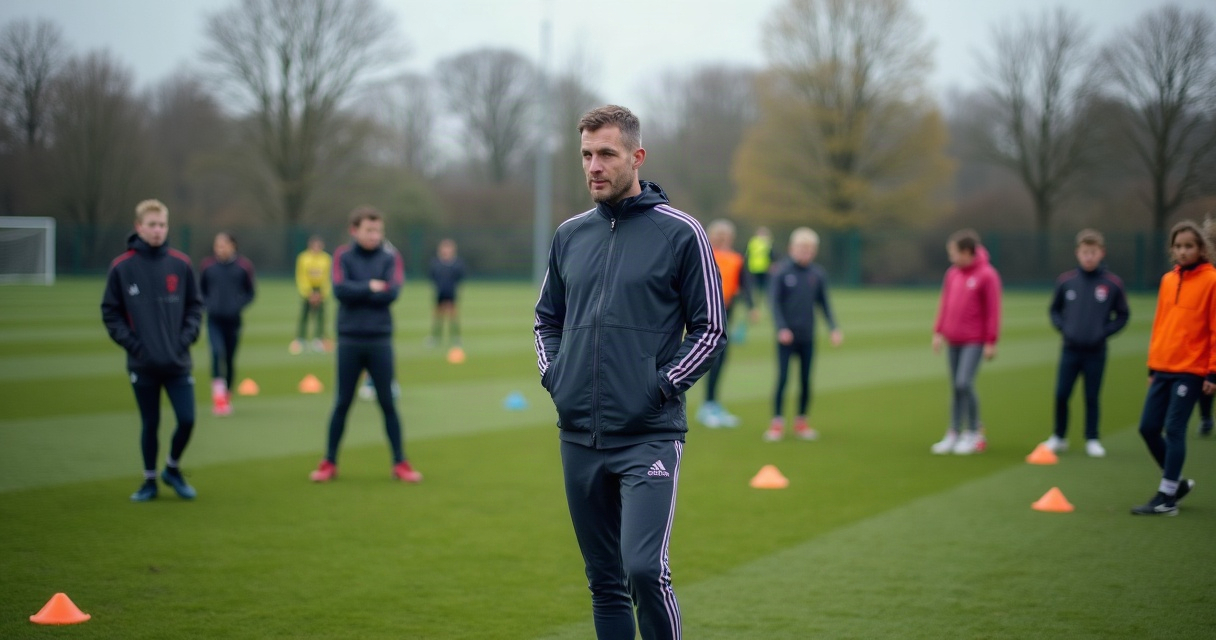
Help your U16s feel the satisfaction of defending set pieces well with a simple man-to-man marking session built on smart positioning and communication.
There is a moment most grassroots coaches recognise instantly. A corner comes in, your team has numbers in the box, and somehow the ball drops to an unmarked attacker who tucks it away. Nobody was being lazy — they just had not quite made the connection between 'defend the ball' and 'defend the person.' At U16, players are absolutely ready to make that connection. They can feel the difference between drifting and marking with intent, and when they get it right, that feeling sticks.
This session gives them the tools — and the experience — to make intelligent defending a habit they are proud of.
Session at a glance
- Age group: U16
- Session time: 60–75 minutes
- Players: 12–16 (works well at 7v7 or 8v8)
- Space: Half pitch or full pitch with one goal
- Equipment: Cones, bibs, two footballs, a goal
Why children enjoy this game
Set pieces have a natural drama to them. There is a pause, a build-up, then a delivery — and your players either dealt with it or they did not. That clarity is satisfying. When a teenager picks up their player early, holds a good side-on position, and clears the ball cleanly, they know they have done something right without anyone needing to tell them.
This session rewards awareness and communication rather than size or physical dominance, which means quieter or less physically confident players can shine. A well-timed call of 'I've got four!' is just as valuable as a headed clearance, and most children respond well to that once they see it working.
The short, repeated nature of set-piece practice — deliver, defend, reset — also means every player gets frequent involvement. Nobody is waiting on the sideline watching others do the interesting bits.
How to run the session
Set-up Mark a delivery zone with cones roughly 20 yards from goal — this acts as your corner or free-kick position. One team attacks from the delivery zone using a variety of services: high balls, low driven crosses, near-post flicks. The defending team lines up in the box and each player picks up an opponent before the ball is delivered.
Have a second ball ready at the side so the next repetition can begin quickly after each set piece. After the delivery, let play run for 10–15 seconds of open play — this keeps it game-realistic and gives defenders a reason to clear with purpose rather than just hoof it anywhere. Rotate teams every four or five repetitions.
Key coaching cues to use in the moment
- 'Find your player early — before the ball moves'
- 'Side-on — you need to see them and the ball at the same time'
- 'Lean, do not lunge'
- 'Talk to each other — who's got the near post?'
Three progressions
- Add a goalkeeper and a second-ball rebound situation, so defenders must react after their initial clearance.
- Vary where the delivery comes from — a wider angle changes the marking position needed, and players must adjust.
- Introduce a counter element: if the defending team win the ball and play it through a target gate at halfway, they get a bonus point. Suddenly clearances become composed rather than panicked.
Keep every child involved
If a player is less confident physically, do not automatically pair them with the smallest attacker. Pair them with someone of similar size and let them practise body positioning and communication — that is where the real learning is, and it builds genuine trust in their own ability.
A shy or hesitant child can begin the session as the set-piece deliverer. They are involved immediately, they see how different services affect the defence, and they can step into a marking role once they feel ready. No one sits out.
On safety: remind players that backing into an opponent is not a foul. Side-on marking, using your body to hold a position, is intelligent and legal. The things to avoid are elbows, pulling shirts, and pushing — keep the emphasis on positioning rather than physical contest, and the session stays safe and enjoyable.
What to notice and say
Watch for the moment players start scanning for their opponent before the delivery rather than reacting after it. That is the shift you are looking for — from chasing to anticipating. When you see it, name it quietly and specifically: 'Good, you found him before the ball moved — that is the habit.'
Try not to stop the game every time something goes wrong. If an attacker scores from a corner, let the moment land, reset, and ask the group a question rather than delivering a verdict. 'What did we lose there — the ball or the person?' usually opens a good conversation.
Two questions worth asking your players during the session:
- 'When is the best moment to make contact with your player — before the ball is kicked or after?'
- 'What can you see from a side-on position that you cannot see if you are square-on?'
Let them answer. They usually know more than they think.
Easy ways to adapt it
Smaller group (8–10 players): Run a 4v4 in a tighter box with one goal. Fewer players makes communication more audible and marking responsibilities clearer.
Mixed confidence: Give the defending team one free 'swap' per repetition — if a defender feels mismatched, they can call for a switch. This normalises communication and reduces anxiety.
Limited equipment: If you only have one ball, simply have the attacking team jog back into their starting positions while the defending team reset. The rhythm is slower but the learning is the same.
Large group (18–20 players): Run two boxes simultaneously side by side, with coaches on one each. Players rotate between boxes after every six repetitions.
Common coach questions
'My players keep ball-watching and losing their person — how do I fix it?' Name a specific moment to refocus. Something like 'head on a swivel as the ball leaves the taker's foot' gives them a concrete trigger rather than a general instruction. It only takes one or two players to model it before others follow.
'What if my defenders are giving away fouls trying too hard?' This usually means they are arriving late and grabbing rather than positioning early. Bring the trigger earlier — encourage them to find and touch their player the moment the attacking team starts to set up. Early contact, made calmly, means there is no need to lunge.
'How do I stop it becoming chaotic when play continues after the set piece?' Keep the live phase short — 10 seconds maximum — and use a clear signal (a second whistle or a call of 'reset') to bring it back. Players settle into that rhythm quickly, and the brief open-play phase adds realism without losing the focus of the drill.
Set-piece defending is one of those areas where a little clarity makes a huge difference, and U16s are exactly the right age to start taking real ownership of it. When your players leave the session talking about who they marked and how they dealt with it, you have done your job well. Find the full session plan at Own Your Mark: Set Piece Defending, or browse more sessions to find your next training focus.
Written and reviewed by the PlayTactiq Coaching Team
Practical guidance for grassroots coaches, shaped around age-appropriate sessions, clear coaching language and real match-day problems.
Put it into a session
Ready-to-run U15 and U16 session plans
Setup, animated diagrams, coaching points and player-number adaptations — every U15 and U16 session in one place.
U15 and U16 football session plans →