
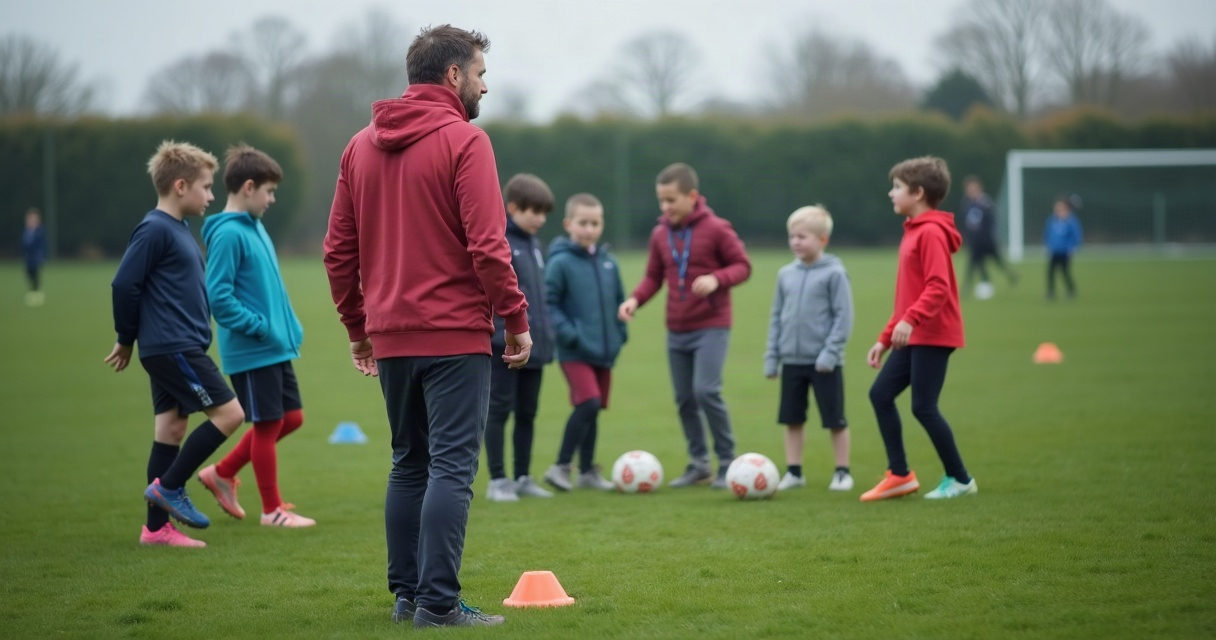
Help your U12 defenders intercept with intelligence, not aggression, using these simple coaching ideas for reading the game.
Interceptions are one of the most satisfying moments in football, and at U12 the groundwork for reading play is genuinely there to be built on. Children this age are starting to notice patterns, track movement, and think a step ahead. The challenge as a coach is helping them trust that instinct rather than abandoning it the moment pressure arrives and lunging in instead.
If you are working through the Read and React: Winning the Ball Back session, this article sits alongside it to give you a bit more context and language for the coaching moments you will meet on the pitch.
What Reading the Game Actually Means at This Age
When coaches talk about reading the game, it can sound abstract. For U12s it is worth making it very concrete. Reading the game means noticing two things before the ball moves: where the passer is looking, and which space is available for them to use.
Passer's hips and shoulders give away the direction of an intended pass more reliably than feet do, because feet are still adjusting right up until contact. If you can get your players watching the upper body of the player in possession, they gain a fraction of a second of information that makes stepping across a passing lane genuinely possible rather than lucky.
The second thing, space awareness, comes with experience but you can accelerate it by asking questions rather than issuing instructions. Instead of telling a child where to stand, ask: 'Where is their player going to want to put that ball?' Let them look, form a view, and move. When they are right, they feel smart. When they are wrong, they adjust. Both outcomes build a reader of the game.
One thing worth noting: children who are more cautious by nature, or who are newer to the group, often take to this type of defending very naturally. It rewards thinking and positioning over pace and physical confidence. Creating space in your session for that to be celebrated openly helps those players step forward.
Stepping Across Versus Diving In: The Key Distinction
Most mistakes in this area come from too much urgency. A child sees the pass coming, commits too early, goes too far, and the ball goes the other side of them. The instinct is right; the execution is overcooked.
The coaching cue that tends to help most is reducing the number of steps. One step across the passing lane, already there when the ball arrives, is the target. Two or three steps and you are likely to miss or, worse, make contact with the player rather than the ball.
A useful image to share with players is a goalkeeper: they do not chase the ball across the goal before it is struck. They hold, read, and move at the last possible moment. Defenders intercepting passes are doing something similar. They are holding their position, watching, and committing only when the pass is on its way.
You can reinforce this in training by physically modelling it yourself. Walk through the moment slowly: watch the passer, take one step, the ball arrives at your feet. Invite a child to try at walking pace first, so the feeling of being in the right place at the right time lands clearly before any game speed is added. Keeping turns high and waiting time low matters here; if every child in your group can practise the step across several times in quick succession, the movement starts to feel natural rather than effortful.
Coaching Language That Builds Understanding
The words you choose when a child makes an interception matter as much as the activity itself. Generic praise like 'well done' or 'brilliant' is pleasant, but it does not help a child understand what they actually did well or how to repeat it.
When a child reads a pass and steps across, try something like: 'You saw that one coming — how did you know?' That question invites them to articulate their thinking, which deepens the learning and also shows them that they were doing something deliberate and repeatable, not just fortunate.
When a child lunges and misses, keep your tone steady and curious rather than corrective: 'That was a brave go — what did you see before you moved?' This helps them notice whether they committed before they had enough information, without any sting in the message.
Ask open questions during the game rather than only between activities. 'Where was their player looking before that pass?' works well as a half-time question for the whole group. It encourages children to start reviewing what they observed, not just what happened. Over time, this habit of noticing becomes part of how they play.
For children who are hesitant to commit at all, pair the question with a closer starting position. If they can physically feel the pass arriving into their feet after one small step, the confidence to try it in a game situation grows quickly. Let them experience success in a forgiving space before moving them into fuller pressure.
Making This Work Across Your Whole Squad
One practical challenge with this type of session is that the skill level in an U12 group can vary quite widely. Some players will be stepping across and winning the ball within twenty minutes. Others will still be working out what to watch.
Differentiate through position and role within the activity rather than by ability label. A player who is developing their reading of the game can be placed closer to the likely pass, so the margin for error is smaller and success is more accessible. A more confident reader can be given the freedom to cover more ground and intercept from deeper — the prediction skill is being tested much more there.
Blocking passes with the body rather than the feet is worth normalising explicitly with your whole group. It counts. If a child stands in the way of a pass and it hits their shin or their side, they read it. That deserves the same recognition as a clean interception with the foot. Making this clear means more players feel included in the success of the activity, not just those who are quickest or most technically confident.
For further session ideas built around smart defending, positioning, and game reading at grassroots level, explore the full session library. You will find plenty of activities that complement this approach across different ages and formats.
Written and reviewed by the PlayTactiq Coaching Team
Practical guidance for grassroots coaches, shaped around age-appropriate sessions, clear coaching language and real match-day problems.
Put it into a session
Ready-to-run U12 session plans
Setup, animated diagrams, coaching points and player-number adaptations — every U12 session in one place.
U12 football session plans →