
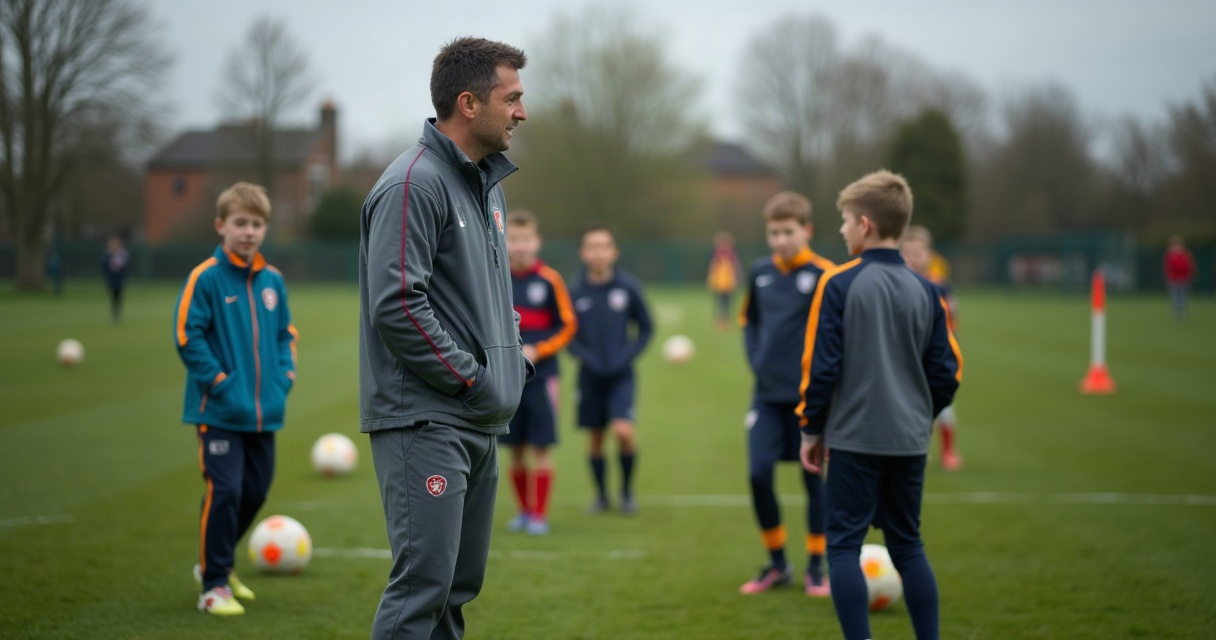
Help your U8s enjoy defending with a fun rondo session that builds timing, confidence and fairness — no sliding, no fear, lots of turns.
You know that moment when a child lunges at the ball, trips over their own feet, and sits on the grass looking bewildered? It happens in almost every U8 session. They want to defend — they really do — but nobody has shown them when to go. This session is about fixing that in a way children find genuinely enjoyable.
Session at a glance
- Age group: U8 (beginners)
- Total time: Roughly 30 minutes of activity
- Players: Works well for groups of 8–15
- Space: 30m × 20m main area; an 8m × 8m grid inside for rondos
- Equipment: One ball per 4–5 players, bibs or coloured cones to mark grids, boundary cones
Why children enjoy this game
Defending gets a bad reputation at this age. Some children worry about fouling someone. Others are nervous about a collision. A few just freeze because they do not know what they are waiting for.
When you shift the focus from 'tackle hard' to 'pick your moment', something lovely happens. Children start to feel clever rather than scared. They discover that patience is a skill — that watching and waiting is actually doing something. When they win the ball cleanly, the pride on their faces is different from the relief after a scramble. They want to do it again.
The rondo format helps here too. Everyone touches the ball constantly. Nobody stands in a queue. The child who struggles to defend is still passing, moving and succeeding for most of the game. That sense of belonging and contribution keeps them engaged and coming back.
How to run the session
Part 1 — Mirror Tag (8 minutes)
Pair children up across the main area. One child leads, moving gently in any direction; the other copies every step and turn like a mirror. No tackling yet — just reading and reacting. Swap roles every 30 seconds.
This warm-up does quiet, important work. Children learn to track a moving player with their eyes, stay light on their feet, and shift their weight without overcommitting. It is also genuinely funny — partners often try to trick each other — and that laughter settles any nerves before the real defending begins.
Coaching cues: 'Watch their hips, not their feet.' — 'Stay bouncy — ready to go either way.'
Part 2 — Soft Challenge Rondo (20 minutes)
Bring children into groups of 4–5 inside the small grid. Three players keep the ball moving; one player defends. The rule that matters most: defenders must stay on their feet. No sliding, no lunging into the passer. A clean win means touching the ball — not the player.
Rotate the defender every 30 seconds so every child spends roughly equal time in each role. If the defender wins the ball cleanly, they join the circle immediately and the player who lost possession steps in to defend.
That rotation rhythm is important. Thirty seconds feels just long enough to try something, short enough that no child is stuck defending through repeated failure. You will often see a child win the ball right at the end of their turn and beam because the timing finally clicked.
Coaching cues: 'Watch the ball, not just the feet.' — 'Wait... wait... now!' — 'Soft feet — stay light and ready.' — 'Well done — you stayed on your feet and won it fairly.'
Safety note: Before the rondo starts, show children what a fair challenge looks like. Stand side-on, reach with your nearest foot, and step away cleanly if the player passes. Make clear that any contact that hurts is simply not part of your game — and mean it. Children feel safe when they trust that rule will be kept.
Keep every child involved
A quieter child who looks uncertain? Start them as a passer inside the circle. They are contributing, touching the ball, and watching a defender without the pressure of defending themselves. When they are ready, they will let you know — sometimes with a little nod, sometimes just by stepping into the middle without being asked.
A child who rushes in too early? Crouch beside them during a rondo and whisper, 'Watch when the ball is loose — that is your moment.' You do not need to stop the game. A quiet word lands better than a whole-group pause.
A child who finds it physically harder to close space quickly? Give their group a slightly bigger grid. They will still experience the timing moment — it just comes with a little more room to think.
What to notice and say
Watch for the child who almost wins the ball and then gives up. That near-moment is gold. After their turn, catch their eye and say, 'You were so close — what did you notice about when the ball moved?' Let them answer. They usually know.
Trust yourself not to stop the game every time a defender mis-times a challenge. If the play continues and children are safe, let it run. The game corrects itself more effectively than a whistle often does.
Two questions worth asking the group at the end: 'When did you feel like you knew the right moment to go?' and 'What made it tricky to wait?' Their answers will tell you more about how they are learning than any drill can.
Easy ways to adapt it
- Fewer players: Run a 3v1 rondo in a smaller grid. Less space, quicker decisions, more touches for everyone.
- More players: Add a second defender and a slightly larger grid. The ball-carriers must now work together, which adds a lovely cooperative layer.
- More confident group: Reduce the grid size so defenders have less distance to cover but less time to think. The timing challenge becomes sharper.
- Hesitant group: Increase the grid, slow everything down, and celebrate every 'good wait' as enthusiastically as you celebrate a ball won.
- Limited equipment: Mark the rondo grid with jumpers or water bottles. You need the ball and the children — everything else is optional.
Common coach questions
'What if a child keeps sliding even after I explain the rule?' Keep your tone calm and curious rather than corrective. Ask them, 'What happens when you slide and miss?' Usually they already know the answer — they just need the habit interrupted gently a few times.
'The ball is flying everywhere — how do I keep control of the session?' You do not need to control every ball. Keep your eye on the child, not the ball. If children are moving safely and trying honestly, the session is working.
'Some children are clearly better defenders already — will this bore them?' Give them the harder progressions: a smaller grid, a second defender, or ask them to win the ball and immediately play it to a specific teammate. Capable children enjoy a new layer of thinking, not just a bigger stage.
Defending can become one of the parts of the game children look forward to — not because it feels powerful, but because it feels skilful. When a child times a challenge well, stays on their feet, and wins the ball cleanly, that is a moment worth celebrating properly.
You can find the full session plan for Timing Your Challenge here, ready to print or save to your phone, or browse more sessions for all ages and themes whenever you need fresh ideas.
Written and reviewed by the PlayTactiq Coaching Team
Practical guidance for grassroots coaches, shaped around age-appropriate sessions, clear coaching language and real match-day problems.
Put it into a session
Ready-to-run U8 session plans
Setup, animated diagrams, coaching points and player-number adaptations — every U8 session in one place.
U8 football session plans →