
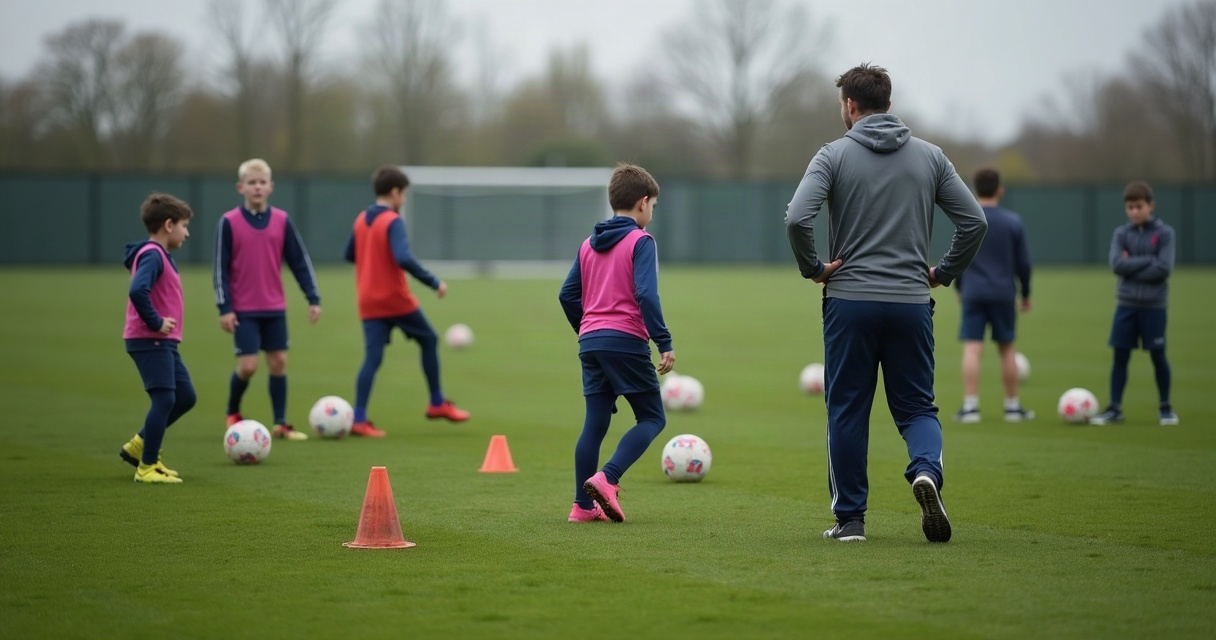
Help your U14s defend as a connected unit with a compact zone drill that builds communication, confidence and genuine enjoyment of defending.
There is a moment in nearly every grassroots session when one defender sprints out to press the ball, two others follow in different directions, and suddenly there is a gap wide enough to drive a bus through. The opposition score, nobody quite knows whose fault it was, and the defenders trudge back looking deflated. Sound familiar? The answer is rarely about individual ability — it is about helping players understand that defending is a team conversation, not a series of solo decisions.
This session gives your U14s a simple, active way to feel what compact, connected defending actually looks like — and more importantly, to enjoy it.
Session at a glance
- Age group: U14 (approximately 12–14 years)
- Ability level: Intermediate
- Session time: 45–60 minutes including warm-up and cool-down
- Players: 12–14 (adaptable — see below)
- Space: 50×40-yard area with a 20-yard-wide central zone marked by cones
- Equipment: One ball per game, cones to mark the zone boundaries
View the full session plan here
Why children enjoy this game
Defending has a reputation for being the unglamorous side of football. Most children that age want to score goals, not protect them. The trick is to make defending feel like a puzzle to solve together rather than a punishment to endure.
This drill does that because the whole group moves as one. Nobody is isolated, nobody is blamed, and when the shape holds and the ball gets intercepted, everyone shares the satisfaction. There is a strong sense of belonging that comes from being part of a unit that is actually working — the kind of 'we did that together' feeling that keeps children coming back on cold Tuesday evenings.
The format also moves quickly. Short rounds, clear roles, and an immediate swap between attacking and defending mean the energy stays high. One thing that is easy to underestimate is how much the intensity drops when a drill runs too long — a six-minute cap with a clear scoring rule tends to keep things sharp in a way that open-ended repetition simply does not. The moment children know there is something to win within the next few minutes, focus sharpens noticeably.
How to run the session
Set-up: Mark your 50×40-yard area and lay down cones to create a 20-yard-wide zone across the middle. Split into two teams of six or seven. One team defends the zone, the other attacks from outside it.
How the game works: Attackers stay outside the zone and try to move the ball through it using quick passing. Defenders position themselves inside the zone and shift together as a connected block to close passing lanes. The key rule for defenders is simple: nobody goes alone. If one player moves, the whole unit adjusts.
Attackers have five passes to get the ball through. If defenders block or intercept, the roles swap and the defending team becomes the attacking team. Play rounds of five to six minutes with a clear score — intercepting or blocking the ball earns the defending team a point.
The scoring rule matters. Without it the game can drift. With it, defenders understand exactly what success looks like and celebrate it together.
Keep every child involved
If your numbers allow, run two simultaneous games in the same space. This cuts waiting time immediately and doubles the number of decisions each child is making.
For a player who is less confident or finds it hard to read the game, position them alongside a more experienced defender before the round begins. A quiet word — 'stay on her shoulder and move when she moves' — gives them something concrete to do rather than leaving them guessing. Pair rather than isolate.
For your more confident players, give them a leadership role within the unit: they call the shift direction before the group moves. This stretches them without putting anyone else under pressure.
Praise organised moments as loudly as you praise good tackles. When the whole line shifts together and closes a lane, name it. 'Did you see how you all moved at the same time there? That is exactly it.'
What to notice and say
Watch for the moments when the shape is working rather than only the moments when it breaks down. When defenders shuffle across together without the ball reaching them, that is a success — it just does not always look dramatic.
When not to stop the game: If the shape is messy but the group is talking and trying to adjust, let it play out. Children learn more from feeling the consequence of being disorganised than from a mid-drill freeze-frame every time something goes slightly wrong. Stop only when the same problem repeats two or three times without any self-correction.
Short cues that land well:
- 'Stay together like a chain.'
- 'Move with your teammates, not away from them.'
- 'Call each other's names before you shift.'
Two questions worth asking during a break:
- 'When the ball moved to the right, what did the rest of you do?'
- 'How did it feel when you all moved at the same time?'
The second question matters as much as the first. You want children to connect the tactical action with a feeling of confidence and togetherness — that is what they will remember.
Easy ways to adapt it
To add pressure for confident groups: Allow attackers to enter the zone but they must pass the ball back out before receiving again. Defenders now have to deal with a player in among them while staying compact — a genuine step up that rewards good shape rather than punishing individuals.
To increase compactness: Reduce the zone width from 20 yards to 15 yards. The defenders immediately feel how much tighter the unit needs to be, without anyone needing to explain it.
To build communication: Add a condition that defenders must call 'shift left' or 'shift right' out loud before the group moves. It feels slightly awkward at first and then suddenly clicks — and when it does, the noise level on the pitch goes up in the best possible way.
Smaller group (eight or fewer): Run a 4v4 version in a 30×25-yard area with a 12-yard zone. The principles are identical; the space just makes the relationships easier to see.
Common coach questions
'What if one player keeps breaking away from the shape and trying to win the ball individually?' Avoid singling them out in front of the group. After the round, ask the whole unit what happened when the shape broke — let the group notice the effect rather than you pointing at one person. Most children will adjust once they feel the difference.
'My group struggles to communicate — they just go quiet.' Start small: ask just one player in the unit to be the caller for a round. As soon as one voice is out there, others tend to join. The communication cue works best when someone has a specific, brief job to do rather than a general instruction to 'talk more'.
'How do I keep the energy up across the whole session?' Short, scored rounds are your best tool. If the intensity dips after a water break, check whether the round has gone on too long — dropping to a strict five or six minutes with a clear point to win almost always brings the focus back quickly.
Defending as a unit is one of those things that, when it clicks, genuinely excites a group of U14s — because they did it together, and they felt it work. Give this a go at your next session and see what the conversation sounds like on the walk off the pitch. Browse more sessions like this at Playtactiq and find the full Moving Together plan here.
Written and reviewed by the PlayTactiq Coaching Team
Practical guidance for grassroots coaches, shaped around age-appropriate sessions, clear coaching language and real match-day problems.
Put it into a session
Ready-to-run U13 and U14 session plans
Setup, animated diagrams, coaching points and player-number adaptations — every U13 and U14 session in one place.
U13 and U14 football session plans →